Abe Kosoff: Dean of Numismatics
Q. David Bowers
The 1841 Proof dollar brought $150, while the following prices were registered for others: 1842 $130, 1843 $150, 1844 $140, 1845 $150, 1846 $85, 1847 $145, 1848 $135, 1849 $140, 1850 $150, 1851 $210, 1852 $180, 1853 $220, 1854 $75, 1855 $115, 1856 $70, 1857 $37.50, and 1858 $180.
The year 1851 was represented not only by the Proof which sold for $210 but also by an Uncirculated piece described as: "An unlisted variety with date high, closer to base on which Liberty is seated than on the above listed variety. It is quite likely that the Uncirculated variety is much more rare than the Proof coin. As a matter of fact, it was believed that only Proofs were struck in 1851." The Uncirculated coin brought $150. In later years, research by Walter Breen and others suggested that only a few original Proofs were struck in 1851. The few remaining Uncirculated pieces of that year represent nearly all of those actually struck in the year indicated. At a later date, possibly circa 1858-1860, it was realized that few if any Proof 1851s existed, at which time a new die with a centered date was prepared. These represent the Proofs now known.
Among Morgan silver dollars, most Proofs sold in the $7 to $10 range. There were some exceptions, the popular 1895 being one of them. It sold for $14, slightly less than the $18 another example had sold for in an Abe Kosoff sale a few months earlier.
As an aid to collectors, the back part of the catalogue consisted of a reprint of the Type Table of United States Silver Dollars, as compiled by John W. Haseltine during the 19th century. At the time this was the only guide to early silver dollar die varieties.
Before the sale commenced, Fred Boyd suggested that his entire collection of copper, nickel, and silver pieces might be worth about $25,000. Apparently, Abe Kosoff and Abner Kreisberg were given the opportunity to purchase it for this price, but sensing an opportunity for a spectacular auction, they made arrangements to present it in a series of public sales. By the time that Part I was completed and the silver dollars and trade dollars had been sold, $15,112.35 was realized, clearly indicating that Boyd's earlier valuation of $25,000 for the entire collection might be more than doubled!
Next on the auction block was Part II of the World's Greatest Collection, which made history on March 3, 1945. Among the coins offered in Part II were four 1796 quarters. An Uncirculated example with a prooflike surface fetched $100 and a piece described as a superb Proof brought $160. Little fuss was made about these pieces, although decades later the appearance of even one 1796 quarter in a higher grade would be a cause for excitement within the collecting fraternity. Abe Kosoff had every reason to be blase about 1796 quarters in 1945. Years laters in his reminiscences he explained:
"Lest our dear readers be overwhelmed by the inclusion of four choice quarters of 1796 in the World's Greatest Collection, let me divert for a moment and tell a little tale. It was well known that the fabulous Col. E.H.R. Green Collection contained many hoards. Green used to travel by automobile quite extensively. He loved to buy, and quantity did not deter him. Stories are told of how he would stop at an antique shop and end up buying the entire place!
"Among his hoards was one containing 1796 quarters. Burdette G. Johnson, the St. Louis dealer, had an 'in' on the Green estate. There is no doubt in my mind that this 'in' came about through Fred Boyd's influence. Boyd had been in charge of appraising the coins in the Green estate and invited Burdette G. Johnson and Joseph Barnet to assist him. They spent about five weeks on the job.
"I was not yet Fred Boyd's 'fair-haired boy,' so these were things I didn't know about at the time they happened but learned later during our Tuesday lunch date. At any rate, Johnson got his hands on the Col. Green quarters, and James G. Macallister, the well-known Philadelphia dealer, went out to St. Louis to transact for these and other items.
"When Macallister reached New York City on his return trip he stopped in to see me at the Numismatic Gallery. Mac used to wear a homburg hat and a heavy overcoat. From one inside pocket he took out a narrow package about 15 to 18 inches long, wrapped in brown paper. On the show counter he unwrapped it and displayed row after row of 1796 quarters, everyone Uncirculated. 'Ninety bucks, take your pick,' he said. Before the 'wow' got out of my mouth, out of another inside pocket Mac took another package, very much like the first. 'These will cost you $125 each,' he advised. This group contained the so-called Proof 1796 quarters, brilliant gems, each and everyone. The first parcel contained the frosty coins. I don't recall how many I bought, perhaps five or six of each. All in all I would say that there were about 100 pieces, possibly a few more or less.
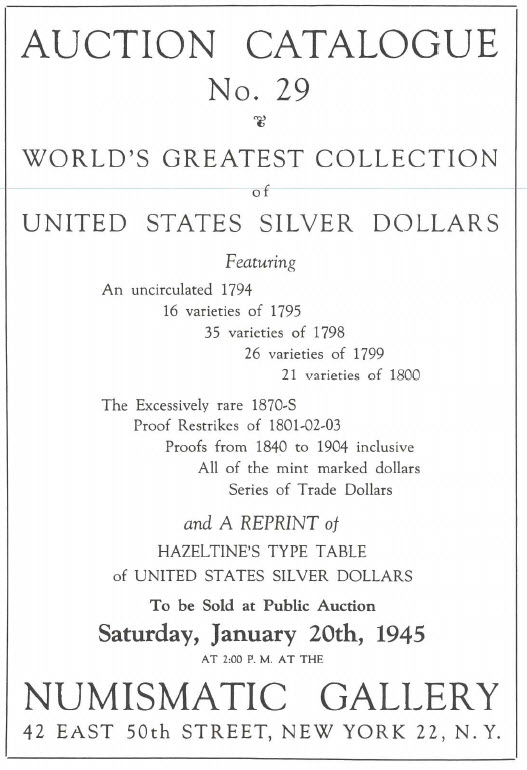
Title page to Auction Catalogue No. 29, better known as the "World's Greatest Collection of United States Silver Dollars." Although it wasn't announced at the time, the coins offered were the property of Frederick C.C. Boyd, one of America's most prominent collectors.