Abe Kosoff: Dean of Numismatics
Q. David Bowers
"So business went on, people went to their offices, theatres, concerts-and coin auctions. The December 12th sale was well attended, and we even had the time for a little humor. Mike Powills of Chicago was building up a fine numismatic library, and he and his wife Dorothy attended thesale. While Mike was bidding, Dorothy stood in the rear and playfully bid against him. Mike bought several lots before he learned who his' competition' was. I don't think he took the difference out of Dorothy's allowance."
Auction Sale No. 13 was conducted in New York City on Saturday, January 24, 1942. Offerings included the United States coin collection of A.D. McIlvaine, with emphasis on silver dollars; Mexican coins from the Guttag Collection; United States gold, and from "a famous midwestern collection United States patterns." In a time of national preoccupation with World War II, Abe Kosoff added American flags as a patriotic decoration to the cover of the sale catalogue.
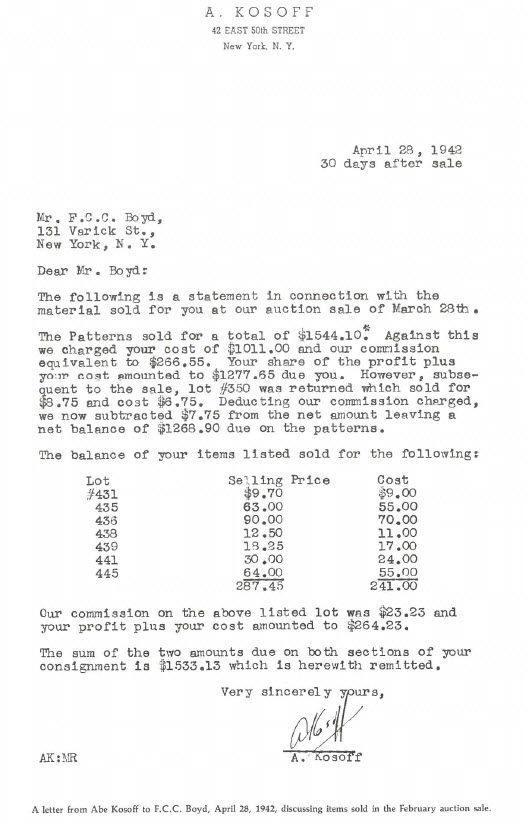
Part of the January 1942 sale consisted of a consignment of pattern coins from the William H. Woodin and Col. E.H.R. Green estates given by F.C.C. Boyd, one of a series of groups of patterns to appear in sales at the time. During that era, few other sales contained patterns, and few collectors or dealers knew what the price levels should be. So, the prices realized lists of Abe Kosoff's early auctions stood as references.
At the same time, a "rarity" was "discovered" as Abe Kosoff later related:
"In this sale we offered the $20 gold 1909/8 overdate, indicating that it was 'not listed in theStandard Catalogue.' We had just discovered it-rediscovered would be more accurate.
"It was brought to Wayte Raymond's attention, and subsequently the variety was listed in the Standard Catalogue of United States Coins. Sometime after taking credit for the discovery of the 1909/8, I was speaking with Stuart Mosher, who was one of the brightest and best-versed numismatists in New York City. Stuart was one of the experts for the New Netherlands Coin Company and later was editor of The Numismatist.
"Stuart called my attention to the fact that Edgar H. Adams had actually discovered the 1909/8 and had written it up around 1915. Somehow, the coin never was listed by any cataloguer or in any pricelist until it was rediscovered in 1942! I remember that Joe Barnet and Adolph Friedman bid on it, but Friedman decided that it was not too nice a specimen, only Fine, and let it go. Barnet bought it at $36. As will sometimes occur, this overdate soon was found to be rather plentiful. Collectors looked at their coins and were surprised to find that the 1909 they had owned for years was actually a 1909/8. In fact, it turned out that the 1909 non-overdate variety was a lot scarcer, than the overdate!"
The March 1942 sale also included numerous pattern coins. An 1855 Flying eagle cent in copper brought $2.50, an 1863 copper Indian cent with the L on the ribbon brought $28.50, and an 1882 transitional Liberty head nickel sold for $10.
An 1880 Flowing Hair $4 Stella fetched $377.50.
Perhaps prematurely, the catalogue stated: "It's a $500 coin and it may go higher." Nearly forty years later the coin was to be valued in the $100,000 range!
A Confederate restrike half dollar sold for $34, while a silver restrike of the Confederate cent brought $37.50 and a copper restrike went for $15. One of just 12 original 1861 copper-nickel Con-federate cents sold for $20