Abe Kosoff: Dean of Numismatics
Q. David Bowers
Greeting readers of the sale catalogue was a full-page announcement: "INCREASED SPACE FOR INCREASED BUSINESS," which noted:
"We are pleased to announce our removal to larger quarters necessitated by the increased business which we have experienced.
"This affords us an opportunity to thank you, who are responsible for the move, for your patronage and to express the hope that we shall be privileged to serve you further.
"It is our intention to open up in our new premises NUMISMATIC GALLERY for free public exhibition. This will be accomplished in the very near future. Watch for the announcement and plan to visit us, please.
"In the meantime, we are ready to handle our regular numismatic business as usual. Remember our new address, 42 East 50th Street, still in the 'fashionable fifties.'
"April 1, 1941.
"A. Kosoff."
The "Numismatic Gallery" notation capitalized in the preceding announcement evidently caught Abe Kosoff's fancy, for soon the name was adopted for his business.
The sale offered a mixture of United States and world coins. The P .E. Wickes Collection of wooden money was comprised of many souvenir issues of the 1930s and occupied several pages of the catalogue, as did the same consignor's collection of embossed business cards. Among United States coins, a complete set of 11 commemorative gold dollars and quarter eagles was described as Uncirculated, and an octagonal 1915-S Panama Pacific gold piece was offered in the same grade. Among the consignors was the American Numismatic Society, which offered duplicate items from its collection. These pieces fit nicely with the Guttag Latin American Collection offered in the same publication.
The sale started out with silver denarii of the Roman Republic, headed by Lot No.1, Aemilia family, 54 B.C., veiled head of the goddess Concord, with Paullus Lepidus Aemilius around, Very Fine, $1.40. Only a few scattered lots in the 2,303 lot offering broke the $100 mark, and none broke the $200 mark. Most lots sold for less than $10.At the time it was the practice to bid so much per piece. That is, if there were eight pieces in a lot, and one wanted to pay 10c each for the pieces, one would submit a bid of 10c-not 80c. As an example, Lot 2295 offered eight different counterstamped United States copper coins, listed in the prices realized list for 10c-which is per each coin. Common double eagles in the sale brought $32 to $33 each, or about melt value, for there was scant premium attached to them at the time.
Years later, Abe Kosoff recalled the 1941 sales:
"In the first sale at the new Gallery location, a Pike's Peak double eagle by Clark & Gruber & Co., an 1860 issue, brought $405. A $4 Stella of 1879 sold for $169. A 1796 half cent, Fine, went for all of $93, and a $50 Panama-Pacific octagonal slug fetched $208. A Mexican 60-peso piece brought $235.
"Part III of the Guttag Latin American Collection offered the coinages of Guatemala, Argentina (Part 1), Salvador, Ecuador (Part I), Bolivia (Part 1). Interest was stirring just a little bit in this collection, but bargains were the password.
"Sale No. 8 was held in June. A platinum 6-rouble of Russia sold for $49; a Very Fine 1836 Gobrecht silver dollar fetched $23.25; an 1856-D gold dollar brought $62.50; an 1875 Proof gold dollar sold for $127.50; a 1796 quarter eagle without stars, $75; an 1848 CAL. quarter eagle sold for $52.50; and an 1834 Uncirculated $5 with motto brought $175 ...
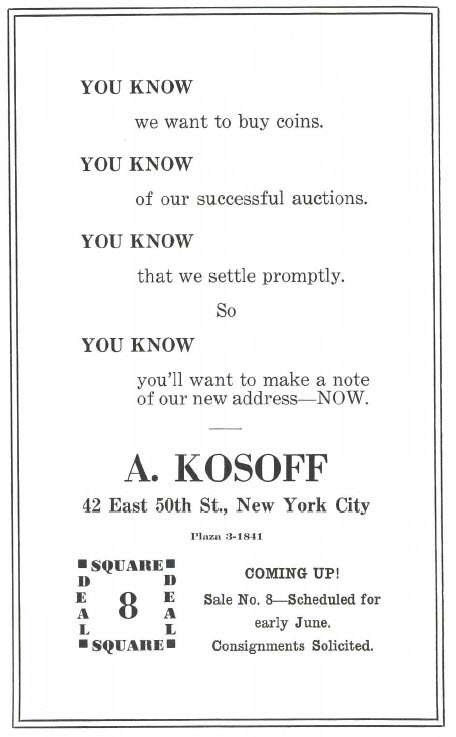
In May 1941, Abe Kosoff announced his move to still another New York City location: 42 East 50th Street, just a few steps away from the famous Waldorf Astoria Hotel. Coming up soon was Sale No.8. ("The Numismatist," May 1941)