Abe Kosoff: Dean of Numismatics
Q. David Bowers
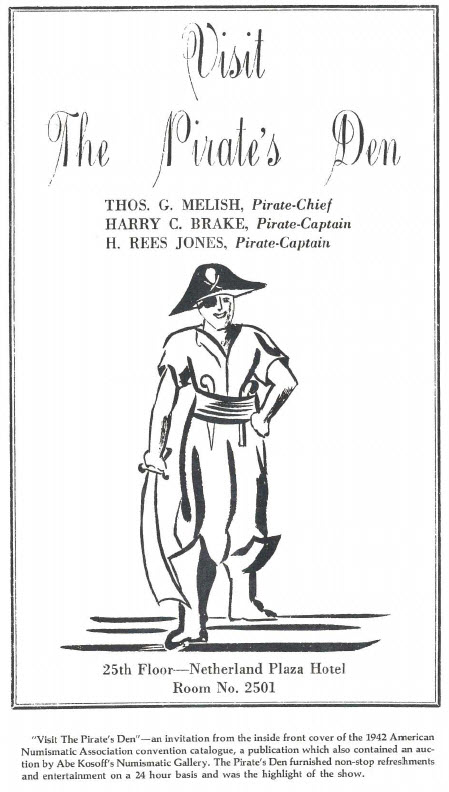
"Due to war activities of members of our firm we cannot be represented at this year's convention of the American Numismatic Association. So we extend our cordial greetings and best wishes for a pleasant, successful meeting. That you should gather during these trying times is a high tribute to the loyalty you have for your Association and a splendid indication of the genuine interest you have in numismatics," noted a special full-page announcement of the New Netherlands Coin Company, New York City, signed by Charles M. Wormser (who was serving in the Navy) and other staff members.
The convention auction comprised 1,190 lots and commenced at 7 o'clock in the evening of Tuesday, August 25th. As the entire auction was conducted in a single session, there were intermissions with refreshments served.
The first coin to go under the hammer was a 1794 silver dollar, described as having an altered date and with a hole, About Fine, and "a good fill-in" until a better specimen could be obtained. The price was $7. Lot 108, an 1802 half dime, was described as being one of not more than 16 to 20 pieces known. The specific condition wasn't stated, but it was observed that "the reverse shows wear. Some of the upper stars are worn (these stars are generally weak)." The coin must have been a nice one, for it brought $302.50, a high price for the era.
Collectors of a later era would find many of the 1942 offerings to be incredibly inexpensive. For example, a set of Lincoln cents from 1909 through 1938, complete in Uncirculated grade, brought $47, while a complete set of two-cent pieces from 1864 through 1873, including the very rare Proof 1864 Small Motto and numerous other Proofs, fetched $80. A set of silver three-cent pieces from 1851 through 1873, with most of the early issues Uncirculated and with issues from 1863 onward in Proof grade, went to a new home for $65, while a set of nickel three-cent pieces from 1865 through 1889 realized $55. Complete sets of Shield, Liberty Head and Buffalo nickels, nearly all in the best obtainable grade, brought $62.50, $72.50, and $115 respectively.
Lot 239, an 1848 CAL. quarter eagle, "Brilliant Uncirculated with Proof lustre-finest we have ever seen-cost recent owner $150," brought $100, undoubtedly a bargain. Several decades later a comparable piece was to break the $50,000 mark!
Lot 303, a Very Fine specimen of the 1855 Wass, Molitor & Co., $50 piece, fetched $485; while an 1852/1 $20 by Augustus Humbert, Very Fine, brought $207.50; and an 1860 Mormon $5, Extremely Fine, brought $122.50. Grading was as controversial back in 1942 as it is today, and in his description of the 1860 Mormon piece, Abe Kosoff gave his opinion that it was Extremely Fine but was careful to note that it was "sold to the present owner as Uncirculated."
Patterns received their share of attention in the 1942 ANA convention catalogue. An introduction to the series noted:
"United States patterns is a series which has received very little attention in the past few years. The renewed interest can be traced back to our sale No. 13, held in January of this year. 175 lots of patterns in the quarter, half dollar, and dollar series were offered in this sale, and in our March sale a like number were offered in the minor series.