Abe Kosoff: Dean of Numismatics
Q. David Bowers
"An interesting thing happened during this eighth auction sale. The first lot of the fourth section of the Guttag Latin American Collection was a unique set of Peruvian coins comprising the 8, 4, 2, 1, ½ and 1/4 real of Philip II. When the catalogue of the Guttag Latin American Collection was prepared as a separate book by Edgar H. Adams, Guttag owned only the 8 reales and the quarter real. The Quadres Collection owned 8, 2 and one-half real pieces, and the four and one real pieces were illustrated by Heiss. The one-fourth real or cuartillo in the Guttag Collection was the only known specimen. Hence, the coin, therefore the set, was unique.
"There was much excitement in New York City for weeks before the sale-and there were a few problems. My good friend Robert R. (Bob) Prann of San Juan, Puerto Rico, wanted the set badly. Fred Boyd had to have it, and Wayte Raymond was set on getting it. The group had been on exhibit at the American Numismatic Society in New York City, and it was rumored that the Society also wanted to own the set.
The problem was that if the Society wanted the set, Fred Boyd was not inclined to bid against it so he stayed home. Wayte Raymond never came to sales, but he phoned, and since Fred Boyd wanted the set, and Fred was both a fine customer and a good friend of Wayte's-why, Wayte would pass.
"Bob Prann couldn't pin me down to how much it would take to buy the set, but all the rumors reached him and discouraged him. However, at my suggestion, he contacted Joe Barnet and gave him a bid.
"The day of the sale came-Joe Barnet was in the front row, Raymond was out, Boyd had passed, and the Society-oh yes, the Society was represented. I don't recall how low the bidding started, but it was only a very few dollars, and then Barnet's hand was up. The Society's representative did not respond, but another gentleman, a neophyte in the series was bidding. Perhaps the Society was waiting until the preliminaries were over, then they would bid. Slowly we crawled up to $50, then $60, $70, $80, $90 and finally the new collector, a gentleman who subsequently became well known in the field, called $100.
"Barnet hesitated, apparently $100 was Prann's limit. Oh, well, one more bid, and $105 he made it. But the new collector, Arnold Perpall, scented that he was about to make one of the best buys of his lifetime-$110 he bid -the Society had not yet raised a finger. Slowly I called $110 for the first time, $110 for the second time-finally, looking directly, questionably at the Society's representative $110 for the third and last time-fair warning-sold to Arnold Perpall at $110.
"After the conclusion of the sale, the story I got was that the Society used a special fund for purchases of this kind and, at that moment, that special fund was dry. I don't know if that is fact, but that's the way I recall it.
"On Monday morning, about 10 a.m., Perpall came up to the Numismatic Gallery to pick up his lots. The grapevine had been working-Fred Boyd was also there. I introduced him to Perpall, who by this time was truly aware of the numismatic prize which he had attained. 'I'll give you $500 for that set,' Boyd stated, but Perpall wasn't interested. He admitted that he had not intended to go anywhere near $500 in the bidding, nevertheless, now that he owned it, he wasn't at all interested in selling the set.
"The moral of the story is, if you want something at an auction, be prepared-be there or be represented and be prepared to buy. You never know who cannot show up or how far the other fellow is prepared to bid."
Auction Sale No.8 was held at the Numismatic Gallery, 42 East 50th Street, New York, rather than at the New Yorker Hotel. For the first time "The Numismatic Gallery" appeared on the title page of an auction catalogue. The sale consisted of a mixture of United States and world coins from various consignors. A separate section of five lots was titled "United States Rarities" and offered a 1856-D gold dollar in Very Fine grade, an 1875 Proof gold dollar, a 1796 quarter eagle without stars, Very Fine, an 1848 CAL. quarter eagle in Very Fine, and an 1834 half eagle with motto, crosslet 4, Uncirculated, with Proof lustre.
An eclectic offering of numismatic books featured such titles as Half Dollar Die Varieties by M.L. Beistle, the State Coinage of Connecticut, Vermont, and Massachusetts by the American Numismatic Society, 1920, several National Geographic magazines depicting military insignia, Medallic Memorials of the Great Comets, by David L. Walter, 1893, and numerous back issues of The Numismatist, the Numismatic Scrapbook Magazine, and The Coin Collector's Journal. More coins from the P .E. Wickes Collection were offered, including Civil War patriotic tokens, store cards, and Hard Times tokens. Obsolete bank notes from the Guttag Collection comprised several pages of the catalogue, as did additional items from the Guttag Latin American Collection.
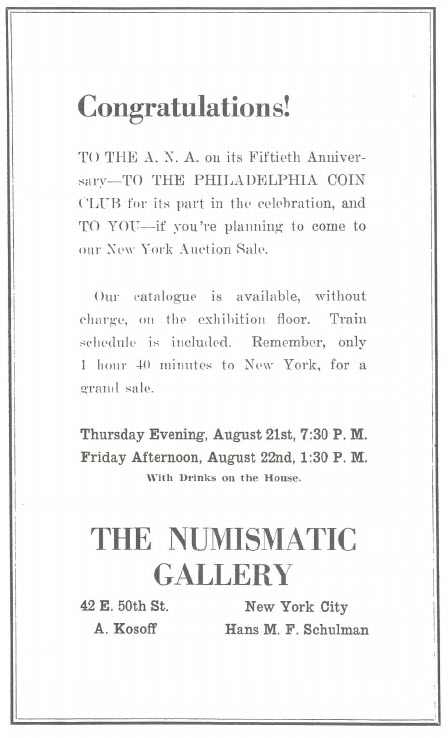
Appearing in "The Numismatist," August 1941, this advertisement enticed visitors to the American Numismatic Association's annual convention, held that year in Philadelphia, to come to New York City, just one hour and 40 minutes away by train, to attend a Numismatic Gallery auction sale. By this time the "Numismatic Gallery" designation was prominent in most advertisements, with the name of the owner, A. Kosoff, taking a secondary position, although there were numerous exceptions.