Abe Kosoff: Dean of Numismatics
Q. David Bowers
Another anecdote concerning Julius Guttag involves an incident which took place in the 1920s, when Guttag was a prime buyer. Apparently one or more auction catalogues were prepared in Europe just for the purpose of attracting Guttag to the sale. Later, Julius took pride in "buying out the whole sale." Little did he know that if he didn't buy, there would have been no other buyers! Interestingly, a similar story was told about Virgil M. Brand, who made many purchases from European dealers.
After the Guttag brothers split up, Julius' brother Henry received 10 sets of 1915 Panama Pacific commemorative coins. Abe Kosoff set up an arrangement whereby he obtained an option on all 10 sets at $540 each.
Another of Abe Kosoff's recollections concerning Henry Guttag had an unpleasant ending. It seems that Abe Kosoff had a client for some 1856 Flying Eagle cents. He visited Henry Guttag toward the end of the day and was quickly handed two envelopes containing Flying Eagle cents at $20 each as the office was closing. The young dealer was instructed to send Henry a check for $40 later, as there was no time to do it then.
Returning to his office, Abe Kosoff studied the pieces and noted that one was a forgery, an altered date. As the first order of business the next morning, Kosoff telephoned Guttag, and then he took the fake back to the latter's office. Guttag mumbled something about the possibility that Abe might have switched coins and would not take the piece back. "On my return I mailed a check for the full amount due him. I never returned to that office. My lesson had been learned, and not at too great a price," Abe Kosoff noted.
Sale No.2 was held at the Hotel New Yorker, 34th Street and Eighth Avenue, on Tuesday, August 6, 1940.
The event commenced with numismatic books.
Lot No. I, Edgar H. Adams' Official Premium List of United States, Private and Territorial Gold Coins, fetched $2.25. The last lot in the sale, a 15c fractional currency note, brought all of 90c. In between were 857 other lots, many of which brought less than a dollar each, and most of which brought less than $10 each. However, for the market at the time the prices were good. It is significant to note that Abe Kosoff devoted a sizable section of his catalogue to back issues of numismatic publications and reference books, evidence of his interest in education. At a time when most other auctioneers were ignoring such things, Abe Kosoff's sale provided the opportunity to fill in sets of The Numismatist, the American Journal of Numismatics, and other worthwhile periodicals.
Among United States coins, an 1829 Uncirculated half dime brought 75c, while several 1830 half dimes brought 50c each in the same grade. A Grant with star commemorative half dollar brought $31, while a pair of 1938 New Rochelle halves brought $1.60 per coin, a 1922 Grant with star commemorative gold dollar fetched $5, an Uncirculated 1933 $10 piece brought $160, and a 1915-S Panama-Pacific octagonal $50 in the original box realized $210.
The 575 lots brought about $1,600. Abe Kosoff never stated the net profit after expenses, but, presumably, it was better than the $56 from his first sale!
After Abe Kosoff's second auction sale had concluded, he placed advertisements offering copies of the prices realized list for 50c. "In view of the fact that numismatic libraries seldom come up for sale, such a price list proves to be a great valuable reference," he noted.
Soon, copies of the sale catalogue itself became scarce, prompting him to advertise:
"We should like to obtain a number of our catalogues covering Sale No.2, held August 6th. If you have one which you do not care to keep permanently, you will favor us greatly by sending it to us."
Auction Sale No.3, "Rare Coins, Medals, Numismatic Books," was held on Saturday, October 26, 1940. The modest catalogue described 796 lots and realized $7,074.44. The sale was held at the Hotel New Yorker in a fourth floor parlor, 34th Street at Eighth Avenue, New York City. The sale again was under the hammer of O. Rundle Gilbert, a well-known auctioneer of antiques.
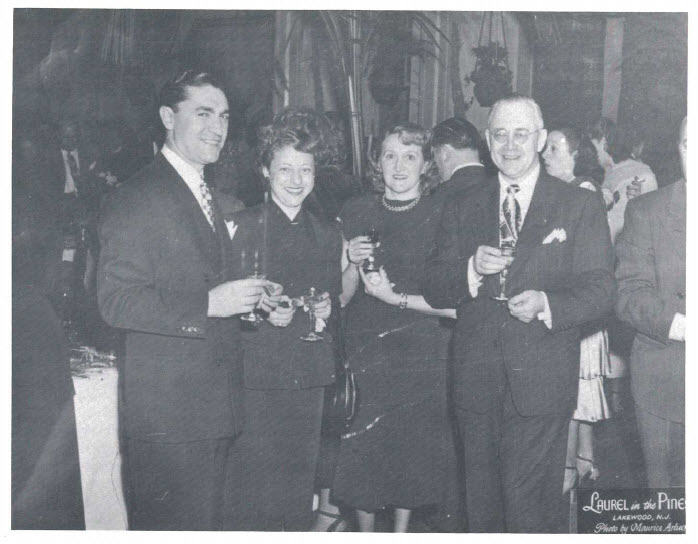
Abe and Molly Kosoff with their close friends, Adolph and Miriam Friedman, at a New Jersey resort in the 1940s.