Navigating the world of coin collecting can be a thrilling adventure, filled with unique, historical artifacts. But just like any treasure hunt, there can be hidden challenges. Thankfully, PCGS exists to help collectors navigate the exciting – and sometimes confusing – world of coins. Founded in 1986, PCGS is the industry standard for coin authentication and grading. The labels in their coin holders use a variety of abbreviations to communicate vital details about the coins they encapsulate. Understanding these abbreviations can be the key to unlocking a wealth of knowledge about your collection.
This short guide will equip you with the tools to decipher these PCGS abbreviations, empowering you to make informed decisions about your prized coins. We'll embark on a journey of discovery, starting with the fundamental distinctions between strike types: Mint State (MS), Proof (PR), and Specimen (SP).
Demystifying PCGS Holders: A Look at Strike Types (MS, PR, SP)
PCGS uses abbreviations on their coin holders to communicate key details about the coin. Let’s focus on strike types, specifically Mint State (MS), Proof (PR), and Specimen (SP). Understanding these distinctions is crucial for both collectors and investors.
Mint State (MS)
- Grades: MS60 through MS70
- Meaning: Denotes a business-strike coin, which traditionally refers to coins intended for circulation (though some pieces are produced as business strikes though intended for numismatic purposes only).
Proof (PR)
- Meaning: A coin specially struck from specially prepared dies and planchets. Proofs usually receive multiple strikes resulting in sharper details.
- Characteristics: Often display a "mirror-like" finish and a "frosty" devices, lettering, and other design elements.
- PCGS Recognition: Applies to Proof coins minted from 1817 onward.
Specimen (SP)
- Meaning: Term used to indicate special coins struck at the Mint from 1792-1816 that display many characteristics of the later Proof coinage. Prior to 1817, the minting equipment and technology was limited, so these coins do not have the “watery” surfaces of later Proofs nor the evenness of strike of the close collar Proofs. PCGS designates these coins SP.
- Distinction:
- Lack the "watery" surfaces of later Proofs.
- Strike may not be as even as coins struck with close collars.
- By understanding these Strike Type designations (MS, PR, SP), you can better interpret the information on PCGS holders and make informed decisions about your coin collection.
PCGS Designations (Cameo, Deep Cameo, Prooflike, First Strike, etc.)
In addition to the grade, PCGS uses "Designations" to mark noteworthy characteristics of a coin series.
Cameo Designation
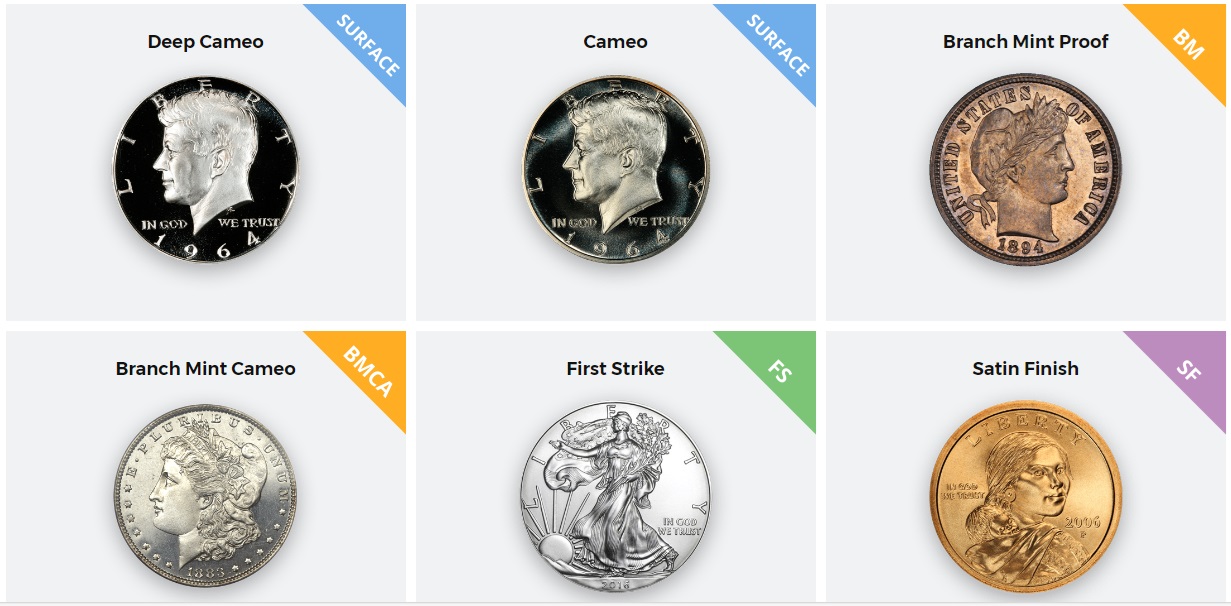
For a coin to receive a Cameo designation, both the obverse (front) and reverse must display a frosted appearance on their raised design elements (devices). This "frosting" creates a clear contrast with the smoother background areas (fields) of the coin. The frosting can vary in intensity, with some areas potentially showing a lighter frost or even a hint of brilliance. Interestingly, a coin qualifies as Cameo even if one side exhibits a deeper frost level ("Deep Cameo") while the other shows a regular "Cameo" level of frosting.
Deep Cameo Designation
The term applied to coins, usually Proofs and Prooflike coins, that have deeply frosted devices and lettering that contrast with the fields - often called “black and white” cameos. Specifically applied to those 1950 and later Proofs that meet deep cameo standards (DCAM).
Understanding Prooflike/PL Coins
Prooflike coins can be dazzling, but they're not the same as true Proof coins. Here's what sets them apart:
- Origins: Prooflike coins arise when a brilliant planchet (blank coin) is struck with new or polished dies. This creates a mirror-like finish similar to Proof coins.
- Minting Process: Unlike Proofs, which receive special handling, Prooflike circulation coins go through the standard minting process once. They generally receive no additional care.
- Rarity: Prooflike coins are uncommon, but some series are more likely to exhibit Prooflike surfaces. For example, many Morgan Dollars have a high number of Prooflike specimens.
- Frosted Devices: On rare occasions, early Prooflike strikes might have "frosted devices" (raised design elements with a matte finish). These are exceptionally valuable.
Grading Prooflike Coins
PCGS has a specific standard for designating a coin as Prooflike ("PL"). Here's what they look for:
- Reflectivity: Both sides of the coin must show clear reflections; cloudiness or streaks can affect this.
- Eligibility: Originally, only qualifying Morgan Dollars were considered Prooflike. However, since July 2019, PCGS applies the "PL" designation to any qualifying Mint State coin (U.S. or international), medals, and tokens.
The PCGS First Strike Program
PCGS began designating coins delivered by the U.S. Mint in the 30-day period following the release date of a new product as "First Strike." For instance, new American Silver Eagles typically are released by the Mint on January 1, thus any coins delivered between January 1 and January 31 qualify for the First Strike (TM) designation.
Why Your Coin Might Not Have a Regular Grade: Unveiling the Mystery of PCGS Problem Codes – "UNC Details"
While PCGS strives to assign numerical grades (like MS65 or PR70) to coins in pristine condition, some coins might have imperfections that prevent them from receiving a standard grade. To help collectors understand these issues, PCGS utilizes problem codes displayed above the barcode on their holders.
Let's explore some of the most common problem codes:
- Filed Rims (Code 82): This signifies that the coin's edge or rim has been tampered with by filing, potentially to remove imperfections or alter its weight.
- Questionable Color (Code 91): This code indicates that the coin's natural coloration is suspected to be artificial. This could involve dipping a copper coin to achieve a more desirable tone.
- Cleaning (Code 92): This code denotes a cleaned coin.
- Planchet Flaw (Code 93): This signifies a significant flaw or imperfection present on the blank metal disc (planchet) before the coin was struck.
- Altered Surfaces (Code 94): This code applies to coins that have been treated with foreign substances like wax, putty, or lacquer.
- Scratch(es) (Code 95): This indicates the presence of prominent scratches that detract from the coin's overall appearance.
- Environmental Damage (Code 97): Corrosion, the presence of verdigris (a green copper deposit), or other signs of damage imparted by the coin by elements in its environs can trigger this code.
- Damage (Code 98): This code can indicate one or many types of damage evident on the coin.
By understanding these common problem codes, you can gain valuable insight into the condition of an "UNC Details" coin and make informed decisions about its value.
PCGS Signature Labels
PCGS Signature Labels transform graded coins into unique collectibles. These labels feature autographs from prominent figures like PCGS President Stephanie Sabin or United States Mint Artistic Infusion Program designer Emily S. Damstra, adding historical significance and personalization. Owning a coin signed by a renowned expert adds a personal touch and creates a lasting connection to the world of numismatics.
Demystifying Your Coin Collection – A World of Knowledge at Your Fingertips
By unraveling the meanings behind PCGS abbreviations and designations, you'll gain a deeper appreciation for the fascinating world of coin collecting. Remember, even seemingly minor details like problem codes can significantly impact a coin's value. With the knowledge you've gained here, you'll be able to make informed decisions as you build or expand your collection. So, the next time you encounter a PCGS holder, don't be intimidated by the abbreviations – embrace them as a gateway to a richer understanding of your cherished coins!


 Copper & Nickel
 Silver Coins
 Gold Coins
 Commemoratives
 Others
 Bullion
 World
World
 Coin Market
 Auctions
 Coin Collecting
 PCGS News