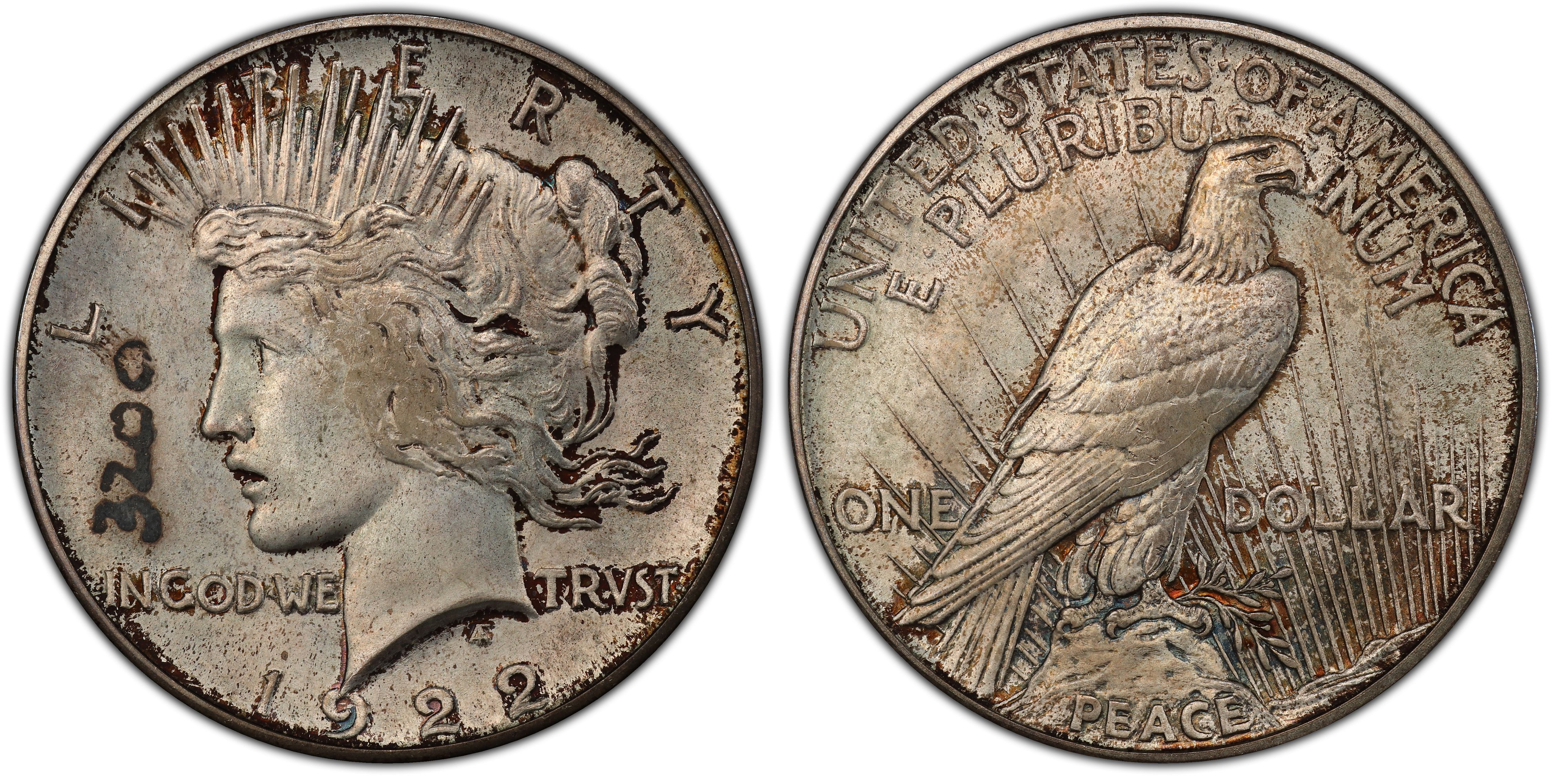
PCGS PR65

PCGS PR63
- PCGS #:
- 97384
- Designer:
- Anthony de Francisci
- Edge:
- Reeded
- Diameter:
- 38.10 millimeters
- Weight:
- 26.73 grams
- Mintage:
- 10
- Mint:
- Philadelphia
- Metal:
- 90% Silver, 10% Copper
- Auction Record:
- $381,875 • PR67 • 08-06-2014 • Stack's Bowers
Major Varieties
- 1922 $1 High Relief, J-2020
Condition Census What Is This?
 #1 PCGS PR67
Mint Director Raymond T. Baker; Raymond T. Baker estate. As PCGS PR67 #30190595. Stack's Bowers, August 2014, Lot 13167 - $325,000. As PCGS PR67 #32928615. |
|
#2 PCGS PR65
Mint Director Raymond T. Baker; Raymond T. Baker estate. As PCGS MS65 #30190596. Stack's Bowers, August 2014, Lot 13168 - $82,250. As PCGS MS65 #39206064. 3,200th and final coin struck with the Medium Relief dies. "3200" written in India ink covers much of the left obverse field. |
|
#3 PCGS PR63
|
A Less Than Perfect Peace: The Complicated Dawn of the Last Silver Dollar Era
The numismatists got their way in December 1921 when the United States Mint commenced production of a new silver dollar. This coin was intended to commemorate the hard-won peace following World War I—then known as "The Great War."
However, neither the peace in Europe nor the Peace Dollar itself would prove enduring. Woodrow Wilson’s League of Nations lacked the teeth to enforce international stability, and the war had already toppled four great European empires (the German, Austro-Hungarian, Ottoman, and Russian). When the Nazi party ascended to power in 1933, it took only six years for the drumbeats of war to set the continent alight once more.
From Design Concept to Legislation
The catalyst for the coin was a November 1918 statement by The Numismatist editor Frank Duffield, who suggested that a victory coin be struck "in such quantities it will never become rare, and it should circulate at face value." Duffield's suggestion gained currency amongst the ANA membership, and correspondence from various members signalled the organization's support.
This momentum culminated in a 1920 paper by Farran Zerbe titled “Commemorate the Peace with a Coin for Circulation." Published in The Numismatist, Zerbe’s proposal prompted the American Numismatic Association (ANA) to lobby Congress for a commemorative issue that would circulate as legal tender.
On May 9, 1921—coincidentally the same day the Mint resumed striking Morgan dollars to satisfy the requirements of the Pittman Act—Congressman Albert Henry Vestal (R-Indiana) introduced Joint Resolution 111 authorizing the "Peace Dollar." While the resolution failed by just one vote, the Treasury proceeded under the authority of the Pittman Act, which mandated the replacement of melted silver dollars, but did not specify about the design.
The Competition: A "Flapper" is Born
The Commission of Fine Arts held a rapid design competition beginning November 23, 1921. Out of nine invited artists, including luminaries like Victor David Brenner (Lincoln Cent) and Adolph A. Weinman (Mercury Dime/Walking Liberty), the selection committee chose the models of Anthony de Francisci.
De Francisci, a 34-year-old Italian immigrant and sculptor, was awarded $1,500 for his win. He reportedly bet his friends $1 each that he would lose to the more "seasoned" artists. As the Peace Dollar entered production, de Friansisci received the first 50 pieces struck.
The Design Elements:
- The Obverse: Popular numismatic lore holds that de Francisci modeled Liberty after his wife, Teresa Cafarelli de Francisci. This is completely false, instead he modeled the design after a copy of Saint-Gaudens' Nike Eirene bust as proposed by James Earle Fraser. Her profile was intended to radiate youth and vitality, with a spiked tiara reminiscent of the Statue of Liberty.
- The Reverse: De Francisci initially submitted a design featuring an eagle breaking a sword. This was accepted by the Commission and the President as an appropriate symbol to mark the end of hostilities; however, just before production began, a newspaper saw an image of the approved design and interpreted the broken sword as a symbol of defeat. To avoid a scandal, Mint Chief Engraver George T. Morgan and de Francisci modified the design to its final configuration.
Immediate Backlash and "Flapper" Criticism
Upon its release in early 1922, the 1921-dated high-relief coins faced a firing squad of aesthetic criticism. The Wall Street Journal derisively labeled it the “Our Flapper Silver Dollar.”
Critics felt the design lacked the "divine wisdom" of previous American coinage. A Philadelphia newspaper scathingly mocked the coin as an exercise in middle-class Babbittry:
"The head on the new coin is merely that of a fairly attractive girl of 17… whose immature chin and half-open mouth merely suggest the expression of her kind. If words were issuing from her lips they would more probably be ‘Say, lissen!’"
Mechanical Failures and the Relief Transition (The Judd 2020)
While the public argued over aesthetics, the Mint faced a mechanical crisis. The 1921 High Relief design was brutal on the dies; they frequently sank under the immense pressure required to bring up the detail, often failing before reaching 5,000 strikes.
On January 3, 1922, Chief Engraver George T. Morgan began remodeling the design to slightly lower the relief. Morgan, who had been on hand as Charles E. Barber famously struggled with the high-relief Saint-Gaudens Double Eagle in 1907, noted that by lowering the relief, he could reduce striking pressure by 20 tons, significantly extending die life.
Morgan made three attempts to improve both design clarity and striking characteristics. Ultimately, his changes did not resolve the issue to the Mint's satisfaction, and de Francisci was given another opportunity to rework the design himself. De Francisci's new models were completed by February 1922.
- Version #1: 1922 revised high relief paired with normal 1921 reverse. Trial pieces were struck but they were no better than the original 1921s. Examples were sent to Fraser, de Francisci, mint director Ray Baker, Fred Chaffin and possibly one or two others. No medal press Proofs are known.
- Version #2: 1922 revised high relief paired with a new revised 1922 reverse with sharper detail and slight alterations intended to improve appearance of the coins. Multiple medal press Proofs were struck and distributed to the same people as Version #1 and likely others. The best known example is from the Norweb Collection. All specimens have a die defect on the reverse at the eagle’s talons. No trial pieces are known. (Judd 2018.)
- Version #3: Known variously as the ”Medium Relief,” or “Modified High Relief", or Judd-2020 (as listed on uspatterns.com), this pattern dollar features a reworked obverse die with significant hand-tooling and lower relief than the 1922 patterns of Varieties #1 and #2. Lettering and digits are slightly irregular and Liberty’s profile is defective. This was paired with the Version #2 reverse (including defect) as shown on Judd 2018 and the same reverse as the 1922 Peace Dollar, Sandblast Proof (#7383).
A trial run of roughly 3,200 pieces of Version #3 ("Medium Relief") was struck using this "Medium Relief" obverse was made before the dies failed. On the very last example, the number 3200 is written in the left obverse field in India ink—an unambiguous signifier of the end of the High Relief Peace Dollar era.
This coin and the "bright" example surfaced in the estate of Raymond T. Baker, who was Director of the Mint in 1922.
Characteristics of the Medium Relief (1922):
- Obverse: The head of Liberty is slightly lower in relief and the hair detail is simplified.
- Reverse: The lettering was strengthened, and the relief of the mountain and eagle was flattened.
- Diagnostics: Look for the distorted "9" in the date and exaggerated profile. On the reverse, there is a defect between the eagle's talons and the leg.
* * *