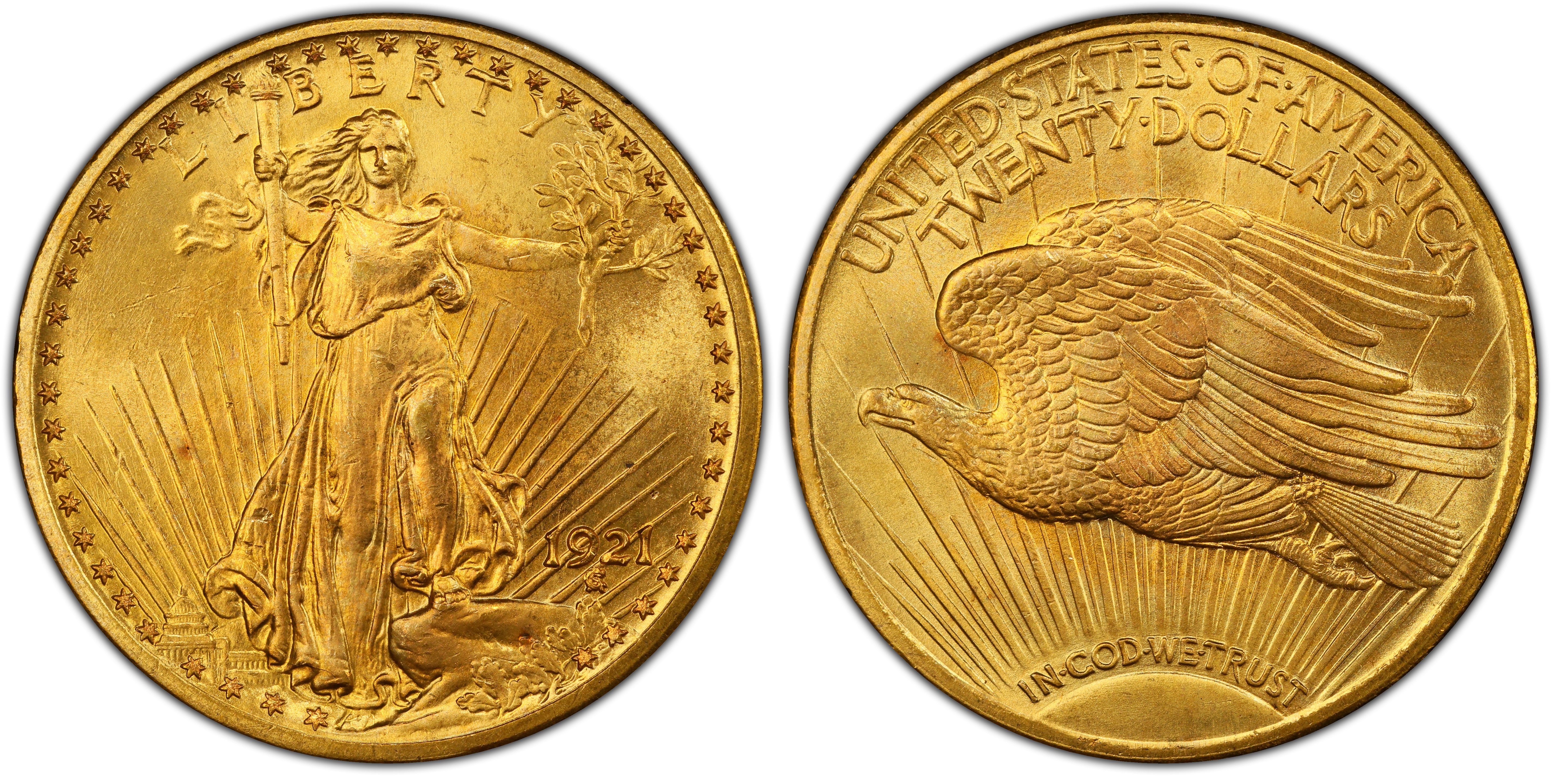
PCGS MS65+
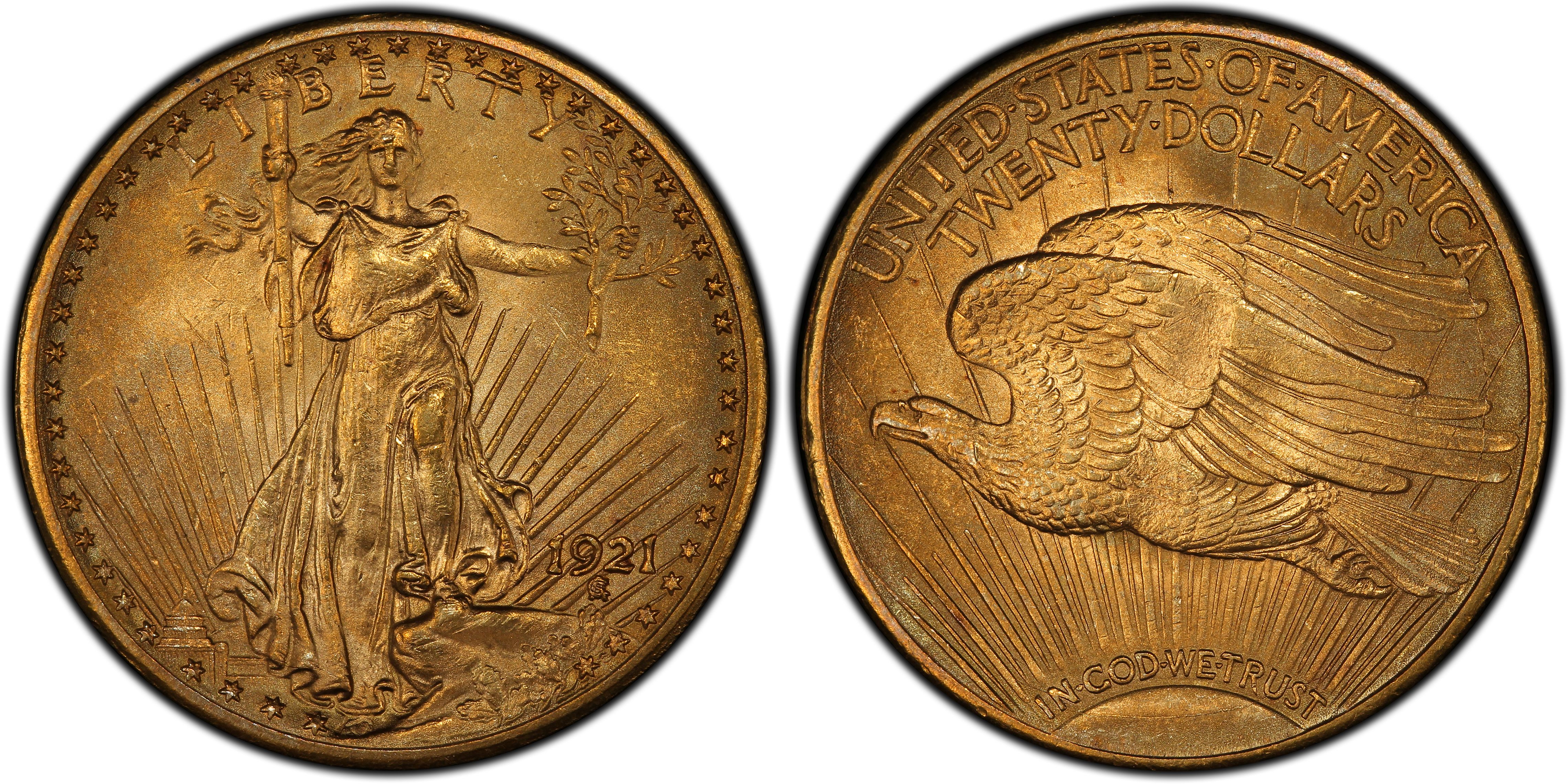
PCGS MS64
- PCGS #:
- 9172
- Designer:
- Augustus Saint Gaudens
- Edge:
- Lettered
- Diameter:
- 34.00 millimeters
- Weight:
- 33.40 grams
- Mintage:
- 528,500
- Mint:
- Philadelphia
- Metal:
- 90% Gold, 10% Copper
- Auction Record:
- $1,560,000 • MS66 • 08-31-2025 • Heritage Auctions
Major Varieties
- 1921 $20
Rarity and Survival Estimates Learn More
| Survival Estimate | |
|---|---|
| All Grades | 145 |
| 60 or Better | 65 |
| 65 or Better | 4 |
| Numismatic Rarity | |
|---|---|
| All Grades | R-7.5 |
| 60 or Better | R-8.3 |
| 65 or Better | R-9.8 |
| Relative Rarity By Type All Specs in this Type | |
|---|---|
| All Grades | 6 / 49 TIE |
| 60 or Better | 3 / 49 TIE |
| 65 or Better | 1 / 49 |
| Relative Rarity By Series All Specs in this Series | |
|---|---|
| All Grades | 6 / 54 TIE |
| 60 or Better | 3 / 54 TIE |
| 65 or Better | 1 / 54 |
Condition Census What Is This?
 #1 PCGS MS66
Dr. Thomas Louis Comparette; possible Senator Hall then Senator Hall's widow; George Seymour Godard; possibly Senator Hall's widow; "Auction '82," Stack's, August 1982, Lot 447 - $32,000; Superior, January 1984, Lot 1875 - $57,500; "The Dr. & Mrs. Steven Duckor Collection," Heritage January 2012, Lot 4630 - $747,500. Scattered coppery-orange toning spots throughout the obverse and reverse. |
|
#1 PCGS MS66
Dr. Thomas Louis Comparette; George Seymour Godard; Senator Hall; Stack's March 1982, Lot 1471 - $41,000; "The Crawford Collection." As PCGS MS66 #05651168. "The Phillip H. Morse Collection," Heritage, November 2005, Lot 6644 - $1,092,500. Scattered copper toning spots along the lower right obverse field. |
|
#3 PCGS MS65+
Dr. Thomas Louis Comparette; George Seymour Godard; Senator Hall; Louis E. Eliasberg, Sr.; "The Louis E. Eliasberg, Sr. Collection," Bowers & Ruddy, October 1982, Lot 1052; Dr. Stephen Duckor; Jay Parrino, 1990. As PCGS MS65. "The Phillip H. Morse Collection," Heritage November 2005, Lot 6645 - $805,000; The Bob Simpson Collection; "The Elite Collection" (PCGS Set Registry). Copper toning spot between rays 6 and 7. |
|
#4 PCGS MS65
Belden Roach Collection; B. Max Mehl, February 1944, Lot 179; possibly "The World's Greatest Collection," Numismatic Gallery, January 1946, Lot 923; possibly "The Dr. Charles W. Green Collection," B. Max Mehl, April 1949, Lot 791; possibly "The Jerome Kern Collection," B. Max Mehl, May 1950, Lot 639; Heritage Auctions October 1994, Lot 7207. As PCGS MS65 #11617047. "The Dr. Robert Hesselgesser Collection," Goldbergs, September 2007, Lot 3524 - $1,012,000. As PCGS MS65 #05875327. Heritage Auctions August 3, 2012, Lot 5453 - $587,500. Small diagonal mark on torso. Lightly toned. |
|
#5 PCGS MS64
As PCGS MS64 #08648060. "The Ralph P. Muller Collection," Heritage Auctions Janaury 7, 2010, Lot 2315 - $322,000; "A & A Saints Collection" (PCGS Set Registry). As PCGS MS64 #30433194. Heritage Auctions, January 9, 2020, Lot 4565 - $210,000. "The Bella Collection" (PCGS Set Registry); Dell Loy Hansen; "The D.L. Hansen Collection" (PCGS Set Registry). Diagonal mark on the ninth ray; small tick under the 'L' of LIBERTY. A small diagonal mark is present to the left of the stem, with a curved die line visible near the right border on the reverse. |
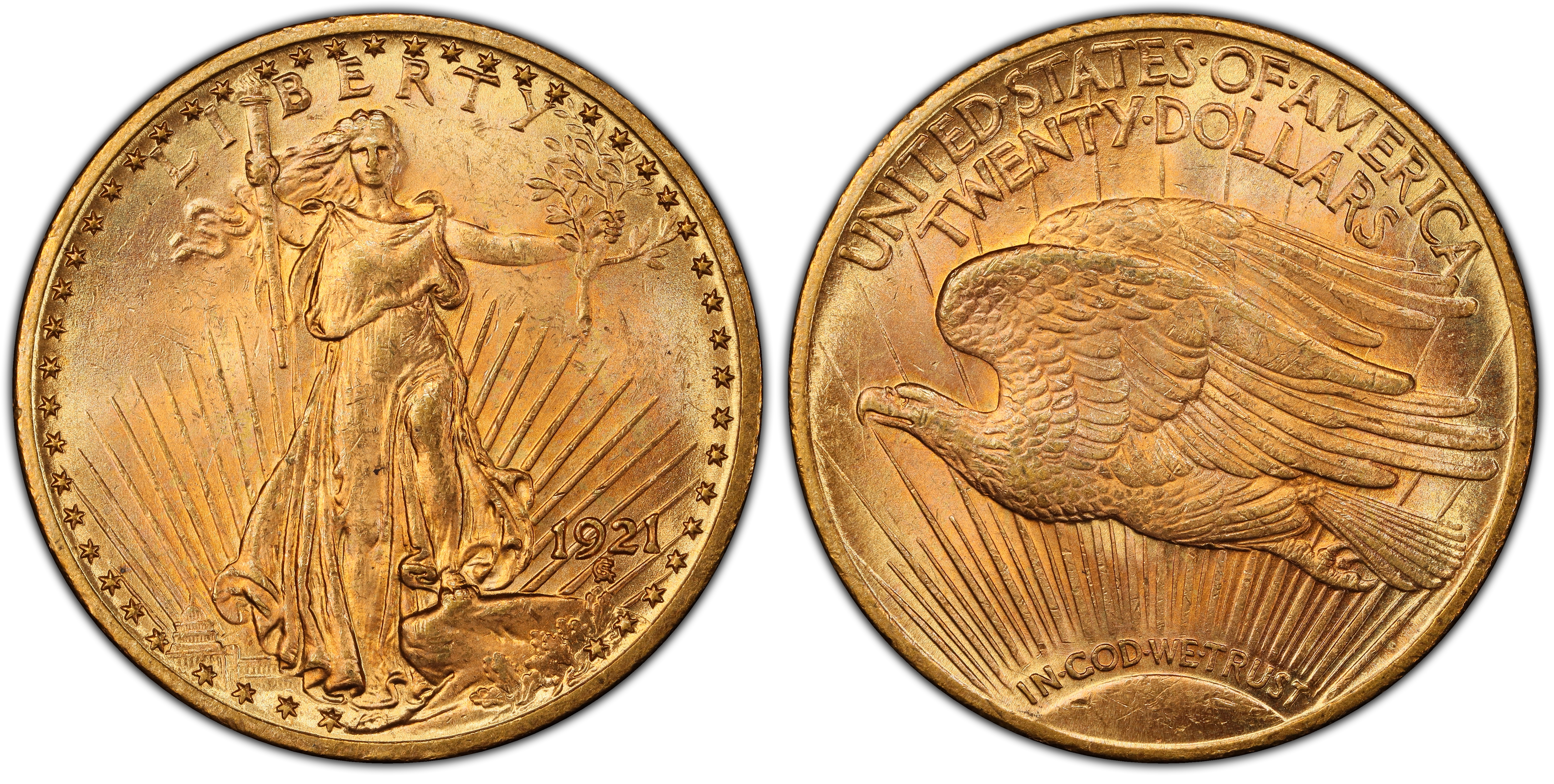 #5 PCGS MS64
“The Philip H. Morse Collection of Saint-Gaudens Coinage,” Heritage Auctions, November 3, 2005, Lot 6646 – $402,500; Heritage Auctions, January 4, 2007, Lot 3288 – $373,750; Heritage Auctions, June 1, 2007, Lot 2772 – $402,500; “The Stephen Stokely Collection, Part Five,” Heritage Auctions, July 31, 2008, Lot 2106 – $474,375. Small ticks on the sun; below G and R. |
| #5 PCGS MS64 |
 #8 PCGS MS63+
As PCGS MS63 #21895703. Goldbergs, February 2007, Lot 2728 – $218,500; Stack’s Bowers, August 2017, Lot 13276 – Passed. As PCGS MS63+ #37543091. “The Rollo Fox Collection,” Heritage Auctions, January 2020, Lot 4031 – $174,000. “The Noel Thomas Patton Collection,” Heritage Auctions, May 3, 2023, Lot 3339 – $288,000. Diagonal mark below Loberty's right arm. Diagonal mark across the eagle's left wing below the second T in TWENTY. |
 #8 PCGS MS63+
"The Dr. James A. Ferrendelli Collection," Stack's Bowers, August 6, 2020, Lot 1304 - $192,000. Mark to the left of olive branch. Hit on wing to the right of center mass. |
 #8 PCGS MS63+
Small mark on Liberty's left thigh. Small tick on the rays above RU. Two contact marks below TWENTY. Light diagonal marks on the eagle's tail feathers. |
The Saint-Gaudens Double Eagle: From Creation to Revision
The Saint-Gaudens Double Eagle is one of the most famous American coin types, acclaimed as one of the most beautiful and artistic numismatic designs ever realized in the United States. Its existence came only at the insistence of President Theodore Roosevelt, who sought for years to beautify America’s "humdrum" coin designs.
Augustus Saint-Gaudens’s involvement in the process was meant to be more far-reaching than it turned out to be. The artist set out to redesign every denomination of America’s circulating coinage but fell seriously ill before this plan could come to fruition. In fact, what we have in the form of the Saint-Gaudens-designed $10 and $20 gold coins was made possible only through the work of Saint-Gaudens’s assistant, Henry Hering.
The United States Mint’s first strikes of this $20 design came in the form of two dozen proofs struck in March 1907; each coin required nine impressions to realize the full detail of Saint-Gaudens’s high-relief design. The Mint’s engraving department, led by Chief Engraver Charles Barber, was adamant that the high-relief models were impractical for striking circulating coins. Barber is often slandered in numismatic circles as entitled, difficult, and unprofessional toward his U.S. Mint peers and outside artists—but the truth is more nuanced. In the case of the Double Eagle design, he was, unfortunately, correct.
After several versions proved too difficult to strike, Barber modified the design, lowering the relief so the coin could be struck with only one blow. When the coins were finally released in 1907, they proved controversial as they lacked the national motto "In God We Trust," which President Roosevelt objected to on religious grounds. Even though the Coinage Act of 1890 did not include that motto among the mandatory legends (perhaps an unintended omission), Congress and the public nevertheless wanted it there. The motto was restored in 1908 by congressional action, which brought the Double Eagle back into compliance with the Act of March 3, 1865, the original mandate for the text.
Before President Franklin Delano Roosevelt ended circulating gold coinage in 1933, the Double Eagle underwent one more significant modification. In 1912, the number of stars encircling Liberty on the obverse was increased from 46 to 48, marking the addition of New Mexico and Arizona to the Union.
The 1921 Saint
The 1921 Saint-Gaudens Double Eagle (#9172) had a mintage of 528,500. While this total is not among the lowest of the series, specialists understand that the scarcity of late-date Double Eagles is more closely tied to survival rates. This is why the 1923 Saint (#9175), with a mintage of 566,000, is often considered a "type coin" or "generic," whereas the 1921 is a significant rarity.
The main reason for the 1921’s elusiveness can be traced to the Treasury Department’s decision to store a significant portion of the issue in its vaults rather than releasing it into circulation. Numismatic researcher Roger Burdette believes the Treasury held these coins as a reserve fund. When gold was recalled from circulation, the stock of 1921 Double Eagles was melted into ingots, which are now held at Fort Knox.
Auction prices for the 1921 Saint-Gaudens are primarily driven by condition. Because fewer than 150 survivors are known to exist, its value is largely unaffected by the prevailing price of gold bullion, despite containing nearly one troy ounce of gold. While most affluent collectors prefer Mint State (MS) examples in "Choice" or better condition, most known survivors grade between AU58 and MS62. Because "AU slider" coins and counterfeits can be deceptive, any purchase of a 1921 Double Eagle should be accompanied by authentication and grading from PCGS.
Price Performance Explained
The 1921 Saint-Gaudens Double Eagle sells for between $55,000 and $80,000 in AU grades. This price increases significantly as one enters the low Mint State grades. The 10-year performance in AU grades has been somewhat stagnant; after surging from the early 2000s to 2010, prices flatlined. For example, Legend Rare Coin Auctions sold a PCGS AU55 example for $52,875 in February 2021, and Stack’s Bowers sold an NGC AU58 in August 2021 for $60,000. Both prices are lower than the $64,625 achieved by Heritage Auctions for a similar coin from the Douglas Martin Collection in 2014.
In Mint State grades of MS63 and above, the 1921 is extraordinarily rare. While significantly more expensive than lower grades, the market for "Choice" or better examples has softened. At least two examples in MS65 and MS66 sold for over $1 million in the mid-2000s, but when those same coins returned to the market in 2012, they sold for significantly less.
To what is this decline owed? It is certainly not due to an increase in supply. Instead, these sub-million-dollar results stem from a similarly timed exit of multiple competing buyers. The rare coin market is driven by supply and demand; when major collectors drop out, prices invariably fall. However, the takeaway is that just a few new competitors building high-end collections could elevate the finest 1921 Saint-Gaudens Double Eagles back to seven-figure prices. With no new supply entering the market, such competition could manifest at any time.
Vintage Market Snippet
Collector Phillip H. Morse once owned not one, but three "condition census" 1921 Saint-Gaudens Double Eagles.
* * *