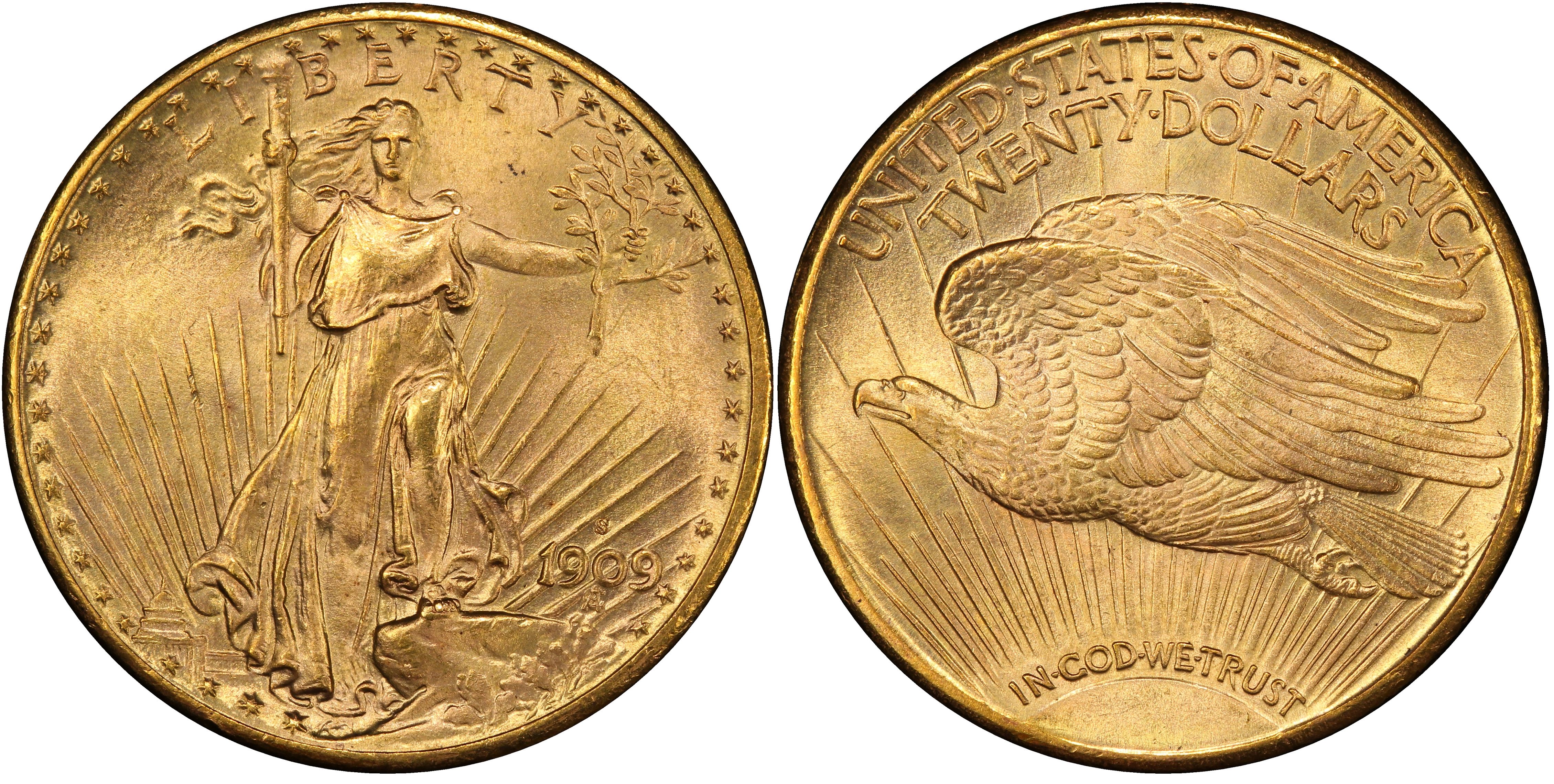

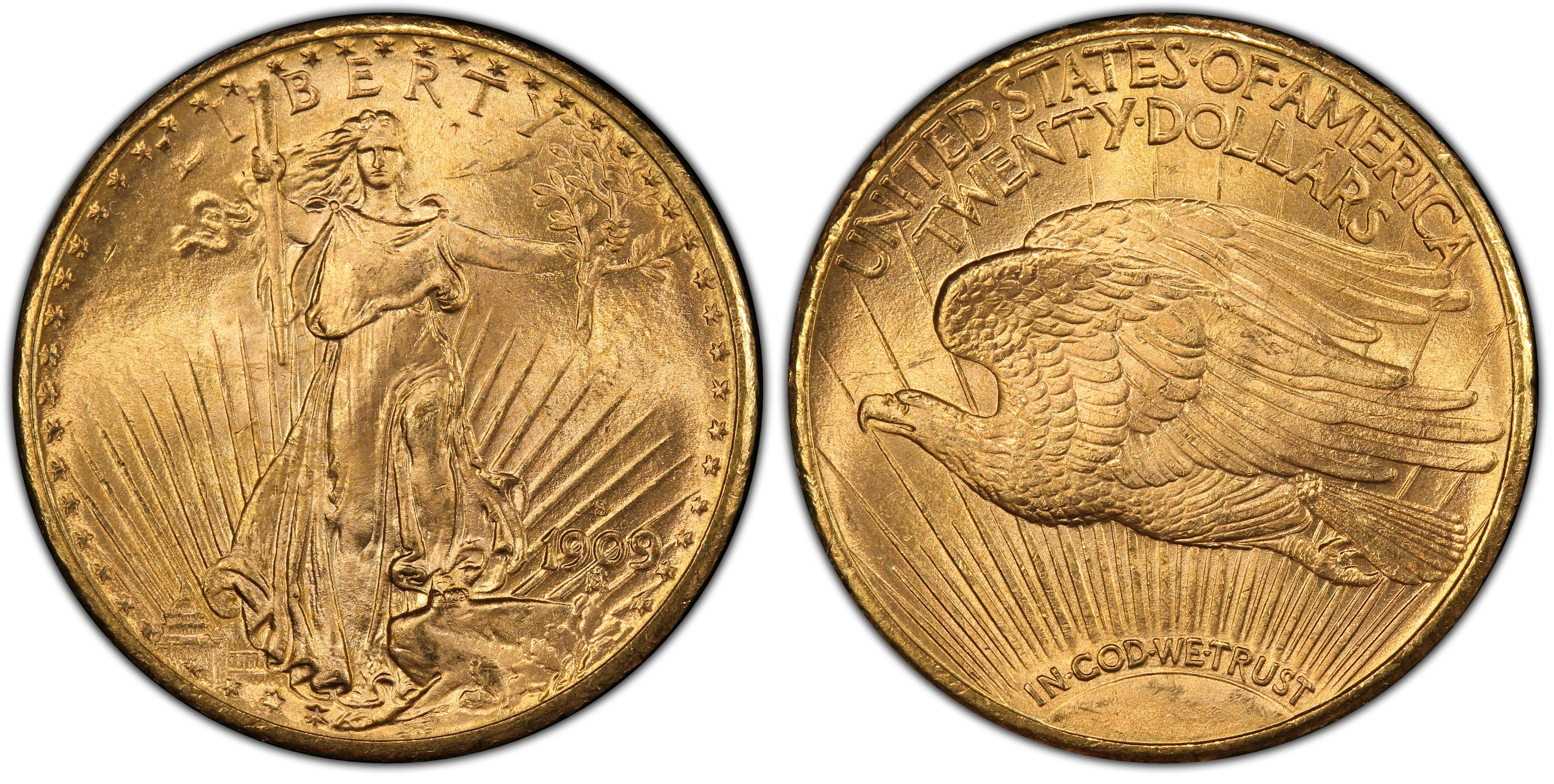
PCGS MS66

PCGS MS66
- PCGS #:
- 9153
- Designer:
- Augustus Saint Gaudens
- Edge:
- Lettered
- Diameter:
- 34.00 millimeters
- Weight:
- 33.40 grams
- Mintage:
- 2,774,925
- Mint:
- San Francisco
- Metal:
- 90% Gold, 10% Copper
- Auction Record:
- $57,600 • MS67 • 01-12-2020 • Heritage Auctions
Major Varieties
- 1909-S $20
Go To Grade
Current Auctions - PCGS Graded
Current Auctions - NGC Graded
For Sale Now at Collectors Corner - PCGS Graded
For Sale Now at Collectors Corner - NGC Graded
Rarity and Survival Estimates Learn More
| Survival Estimate | |
|---|---|
| All Grades | 71,666 |
| 60 or Better | 23,333 |
| 65 or Better | 1,000 |
| Numismatic Rarity | |
|---|---|
| All Grades | R-2.2 |
| 60 or Better | R-2.7 |
| 65 or Better | R-5.0 |
| Relative Rarity By Type All Specs in this Type | |
|---|---|
| All Grades | 39 / 49 |
| 60 or Better | 35 / 49 TIE |
| 65 or Better | 33 / 49 |
| Relative Rarity By Series All Specs in this Series | |
|---|---|
| All Grades | 42 / 54 |
| 60 or Better | 38 / 54 TIE |
| 65 or Better | 36 / 54 |
Condition Census What Is This?
| #1 MS67 PCGS grade |
| #1 MS67 PCGS grade |
 #3 MS66+ PCGS grade
“Fox” Collection (PCGS Set Registry) |
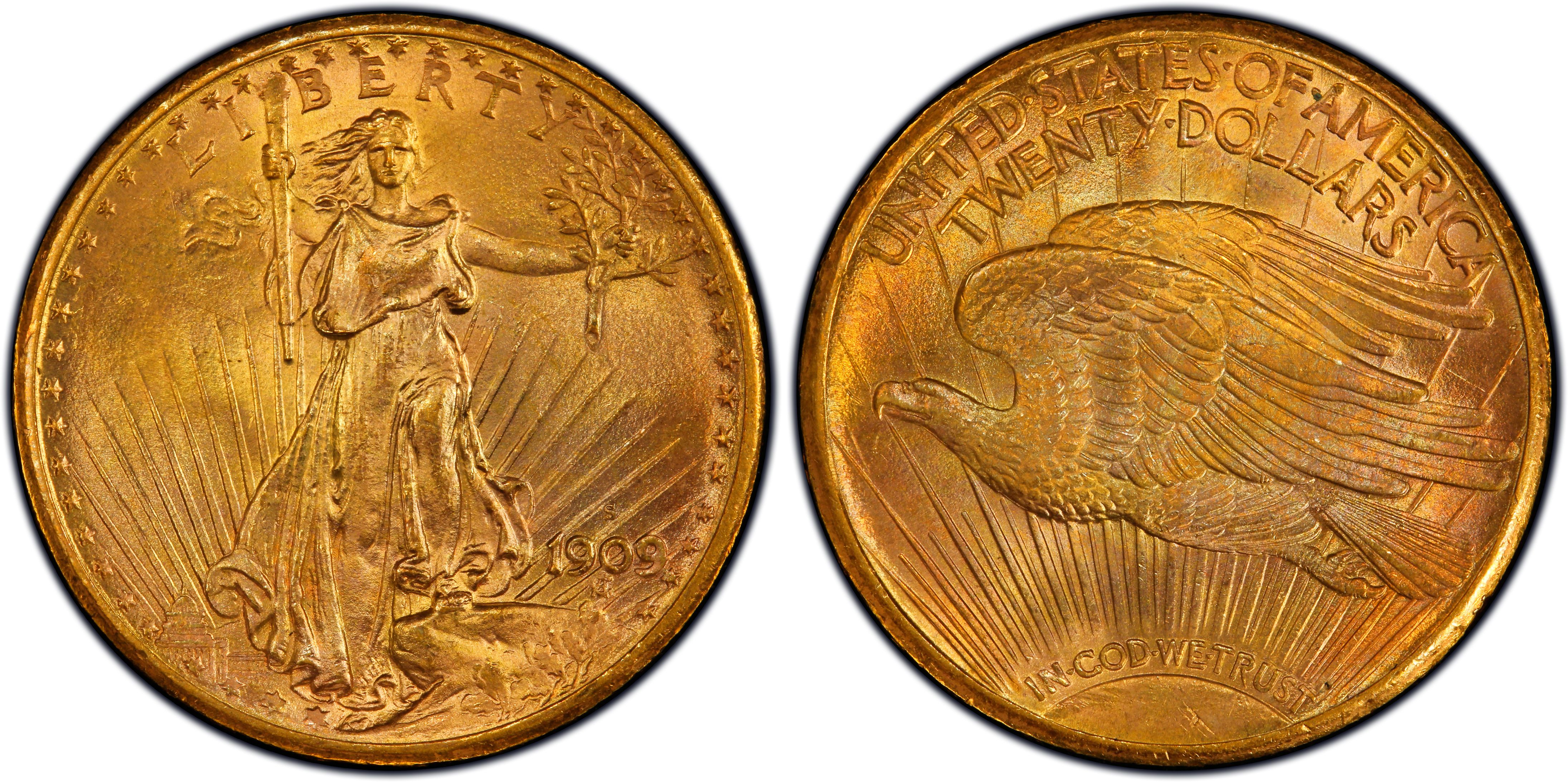 #4 MS66 PCGS grade
David Akers - Dr. & Mrs. Steven L. Duckor Collection - Heritage 1/2012:4611, $34,500 |
 #4 MS66 PCGS grade
Heritage 7/2015:3398, $22,912.50 - "Fox" Collection |
 #4 MS66 PCGS grade
|
 #4 MS66 PCGS grade
"Fox" Collection |
 #4 MS66 PCGS grade
"Fox" Collection |
|
#4 MS66 PCGS grade
|
| #4 MS66 PCGS grade |
David Akers (1975/88):
The 1909-S is a common issue in anything less than gem condition. Several rather large hoards of Uncirculated examples have been uncovered, including several thousand pieces in Central America in 1983. Gem quality coins are very scarce but certainly not rare, and I have seen quite a few that graded a full MS-65 over the years. There are also a few exceptional quality examples of this issue known that are distinctly better than MS-65. The MS-65+ to MS-67 Eliasberg coin comes first to mind, and I have seen others. Overall, I find this issue to be somewhat more elusive in high grade than any of the other early San Francisco Mint issues except the 1908-S and 1913-S.
Most 1909-S double eagles are very sharply struck and have "soft" frosty surfaces and some granularity. A few are rather satiny, but I have never seen one with the super satiny finish that is present on some specimens of the 1908-S. Lustre is good to very good but seldom really exceptional. Color, however, is a strong point with most specimens having very appealing greenish gold to light rose or orange color. Many specimens have distinctly "rounded" rims.
Most 1909-S double eagles are very sharply struck and have "soft" frosty surfaces and some granularity. A few are rather satiny, but I have never seen one with the super satiny finish that is present on some specimens of the 1908-S. Lustre is good to very good but seldom really exceptional. Color, however, is a strong point with most specimens having very appealing greenish gold to light rose or orange color. Many specimens have distinctly "rounded" rims.