
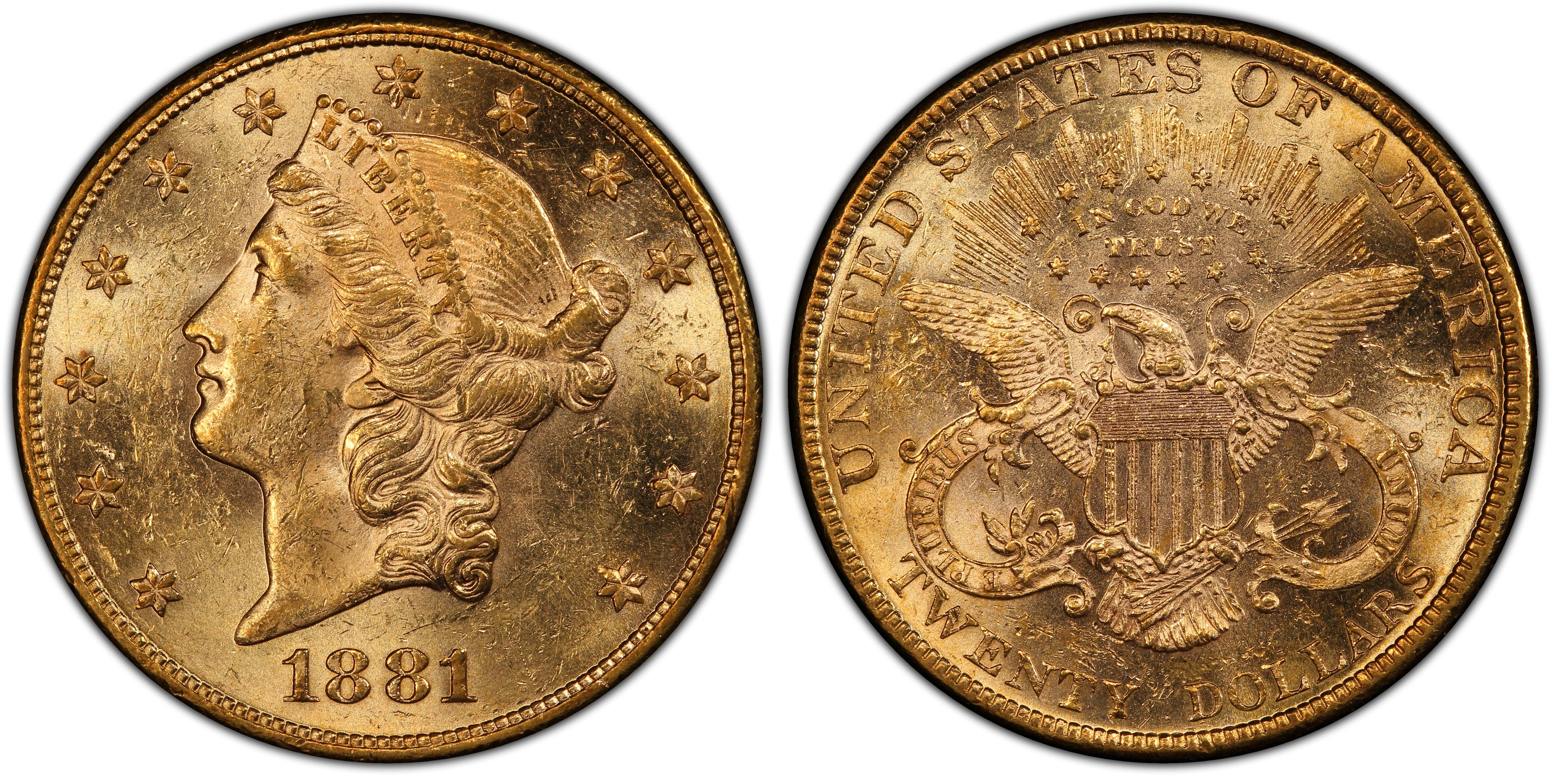
PCGS MS62

PCGS MS60
- PCGS #:
- 8994
- Designer:
- James Barton Longacre
- Edge:
- Reeded
- Diameter:
- 34.00 millimeters
- Weight:
- 33.40 grams
- Mintage:
- 2,199
- Mint:
- Philadelphia
- Metal:
- 90% Gold, 10% Copper
- Auction Record:
- $152,750 • MS61 • 04-23-2014 • Heritage Auctions
Major Varieties
- 1881 $20
Rarity and Survival Estimates Learn More
| Survival Estimate | |
|---|---|
| All Grades | 67 |
| 60 or Better | 3 |
| 65 or Better | |
| Numismatic Rarity | |
|---|---|
| All Grades | R-8.3 |
| 60 or Better | R-9.8 |
| 65 or Better | R-10.1 |
| Relative Rarity By Type All Specs in this Type | |
|---|---|
| All Grades | 2 / 73 TIE |
| 60 or Better | 1 / 73 TIE |
| 65 or Better | 1 / 73 |
| Relative Rarity By Series All Specs in this Series | |
|---|---|
| All Grades | 6 / 148 TIE |
| 60 or Better | 11 / 148 TIE |
| 65 or Better | 1 / 148 |
Condition Census What Is This?
| #1 MS62 PCGS grade |
|
#2 MS61 PCGS grade
Kutasi Collection - Heritage 1/2007:3203, $138,000 - Baltimore Collection - Heritage 10/2008:3091, $138,000 - Heritage 4/2009:2762, $120,750 - Heritage 1/2015:4389, $141,000 |
|
#2 MS61 PCGS grade
American Numismatic Rarities 3/2004:1667, $39,100 - Heritage 6/2004:6363, $57,500 - Heritage 4/2014:5837, $152,750 |
 #4 MS60 PCGS grade
D.L. Hansen Collection |
| #4 MS60 PCGS grade |
|
#6 AU58 PCGS grade
Donald E. Bently Collection - Heritage 1/2014:5550, $111,625 |
| #6 AU58 PCGS grade |
| #6 AU58 PCGS grade |
| #6 AU58 estimated grade |
| #6 AU58 estimated grade |
Whether because of new discoveries over the years or improvements in the way coins are evaluated, there are now several low-end Uncs. available of the 1881 $20. None are choice, but at least collectors have a shot at competing for them. The best of these coins is a PCGS MS62 (which is quite possibly the Dallas Bank example). The price-record-setter for this date was a PCGS MS61 that sold for $152,750 in a 2014 Heritage sale.
The 1881 is the first of a run of seven ultra low mintage issues from the Philadelphia Mint. Overall, the 1881 is almost identical in rarity to the lower mintage 1885 and just a little less rare than the 1886. In AU or Unc., however, the 1881 is possibly the rarest of the three. (The same might be said for the 1886 but one thing is for certain, the 1885 is the most common of the three in high grade.) The 1881 is not quite as rare as the proof-only 1887 or 1882, and, of course, it is also not as rare as the 1883 or 1884. Most known 1881's grade EF or so and always have a prooflike or partially prooflike surface. A few AU's are known and there is one Unc-60 example in a Texas collection. I have neither seen or heard of a choice or gem mint state example and the Texas coin may be the only known unc.