
PCGS MS63+

PCGS MS63
- PCGS #:
- 8982
- Designer:
- James Barton Longacre
- Edge:
- Reeded
- Diameter:
- 34.00 millimeters
- Weight:
- 33.40 grams
- Mintage:
- 397,650
- Mint:
- Philadelphia
- Metal:
- 90% Gold, 10% Copper
- Auction Record:
- $27,600 • MS64 • 05-28-2006 • Superior Galleries
Go To Grade
Current Auctions - PCGS Graded
Current Auctions - NGC Graded
For Sale Now at Collectors Corner - PCGS Graded
For Sale Now at Collectors Corner - NGC Graded
Rarity and Survival Estimates Learn More
| Survival Estimate | |
|---|---|
| All Grades | 4,575 |
| 60 or Better | 625 |
| 65 or Better | |
| Numismatic Rarity | |
|---|---|
| All Grades | R-4.0 |
| 60 or Better | R-5.7 |
| 65 or Better | R-10.1 |
| Relative Rarity By Type All Specs in this Type | |
|---|---|
| All Grades | 28 / 73 |
| 60 or Better | 26 / 73 TIE |
| 65 or Better | 1 / 73 |
| Relative Rarity By Series All Specs in this Series | |
|---|---|
| All Grades | 90 / 148 TIE |
| 60 or Better | 89 / 148 TIE |
| 65 or Better | 1 / 148 |
Condition Census What Is This?
| #1 MS64 PCGS grade |
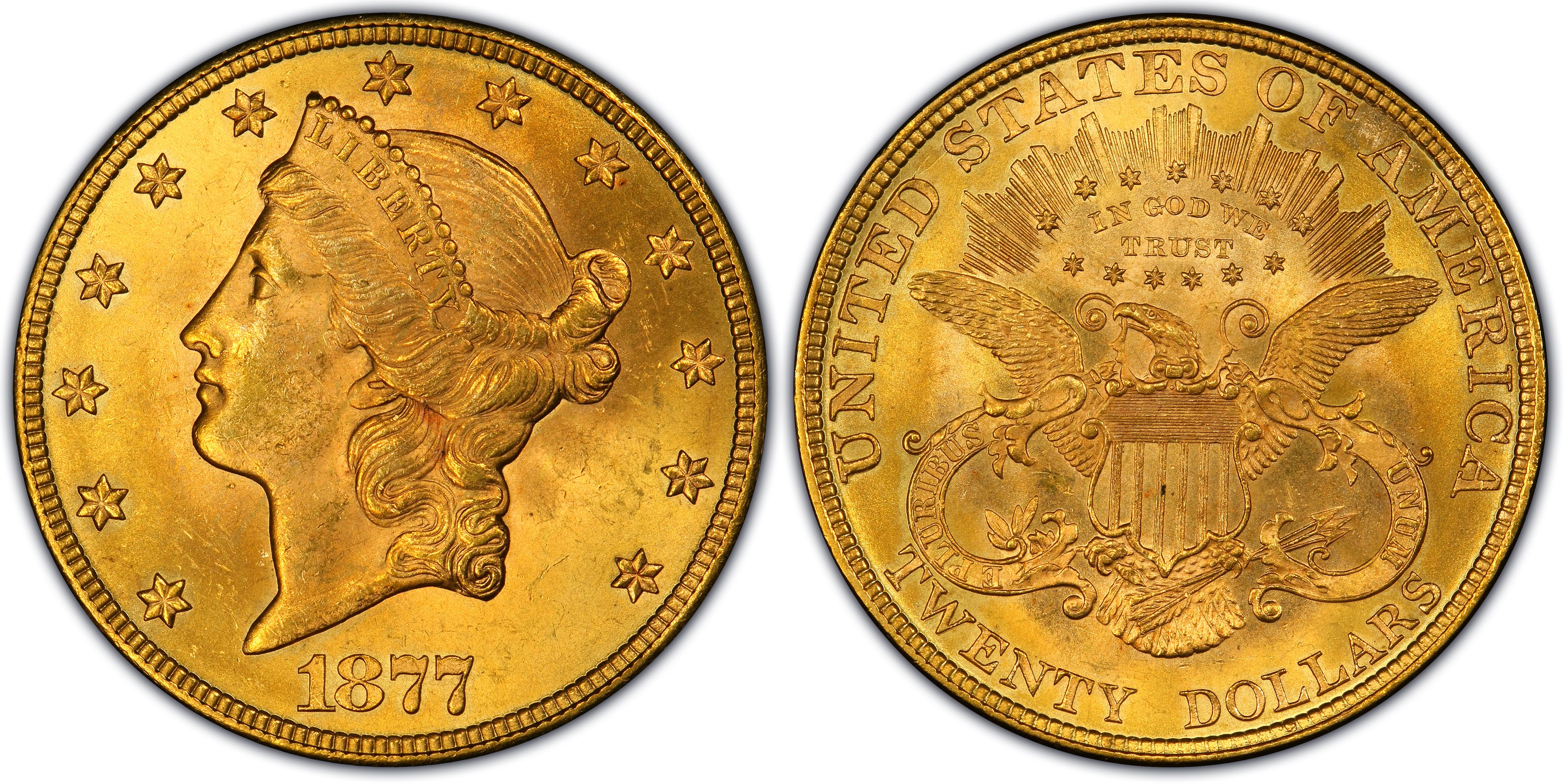 #2 MS63+ PCGS grade
|
 #3 MS63 PCGS grade
|
| #3 MS63 PCGS grade |
| #3 MS63 PCGS grade |
| #3 MS63 PCGS grade |
| #3 MS63 PCGS grade |
| #3 MS63 PCGS grade |
| #3 MS63 PCGS grade |
| #3 MS63 PCGS grade |
David Akers (1975/88):
This date is a scarce one, certainly head and shoulders above the so-called "common dates" of the series. Overall, the 1877 is similar in rarity to the 1854, 1860 and 1878 among others and it is more rare than the 1867 and 1876, especially in strictly uncirculated condition. Also, in my experience, I have seen more Unc. 1872 twenties than I have 1977's although the 1872 had fewer auction appearances in my survey. The 1877, as scarce as it is, is not as difficult to obtain as the 1874 or 1875. When available, this date is usually in EF or AU condition. Average quality uncs are very scarce and choice mint state pieces are rare. In gem condition, the 1877 is very rare and I have seen only a couple at that level.