

PCGS MS62+
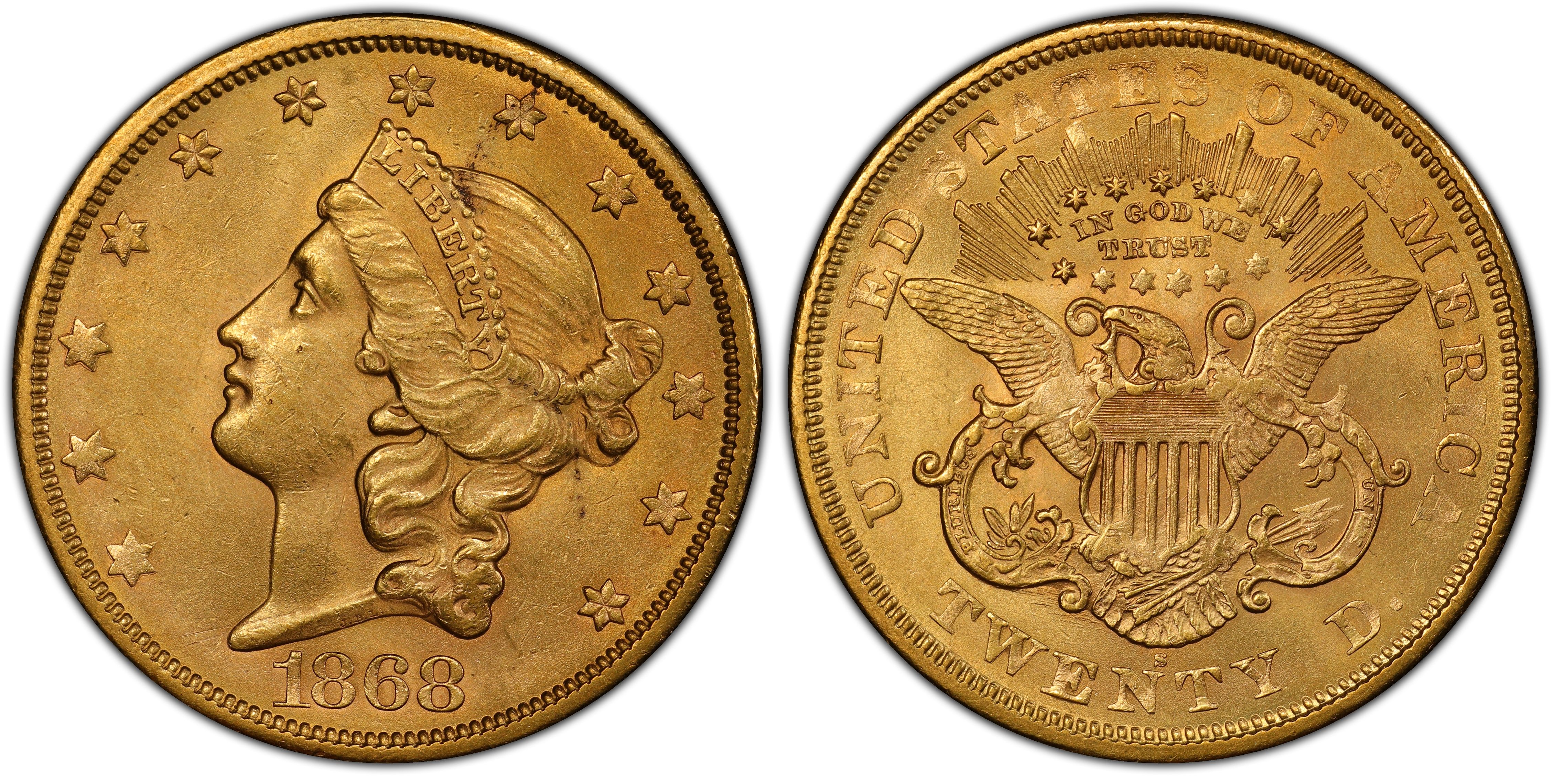
PCGS MS62+
- PCGS #:
- 8954
- Designer:
- James Barton Longacre
- Edge:
- Reeded
- Diameter:
- 34.00 millimeters
- Weight:
- 33.40 grams
- Mintage:
- 837,500
- Mint:
- San Francisco
- Metal:
- 90% Gold, 10% Copper
- Auction Record:
- $120,000 • MS62+ • 01-14-2019 • Heritage Auctions
Major Varieties
- 1868-S $20
Go To Grade
Current Auctions - PCGS Graded
Current Auctions - NGC Graded
For Sale Now at Collectors Corner - PCGS Graded
For Sale Now at Collectors Corner - NGC Graded
Rarity and Survival Estimates Learn More
| Survival Estimate | |
|---|---|
| All Grades | 3,628 |
| 60 or Better | 20 |
| 65 or Better | |
| Numismatic Rarity | |
|---|---|
| All Grades | R-4.2 |
| 60 or Better | R-9.1 |
| 65 or Better | R-10.1 |
| Relative Rarity By Type All Specs in this Type | |
|---|---|
| All Grades | 18 / 31 TIE |
| 60 or Better | 6 / 31 TIE |
| 65 or Better | 1 / 31 |
| Relative Rarity By Series All Specs in this Series | |
|---|---|
| All Grades | 80 / 148 TIE |
| 60 or Better | 29 / 148 TIE |
| 65 or Better | 1 / 148 |
Condition Census What Is This?
| #1 MS63 estimated grade |
|
#2 MS62+ PCGS grade
Quality Sale Corp.'s/Abner Kreisberg's 9/1980:1585 - A.J. Vanderbilt Collection - Stack's/Bowers 3/2018:10403, $43,200 - Heritage 1/2019:4738, $120,000 - D.L. Hansen Collection |
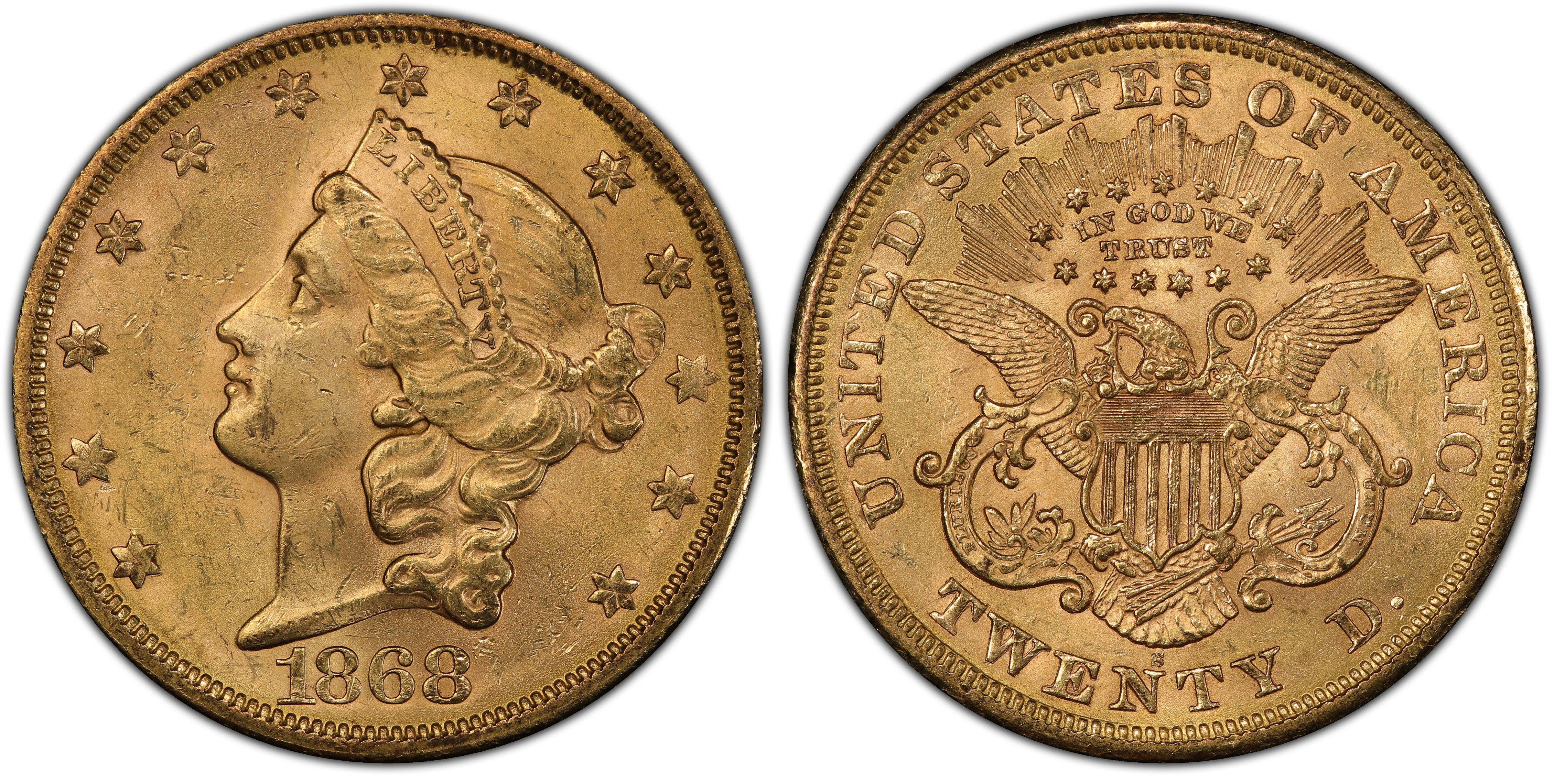 #2 MS62+ PCGS grade
Legend Rare Coin Auctions 1/2019:441, $47,000 - Heritage 4/2019:3922, $33,600 |
 #4 MS62 PCGS grade
Stack's/Bowers 11/2019:3195 |
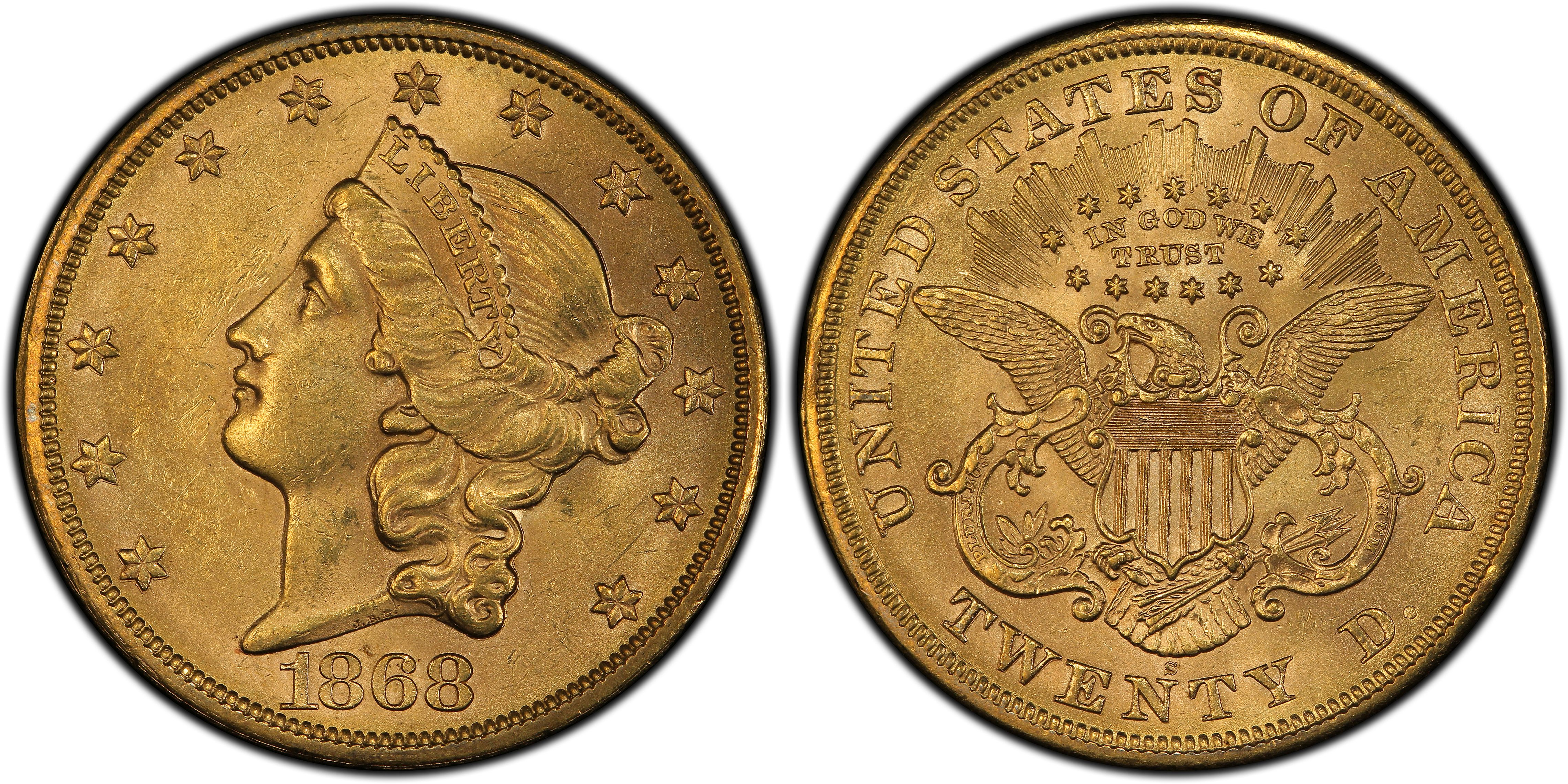 #4 MS62 PCGS grade
|
|
#4 MS62 PCGS grade
Goldbergs 5/2007:1709, $29,900 - Goldbergs 9/2008:1593, $28,175 |
| #4 MS62 PCGS grade |
| #4 MS62 PCGS grade |
| #4 MS62 PCGS grade |
| #4 MS62 PCGS grade |
David Akers (1975/88):
In terms of overall rarity, the 1868-S is just a little less rare than the 1866-S Motto and 1867-S. It is essentially the same rarity as the 1860-S, 1861-S, 1862-S and 1864-S. Like most S-Mint issues of this era, the 1868-S is generally available only in EF or lower grade. In fact, in my experience, the most often encountered 1868-S is a heavily bagmarked VF. In AU, the date is definitely rare and in full mint state it is very rare. I have seen only a couple of Unc-60 examples and cannot recall ever having seen a choice or gem quality specimen.