

PCGS MS65+
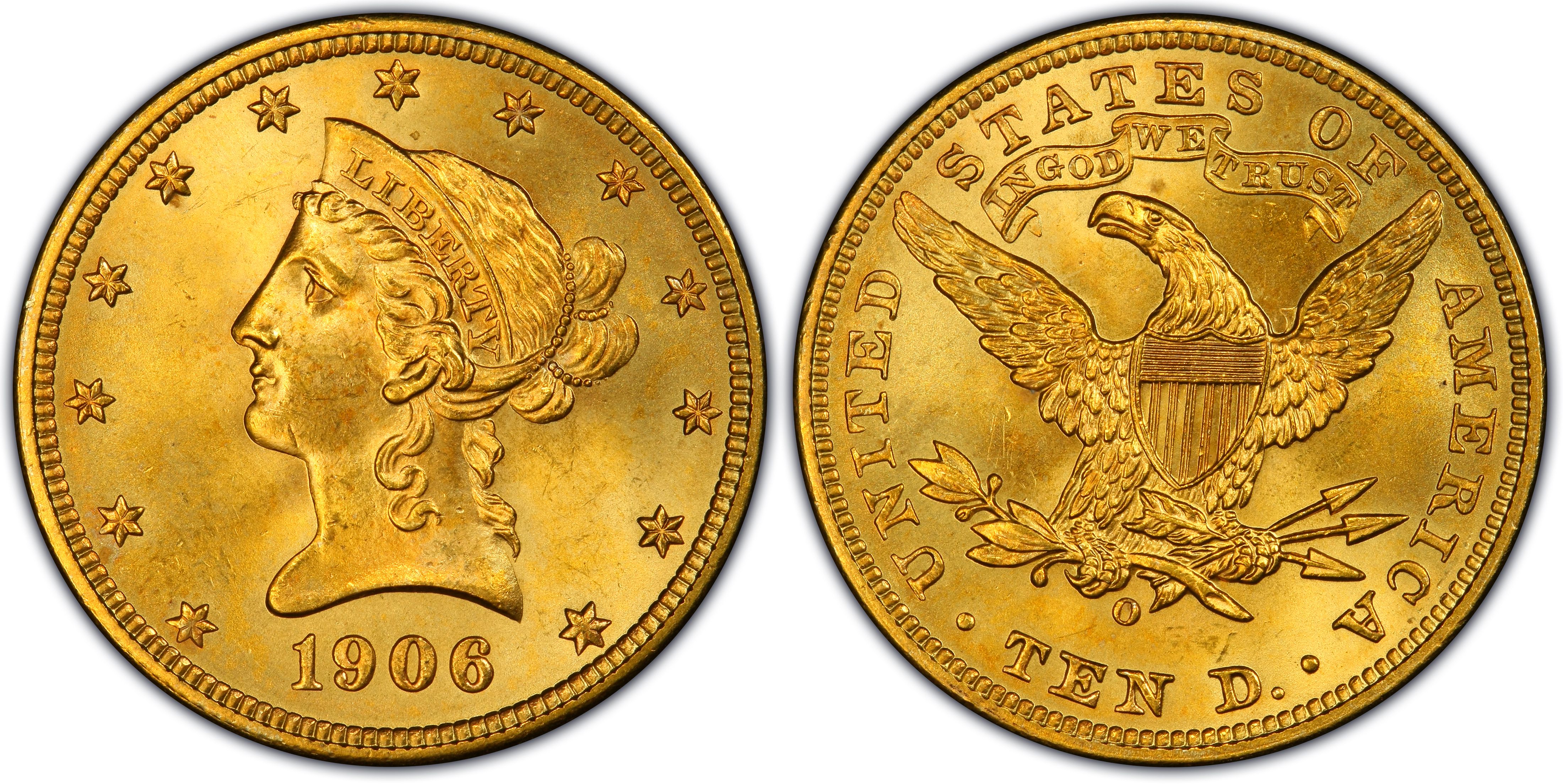
PCGS MS65+
- PCGS #:
- 8761
- Designer:
- Christian Gobrecht
- Edge:
- Reeded
- Diameter:
- 26.80 millimeters
- Weight:
- 16.70 grams
- Mintage:
- 86,895
- Mint:
- New Orleans
- Metal:
- 90% Gold, 10% Copper
- Auction Record:
- $31,200 • MS65+ • 02-23-2020 • Heritage Auctions
Major Varieties
- 1906-O $10
Go To Grade
Current Auctions - PCGS Graded
Current Auctions - NGC Graded
For Sale Now at Collectors Corner - PCGS Graded
For Sale Now at Collectors Corner - NGC Graded
Rarity and Survival Estimates Learn More
| Survival Estimate | |
|---|---|
| All Grades | 625 |
| 60 or Better | 350 |
| 65 or Better | 7 |
| Numismatic Rarity | |
|---|---|
| All Grades | R-5.7 |
| 60 or Better | R-6.3 |
| 65 or Better | R-9.6 |
| Relative Rarity By Type All Specs in this Type | |
|---|---|
| All Grades | 52 / 117 TIE |
| 60 or Better | 49 / 117 |
| 65 or Better | 28 / 117 TIE |
| Relative Rarity By Series All Specs in this Series | |
|---|---|
| All Grades | 113 / 183 TIE |
| 60 or Better | 102 / 183 |
| 65 or Better | 37 / 183 TIE |
Condition Census What Is This?
|
#1 MS67 estimated grade
Clapp-Eliasberg |
| #2 MS66 PCGS grade |
| #2 MS66 PCGS grade |
|
#4 MS65+ PCGS grade
Ellen D Collection (PCGS Set Registry) - Simpson Collection |
| #5 MS65 PCGS grade |
| #5 MS65 estimated grade |
| #5 MS65 estimated grade |
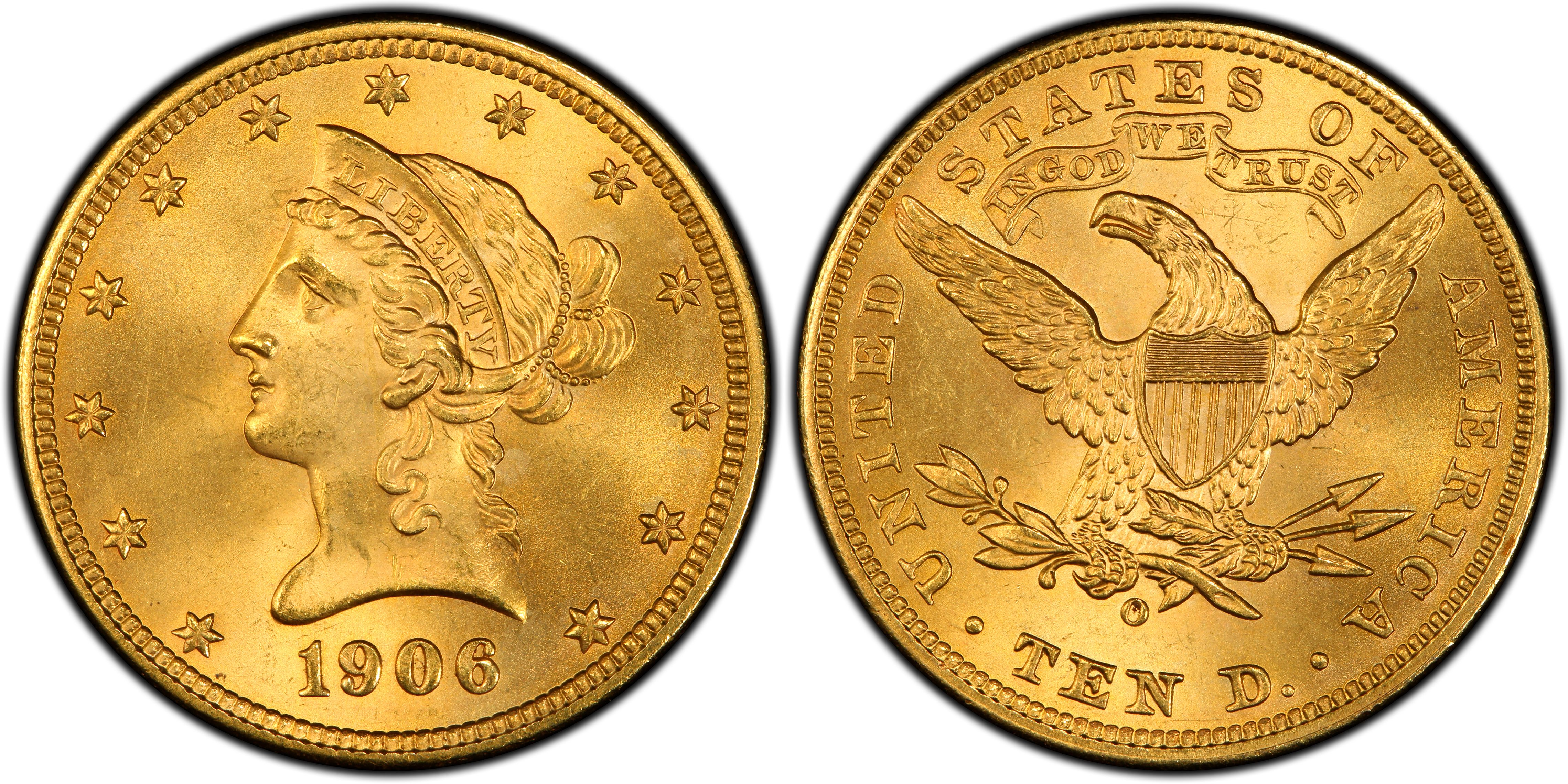 #8 MS64+ PCGS grade
|
| #9 MS64 PCGS grade |
| #9 MS64 PCGS grade |
Doug Winter:
The 1906-O is the final eagle struck at this mint as well as the second to last gold coin produced at New Orleans. It was formerly a scarce coin but it has become more available in recent years due to the discovery of some hoards. It remains the scarcest New Orleans eagle from this decade by a considerable margin.
The 1906-O is the scarcest New Orleans eagle struck after 1900. It is almost never seen below AU55 and most of the pieces known grade AU55 to MS62. It is scarce in MS63 and rare in properly graded MS64. There are as many as a half dozen Gems known and it is possible that a few others will be discovered in the coming years.
STRIKE: The 1906-O eagle is generally a well produced issue. The obverse shows good detail at the center although some flatness can be seen on the curls around the face. On a few pieces, the first two and the final two or three stars may have weakness at the radial lines. The reverse is always very sharp.
SURFACES: The surfaces are typically abraded although not as much so as on the other New Orleans eagles from this decade. I have seen a number of pieces with small mint-made grease stains or areas of discoloration. With some patience, the collector should be able to find a piece that is not overly bagmarked.
LUSTER: Two types of luster are seen on this issue. Most pieces are satiny with a slightly grainy texture. A lesser number are frosty and vibrant and these pieces are generally regarded as more desirable. The luster is often interrupted by bagmarks and a number have been dipped in recent years.
COLORATION: The natural coloration seen on this date can be as attractive as on any gold coin from the New Orleans mint. Hues range from a light green-gold to a deep orange-gold. It is still reasonably easy to find pieces with good color although it is getting harder every year as more and more coins are tampered with.
EYE APPEAL: This issue has above average eye appeal. Most 1906-O eagles are very well struck and lustrous and many have very nice color. Bagmarks can be a problem on this date but there are a decent number of pieces available with acceptable surfaces.
DIE CHARACTERISTICS: There are a number of raised die lines through the reverse legend including ones at TA in STATES, OF and RICA in AMERICA.
MAJOR VARIETIES: There is a single variety known:
Variety One: The date is placed fairly high in the field and is closer to the truncation than the denticles. The reverse is the same as on the 1903-O and 1904-O eagles.
The 1906-O is the scarcest New Orleans eagle struck after 1900. It is almost never seen below AU55 and most of the pieces known grade AU55 to MS62. It is scarce in MS63 and rare in properly graded MS64. There are as many as a half dozen Gems known and it is possible that a few others will be discovered in the coming years.
STRIKE: The 1906-O eagle is generally a well produced issue. The obverse shows good detail at the center although some flatness can be seen on the curls around the face. On a few pieces, the first two and the final two or three stars may have weakness at the radial lines. The reverse is always very sharp.
SURFACES: The surfaces are typically abraded although not as much so as on the other New Orleans eagles from this decade. I have seen a number of pieces with small mint-made grease stains or areas of discoloration. With some patience, the collector should be able to find a piece that is not overly bagmarked.
LUSTER: Two types of luster are seen on this issue. Most pieces are satiny with a slightly grainy texture. A lesser number are frosty and vibrant and these pieces are generally regarded as more desirable. The luster is often interrupted by bagmarks and a number have been dipped in recent years.
COLORATION: The natural coloration seen on this date can be as attractive as on any gold coin from the New Orleans mint. Hues range from a light green-gold to a deep orange-gold. It is still reasonably easy to find pieces with good color although it is getting harder every year as more and more coins are tampered with.
EYE APPEAL: This issue has above average eye appeal. Most 1906-O eagles are very well struck and lustrous and many have very nice color. Bagmarks can be a problem on this date but there are a decent number of pieces available with acceptable surfaces.
DIE CHARACTERISTICS: There are a number of raised die lines through the reverse legend including ones at TA in STATES, OF and RICA in AMERICA.
MAJOR VARIETIES: There is a single variety known:
Variety One: The date is placed fairly high in the field and is closer to the truncation than the denticles. The reverse is the same as on the 1903-O and 1904-O eagles.