

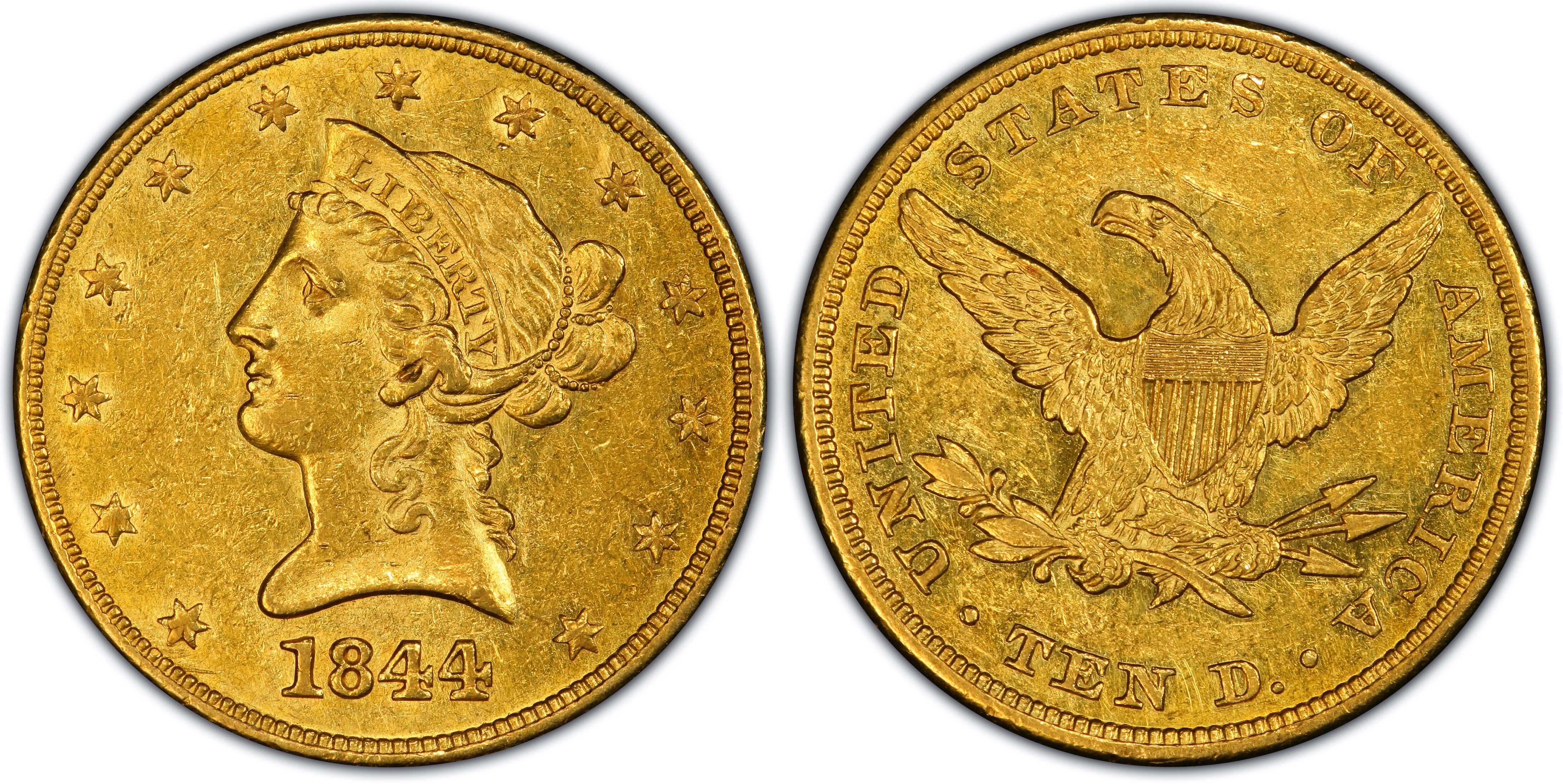
PCGS AU55

PCGS AU55
- PCGS #:
- 8590
- Designer:
- Christian Gobrecht
- Edge:
- Reeded
- Diameter:
- 26.80 millimeters
- Weight:
- 16.70 grams
- Mintage:
- 6,361
- Mint:
- Philadelphia
- Metal:
- 90% Gold, 10% Copper
- Auction Record:
- $72,000 • MS63 • 02-22-2018 • Heritage Auctions
Major Varieties
- 1844 $10
Go To Grade
Current Auctions - PCGS Graded
Current Auctions - NGC Graded
For Sale Now at Collectors Corner - PCGS Graded
For Sale Now at Collectors Corner - NGC Graded
Rarity and Survival Estimates Learn More
| Survival Estimate | |
|---|---|
| All Grades | 55 |
| 60 or Better | |
| 65 or Better | |
| Numismatic Rarity | |
|---|---|
| All Grades | R-8.4 |
| 60 or Better | R-10.1 |
| 65 or Better | R-10.1 |
| Relative Rarity By Type All Specs in this Type | |
|---|---|
| All Grades | 10 / 64 TIE |
| 60 or Better | 1 / 64 |
| 65 or Better | 1 / 64 |
| Relative Rarity By Series All Specs in this Series | |
|---|---|
| All Grades | 17 / 183 TIE |
| 60 or Better | 1 / 183 |
| 65 or Better | 1 / 183 |
Condition Census What Is This?
| #1 MS62 estimated grade |
| #2 AU58 estimated grade |
 #3 AU55+ PCGS grade
Heritage 9/2015:4196, $14,100 |
|
#4 AU55 PCGS grade
|
|
#4 AU55 PCGS grade
Heritage 1/2014:6841, $24,169.75 |
|
#4 AU55 PCGS grade
Heritage 1/2003:8746, $5,060 |
 #7 AU53 PCGS grade
David Hall Collection - Simpson Collection
|
|
#7 AU53 estimated grade
American Numismatic Rarities 3/2004:1499, $5,520 - Goldbergs 9/16/2008:1522, $9,775 |
|
#7 AU53 estimated grade
Donald E. Bently Collection - Heritage 1/2014:6842, $8,812.50 |
|
#7 AU53 estimated grade
Heritage 1/2015:7209, $8,812.50 |
David Akers (1975/88):
This date has the second lowest mintage of this type from 1839-1857 and its rarity matches its low mintage. It is comparable to the 1839 Type of '40, the 1845, and the 1846, although its low mintage had brought it a little more recognition than those three equally rare dates. I have not personally seen a mint state piece but one or two may exist. The Bell 1944 coin in particular was described as "choice". In AU condition this date is extremely rare and the relatively few examples that are availble to collectors grade only VF or EF.
Doug Winter:
There are few coins in the $10 Liberty series that are not well-known outside of the core collecting community of Liberty Head eagles. I would have to rank the 1844 as the number one sleeper in this group and it is a coin whose true rarity even surprised me as I was researching this series.
There were only 6,361 eagles struck in 1844 and my estimate is that 40-50+ are known. When you do find an 1844 eagle, it tends to be very well worn with VF and EF examples most often seen. I believe that there are fewer than ten properly graded AU examples known with most in the AU50-53 range. NGC has graded one in MS63 (I have not seen it) which may possibly be the Bell coin from 1944. The best example I have personally seen is an AU55 and I cannot recall having seen a nice 1844 eagle in over five years.
Every 1844 has two prominent die characteristics on the obverse. There is a horizontal die line below the first star and a series of vertical die scratches from the denticles out onto the fields near star three.
There were only 6,361 eagles struck in 1844 and my estimate is that 40-50+ are known. When you do find an 1844 eagle, it tends to be very well worn with VF and EF examples most often seen. I believe that there are fewer than ten properly graded AU examples known with most in the AU50-53 range. NGC has graded one in MS63 (I have not seen it) which may possibly be the Bell coin from 1944. The best example I have personally seen is an AU55 and I cannot recall having seen a nice 1844 eagle in over five years.
Every 1844 has two prominent die characteristics on the obverse. There is a horizontal die line below the first star and a series of vertical die scratches from the denticles out onto the fields near star three.