1803 $10 Small Reverse Stars (Regular Strike)
Series: Draped Bust $10 1795-1804

PCGS MS65
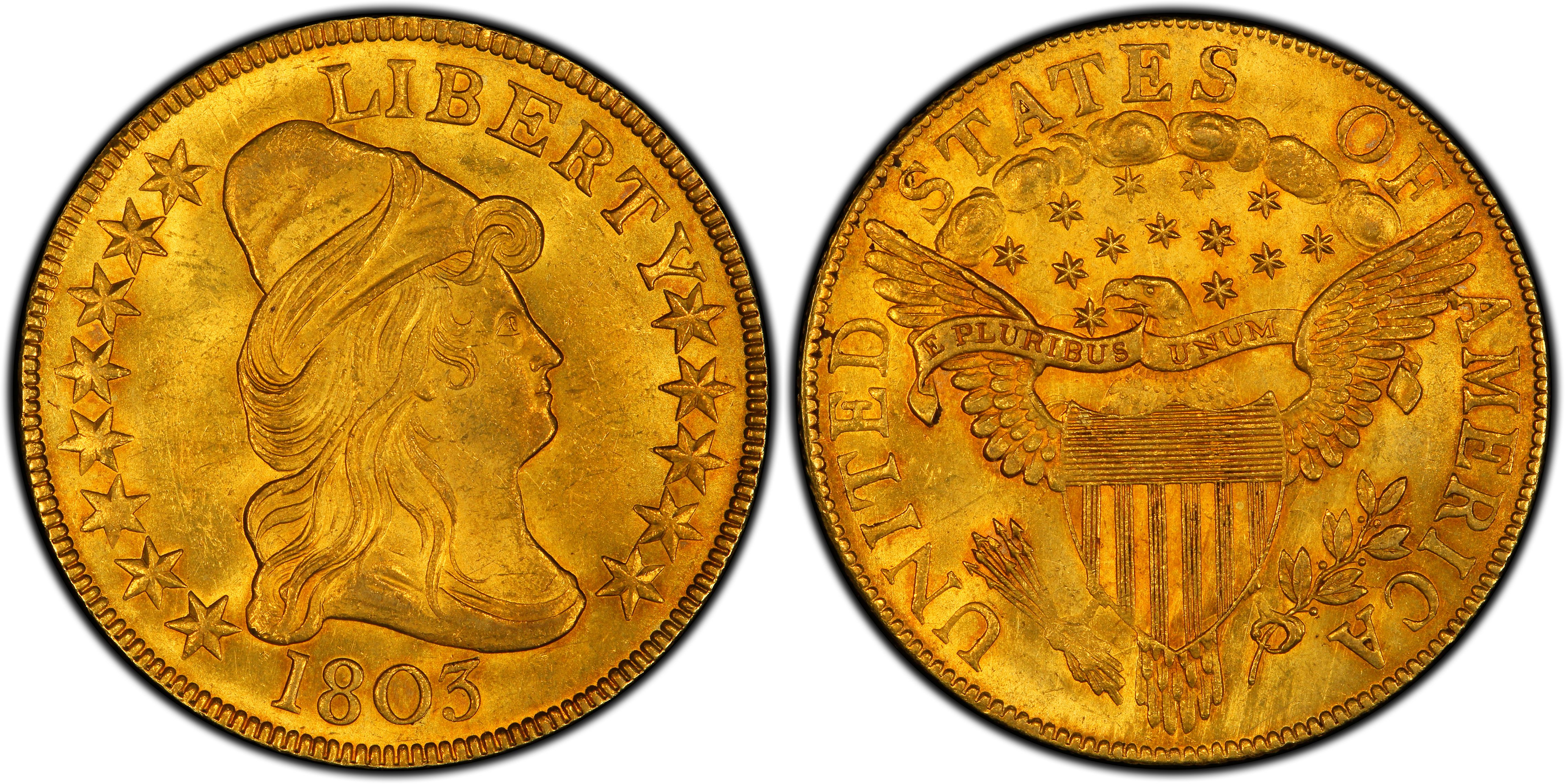
PCGS MS64+

PCGS MS64
- PCGS #:
- 8565
- Designer:
- Robert Scot
- Edge:
- Reeded
- Diameter:
- 33.00 millimeters
- Weight:
- 17.50 grams
- Mintage:
- 15,017
- Mint:
- Philadelphia
- Metal:
- 91.7% Gold, 8.3% Copper
- Auction Record:
- $161,000 • MS65 • 09-19-1999 • Goldberg Auctioneers
Major Varieties
- 1803 $10 Small Reverse Stars
- 1803 $10 Extra Star Reverse
- 1803 $10 Large Reverse Stars
Rarity and Survival Estimates Learn More
| Survival Estimate | |
|---|---|
| All Grades | 250 |
| 60 or Better | 125 |
| 65 or Better | 3 |
| Numismatic Rarity | |
|---|---|
| All Grades | R-6.6 |
| 60 or Better | R-7.7 |
| 65 or Better | R-9.8 |
| Relative Rarity By Type All Specs in this Type | |
|---|---|
| All Grades | 5 / 10 TIE |
| 60 or Better | 8 / 10 |
| 65 or Better | 4 / 10 |
| Relative Rarity By Series All Specs in this Series | |
|---|---|
| All Grades | 8 / 14 TIE |
| 60 or Better | 12 / 14 |
| 65 or Better | 4 / 14 TIE |
Condition Census What Is This?
|
#1 MS65 PCGS grade
Goldbergs 9/1999:1813, not sold - Superior 3/2000:939, $109,250 |
|
#1 MS65 estimated grade
National Numismatic Collection at the Smithsonian Institution |
|
#2 MS64+ PCGS grade
Louis E. Eliasberg, Sr. Collection - Bowers & Ruddy 10/1982:657, $27,500 |
| #2 MS64 PCGS grade |
| #2 MS64 PCGS grade |
| #2 MS64 PCGS grade |
| #2 MS64 PCGS grade |
| #2 MS64 PCGS grade |
| #2 MS64 PCGS grade |
| #2 MS64 PCGS grade |
1803 Eagles ($10) are found with either large or small stars on the reverse. In the years following David Akers' writeup in 1980, sufficient interest has developed in the two varieties that they are now recognized by PCGS and NGC, and the respective population reports give us a good estimate as to their relative rarity. Akers called the Large Stars reverse "decidedly more rare" and he was correct -- the Large Stars (according to the PCGS Population Report) is four times as rare as the Small Stars variety. However, both can be found in Mint State with relative ease, though such high-grade pieces are rather expensive.
The PCGS CoinFacts Condition Census for the Small Stars variety starts at MS64 and ends at MS65. This is an amazingly high level for any early U.S. coin, especially for a large-size gold coin. This indicates that many were saved by collectors, to whom we give thanks for their prescient thinking.
Full struck examples of this variety are non-existent. All come with weak stars, especially on the lower left; the rare example will have strong details on the arrows and the eagle's claw which holds them.
The finest 1803 Small Reverse Stars $10's are a single PCGS MS65 (which has been off the market since 2000) and a similar Gem in the National Numismatic Collection at the Smithsonian Institution.