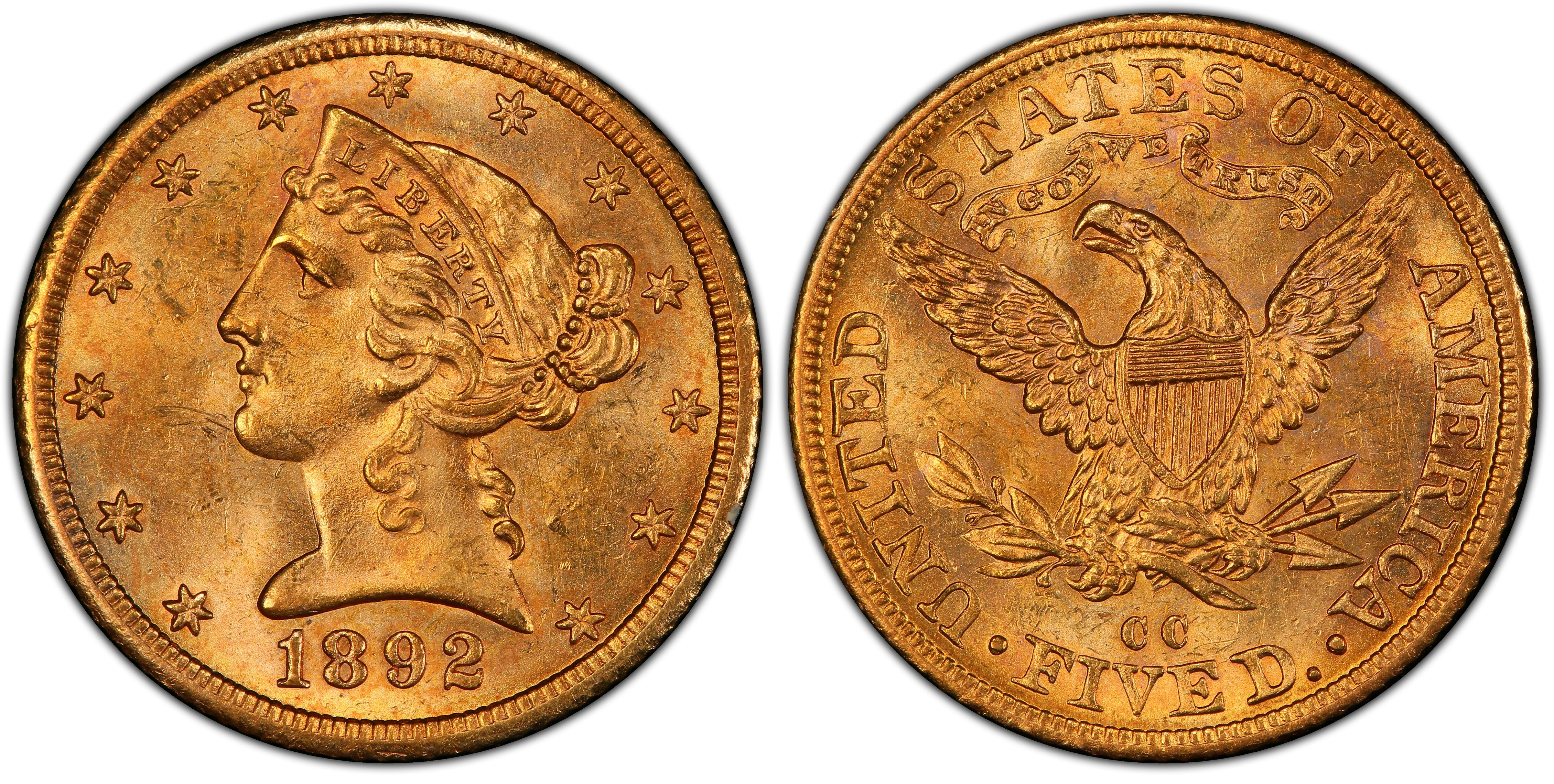
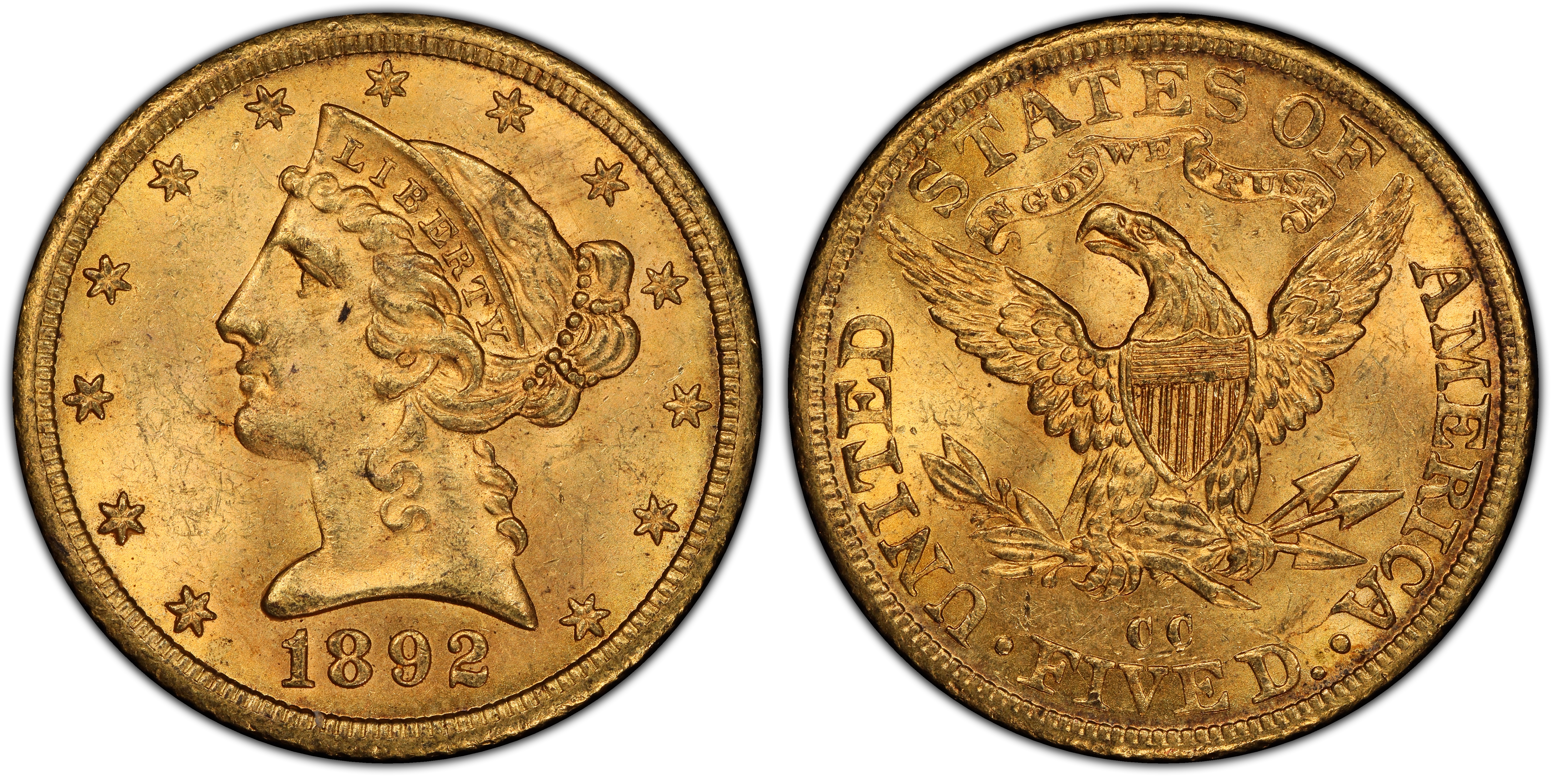
PCGS MS63+

PCGS MS63+
- PCGS #:
- 8380
- Designer:
- Christian Gobrecht
- Edge:
- Reeded
- Diameter:
- 21.65 millimeters
- Weight:
- 8.36 grams
- Mintage:
- 82,968
- Mint:
- Carson City
- Metal:
- 90% Gold, 10% Copper
- Auction Record:
- $33,000 • MS65 • 01-28-1990 • Superior Galleries
Major Varieties
- 1892-CC $5
Go To Grade
Current Auctions - PCGS Graded
Current Auctions - NGC Graded
For Sale Now at Collectors Corner - PCGS Graded
For Sale Now at Collectors Corner - NGC Graded
Rarity and Survival Estimates Learn More
| Survival Estimate | |
|---|---|
| All Grades | 800 |
| 60 or Better | 150 |
| 65 or Better | 1 |
| Numismatic Rarity | |
|---|---|
| All Grades | R-5.4 |
| 60 or Better | R-7.5 |
| 65 or Better | R-10.0 |
| Relative Rarity By Type All Specs in this Type | |
|---|---|
| All Grades | 50 / 106 TIE |
| 60 or Better | 47 / 106 TIE |
| 65 or Better | 1 / 106 TIE |
| Relative Rarity By Series All Specs in this Series | |
|---|---|
| All Grades | 161 / 218 TIE |
| 60 or Better | 147 / 218 TIE |
| 65 or Better | 1 / 218 TIE |
Condition Census What Is This?
| #1 MS65 estimated grade |
| #2 MS64 PCGS grade |
|
#3 MS63 PCGS grade
Old West Collection - American Numismatic Rarities 8/2006:1339, $5,750 |
| #3 MS63 PCGS grade |
| #3 MS63 PCGS grade |
| #3 MS63 PCGS grade |
| #3 MS63 PCGS grade |
| #3 MS63 PCGS grade |
| #3 MS63 PCGS grade |
| #3 MS63 PCGS grade |
Ron Guth:
David Akers' comments on this date are right on. The 1892-CC is one of the most common CC-Mint Half Eagles, and it is far less common than the 1891-CC. Less than twenty percent of the examples certified by PCGS are Mint State, and most of those are either MS62 or MS63. The low grades are usually the result of excessive bagmarks, caused by careless conveyance as they travelled cross-country. The very best example is an NGC MS66, believed to be the former PCGS MS65 from the 1/1990 Superior sale, where it set a record price that has not yet been beaten.
David Akers (1975/88):
The 1892-CC is one of the most common Carson City Half Eagles and is approximately equal in overall rarity to the 1882-CC, 1890-CC and 1893-CC. It is decidedly more rare than the relatively common 1891-CC. Although uncirculated examples are occasionally available, VF or EF specimens are the most often encountered. Choice or gem quality pieces are rare and are seen less often than comparable quality coins dated 1890-CC or 1893-CC.