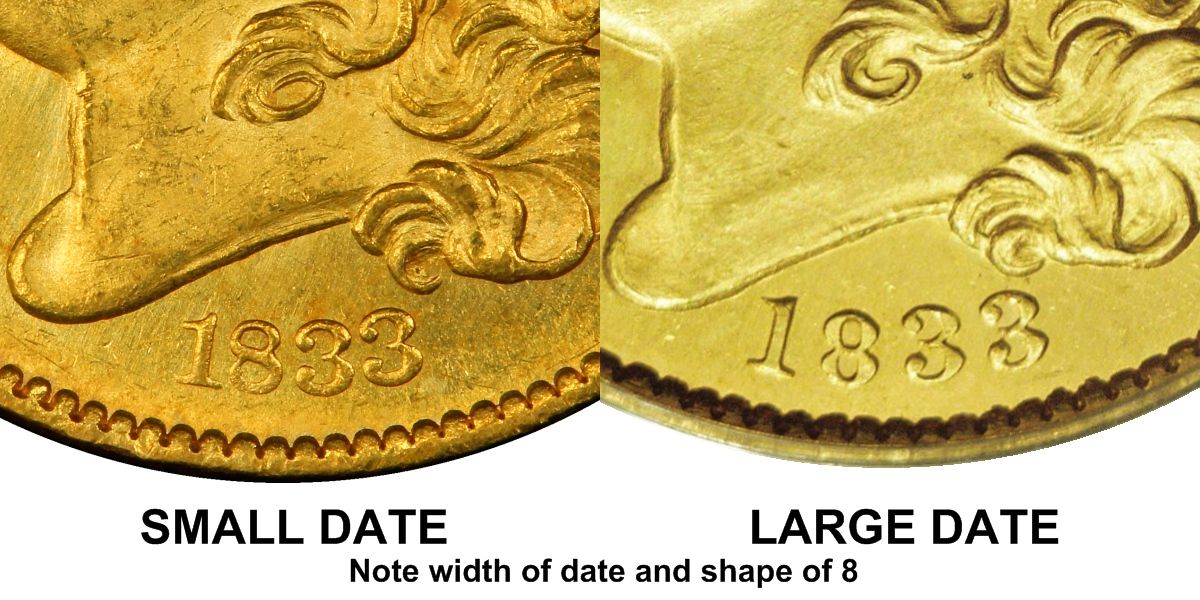
DATE COMPARISON

PCGS MS61
- PCGS #:
- 8157
- Designer:
- Robert Scot & John Reich
- Edge:
- Reeded
- Diameter:
- 23.80 millimeters
- Weight:
- 8.75 grams
- Mintage:
- 193,630
- Mint:
- Philadelphia
- Metal:
- 91.7% Gold, 8.3% Copper
- Auction Record:
- $115,000 • MS64 • 04-26-2006 • Heritage Auctions
Go To Grade
Current Auctions - PCGS Graded
Current Auctions - NGC Graded
For Sale Now at Collectors Corner - PCGS Graded
For Sale Now at Collectors Corner - NGC Graded
Rarity and Survival Estimates Learn More
| Survival Estimate | |
|---|---|
| All Grades | 37 |
| 60 or Better | 17 |
| 65 or Better | 2 |
| Numismatic Rarity | |
|---|---|
| All Grades | R-8.7 |
| 60 or Better | R-9.2 |
| 65 or Better | R-9.9 |
| Relative Rarity By Type All Specs in this Type | |
|---|---|
| All Grades | 6 / 9 TIE |
| 60 or Better | 8 / 9 TIE |
| 65 or Better | 1 / 9 TIE |
| Relative Rarity By Series All Specs in this Series | |
|---|---|
| All Grades | 23 / 42 TIE |
| 60 or Better | 24 / 42 TIE |
| 65 or Better | 3 / 42 TIE |
Condition Census What Is This?
 #1 MS64+ PCGS grade
David Akers, sold privately in 9/1990 - D. Brent Pogue Collection |
| #2 MS64 PCGS grade |
|
#2 MS64 PCGS grade
Heritage 4/2006:2635, $115,000 |
| #4 MS63 PCGS grade |
| #6 MS62 PCGS grade |
| #6 MS62 PCGS grade |
| #6 MS62 PCGS grade |
| #8 MS61 PCGS grade |
| #8 MS61 PCGS grade |
| #8 MS61 PCGS grade |
David Akers (1975/88):
Although the 1833 is a very rare coin, particularly in gem condition, it is possibly the commonest coin of this type unless one combines the varieties of 1830 or 1834. There are two different sized dates for 1833 but the differences are rather slight and past cataloguers have generally made no distinction between the date sizes over the years. Almost all known examples are AU or Unc as the auction data clearly shows.