1820 $5 Curl Base 2, Small Letters (Regular Strike)
Series: Capped Bust $5 1807-1834
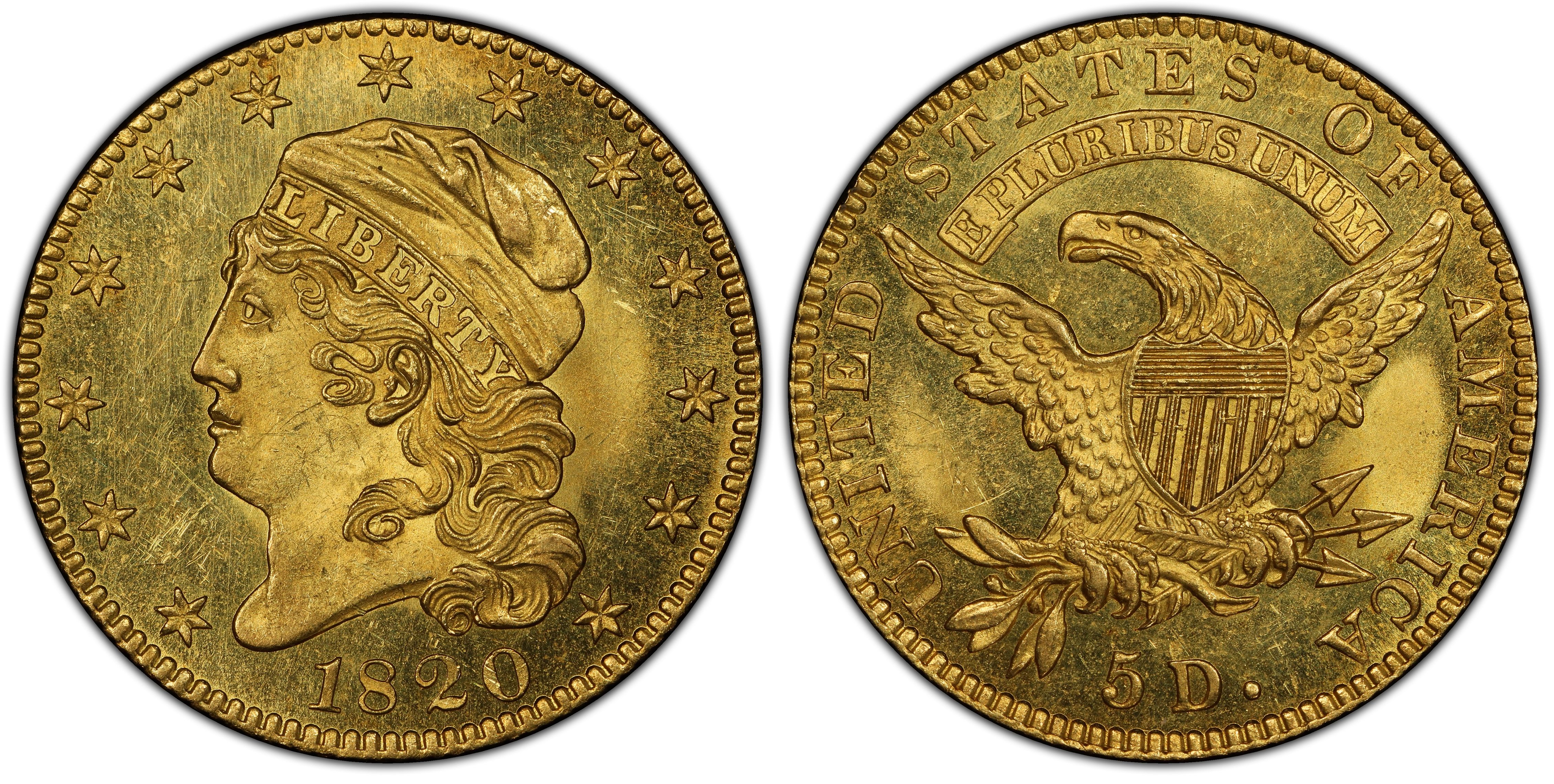
PCGS MS64+

DATE COMPARISON

REVERSE COMPARISON
- PCGS #:
- 8126
- Designer:
- Robert Scot & John Reich
- Edge:
- Reeded
- Diameter:
- 25.00 millimeters
- Weight:
- 8.75 grams
- Mintage:
- 263,806
- Mint:
- Philadelphia
- Metal:
- 91.7% Gold, 8.3% Copper
- Auction Record:
- $300,000 • MS64 • 11-21-2023 • Stack's Bowers
Major Varieties
- 1820 $5 Square-Base 2
- 1820 $5 Curl Base 2, Small Letters
- 1820 $5 Curl Base 2, Large Letters
Rarity and Survival Estimates Learn More
| Survival Estimate | |
|---|---|
| All Grades | 14 |
| 60 or Better | 6 |
| 65 or Better | 2 |
| Numismatic Rarity | |
|---|---|
| All Grades | R-9.4 |
| 60 or Better | R-9.7 |
| 65 or Better | R-9.9 |
| Relative Rarity By Type All Specs in this Type | |
|---|---|
| All Grades | 6 / 22 TIE |
| 60 or Better | 4 / 22 TIE |
| 65 or Better | 3 / 22 TIE |
| Relative Rarity By Series All Specs in this Series | |
|---|---|
| All Grades | 9 / 42 TIE |
| 60 or Better | 7 / 42 TIE |
| 65 or Better | 3 / 42 TIE |
Condition Census What Is This?
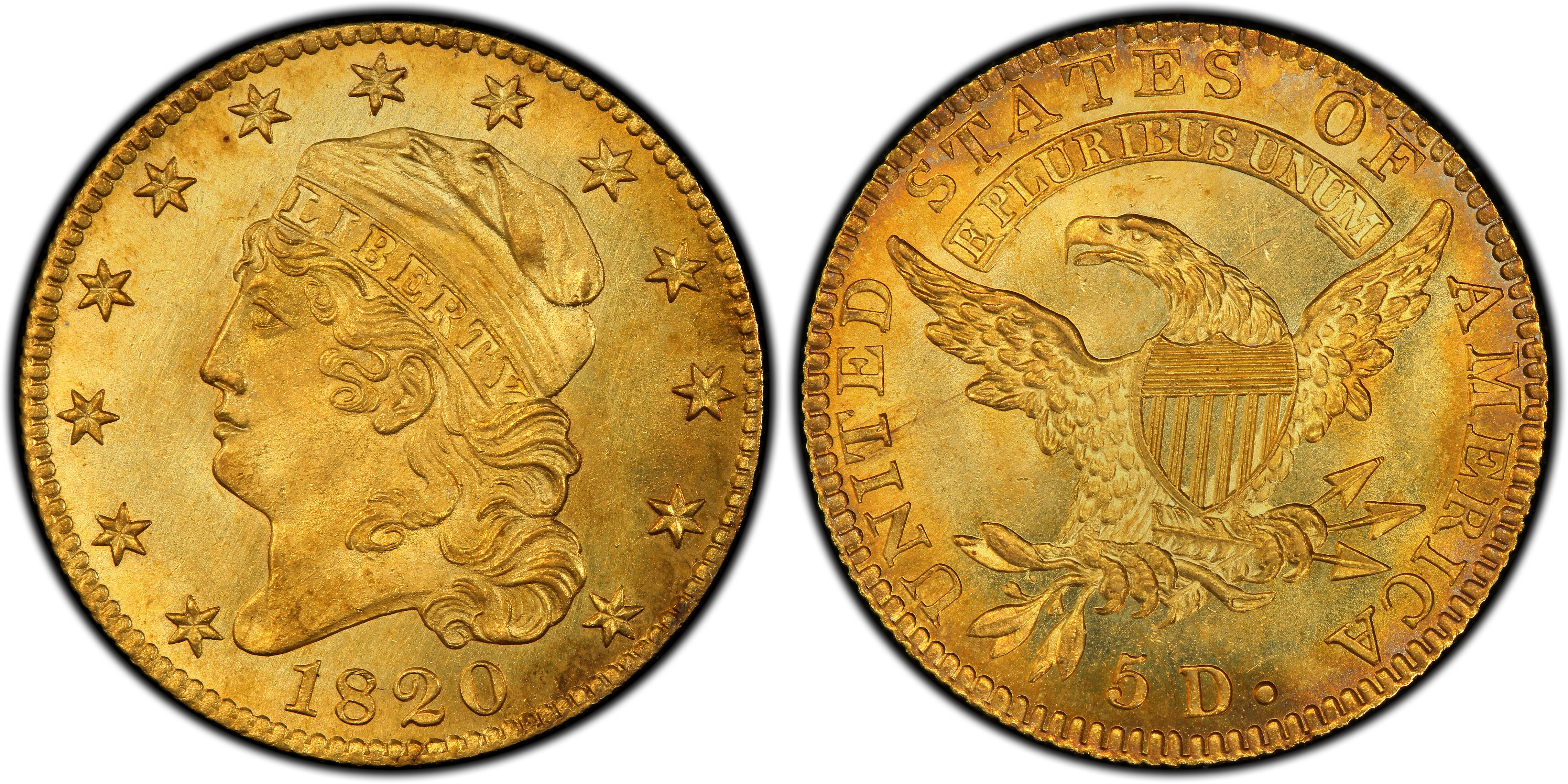 #1 MS66 PCGS grade
|
 #2 MS64 PCGS grade
B. Max Mehl - C.F. Childs - Walter H. Childs Collection - Bowers & Merena 8/1999:706, $42,550 - Harvey B. Jacobson, Jr., Collection - Heritage 1/2012:4672, $172,500 |
| #3 MS63 PCGS grade |
| #4 AU58 estimated grade |
In the February 2016 Sotheby’s/Stack’s-Bowers auction of the D. Brent Pogue auction part III, three 1820 Curl Base 2 Half eagles were offered, two were Large Letter Reverse examples and one was a Small Letter Reverse. Both Large Letter coins were graded MS-65+ by PCGS while the Small Letter coin was graded MS-66+ and the Small Letter coin realized $282,000 while each of the Large Letter 1820 coins brought $188,000 also the 1820 Square Base 2 Half Eagle graded MS-65+ by PCGS in the same sale realized $129,250.
1820 Half Eagles are made up of the following Bass-Dannreuther varieties:
1820 Square Base 2, Large Letters: BD-1, BD-2, BD-3, BD-4 1820 Curved Base 2, Large Letters: BD-5, BD-7, BD-9 1820 Curved Base 2, Small Letters: BD-6, BD-8
As a date, the 1820 is one of the more "common" dates of this type. However, it is much more rare than the 1813, and slightly more rare than the 1814/3 and 1818. The Curved Base 2 and Square Base 2 varieties of 1820 are of comparable rarity but when the Curved Base 2 variety is broken down to Small Letters and Large Letters varieties, each becomes more rare than the Square Base 2 variety which only comes with Large Letters on the reverse. The Large Letters and Small Letters varieties of the 1820 Curved Base 2 are of approximate equal rarity and actually none of the three varieties of 1820 is likely to realize a premium over the other two in similar condition. Most known specimens of the 1820 Curved Base 2, Small Letters are quite high grade, AU or Unc. being the grades typically available. The Small Letters variety is easily distinguishable from the Large Letters variety by examining the word STATES. On both the Small Letters variety all the letters are of equal height while on the Large Letters variety, both ot the T's appear larger than the other letters.