
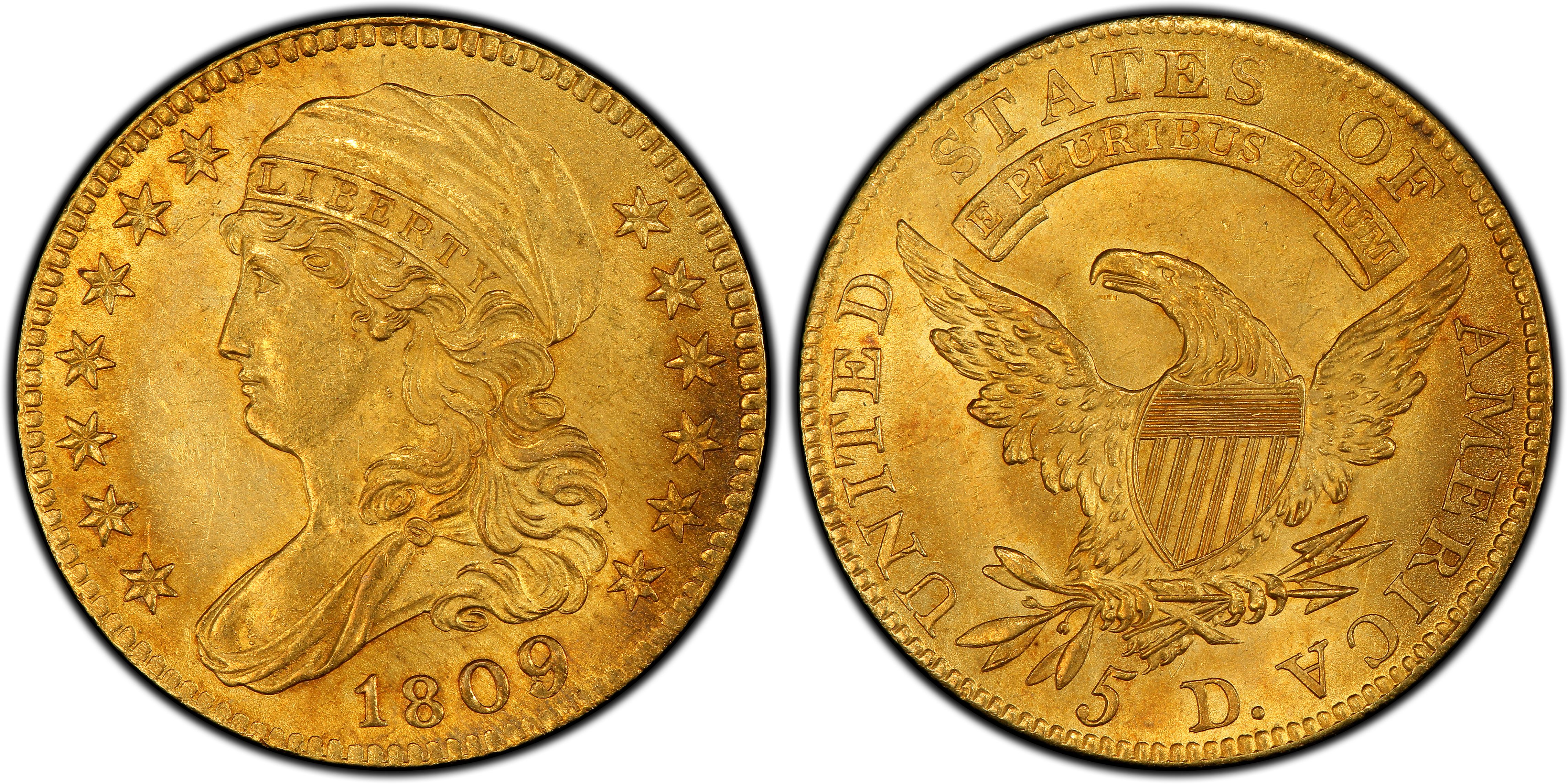
Overdate Detail

PCGS MS65
- PCGS #:
- 8104
- Designer:
- John Reich
- Edge:
- Reeded
- Diameter:
- 25.00 millimeters
- Weight:
- 8.75 grams
- Mintage:
- 33,875
- Mint:
- Philadelphia
- Metal:
- 91.7% Gold, 8.3% Copper
- Auction Record:
- $126,500 • MS65 • 01-05-2011 • Heritage Auctions
Major Varieties
- 1809/8 $5
Rarity and Survival Estimates Learn More
| Survival Estimate | |
|---|---|
| All Grades | 350 |
| 60 or Better | 150 |
| 65 or Better | 6 |
| Numismatic Rarity | |
|---|---|
| All Grades | R-6.3 |
| 60 or Better | R-7.5 |
| 65 or Better | R-9.7 |
| Relative Rarity By Type All Specs in this Type | |
|---|---|
| All Grades | 7 / 11 |
| 60 or Better | 8 / 11 |
| 65 or Better | 5 / 11 |
| Relative Rarity By Series All Specs in this Series | |
|---|---|
| All Grades | 37 / 42 |
| 60 or Better | 37 / 42 |
| 65 or Better | 28 / 42 TIE |
Condition Census What Is This?
 #1 MS66 PCGS grade
F.C.C. Boyd Collection - Numismatic Gallery 1/1946:356 - Paramount (David Akers), sold privately in 8/1985 - D. Brent Pogue Collection - Stack's/Bowers & Sotheby's 2/2016:3136, $152,750 |
 #2 MS65 PCGS grade
Stack's 6/2008:2074, $106,375 - Heritage 2/2009:2676, $92,000 |
 #2 MS65 PCGS grade
Goldbergs 9/2009:3360, $83,375 - Heritage 1/2011:5089, $126,500 |
 #2 MS65 PCGS grade
American Numismatic Rarities 9/2005:1240, $77,625 |
 #2 MS65 PCGS grade
D.L. Hansen Collection |
| #2 MS65 PCGS grade |
 #7 MS64+ PCGS grade
|
| #7 MS64+ PCGS grade |
| #7 MS64+ PCGS grade |
 #10 MS64 PCGS grade
|
This is one of the most common dates of this type and is reasonably available in all conditions including choice uncirculated. As is the case with most dates of this type, the typical specimen is well struck. Although some cataloguers have listed certain examples as simply "1809", all known specimens are actually overdates.
Specialist know of only one die variety for 1809: BD-1 (Breen 1-A). The overdate status of this variety is unclear. Both Bass and Dannreuther questioned the undertype, with Dannreuther noting "There is something under the 9, but whether it is an 8 or remnants of an erroneously punched 9 is uncertain."
Numerous MS64 and better examples are known of this variety and date. The finest example is a single PCGS MS66 from the D. Brent Pogue Collection.
Sources and/or recommended reading: John W. Dannreuther and Harry W. Bass, Jr., "Early U.S. Gold Coin Varieties"