
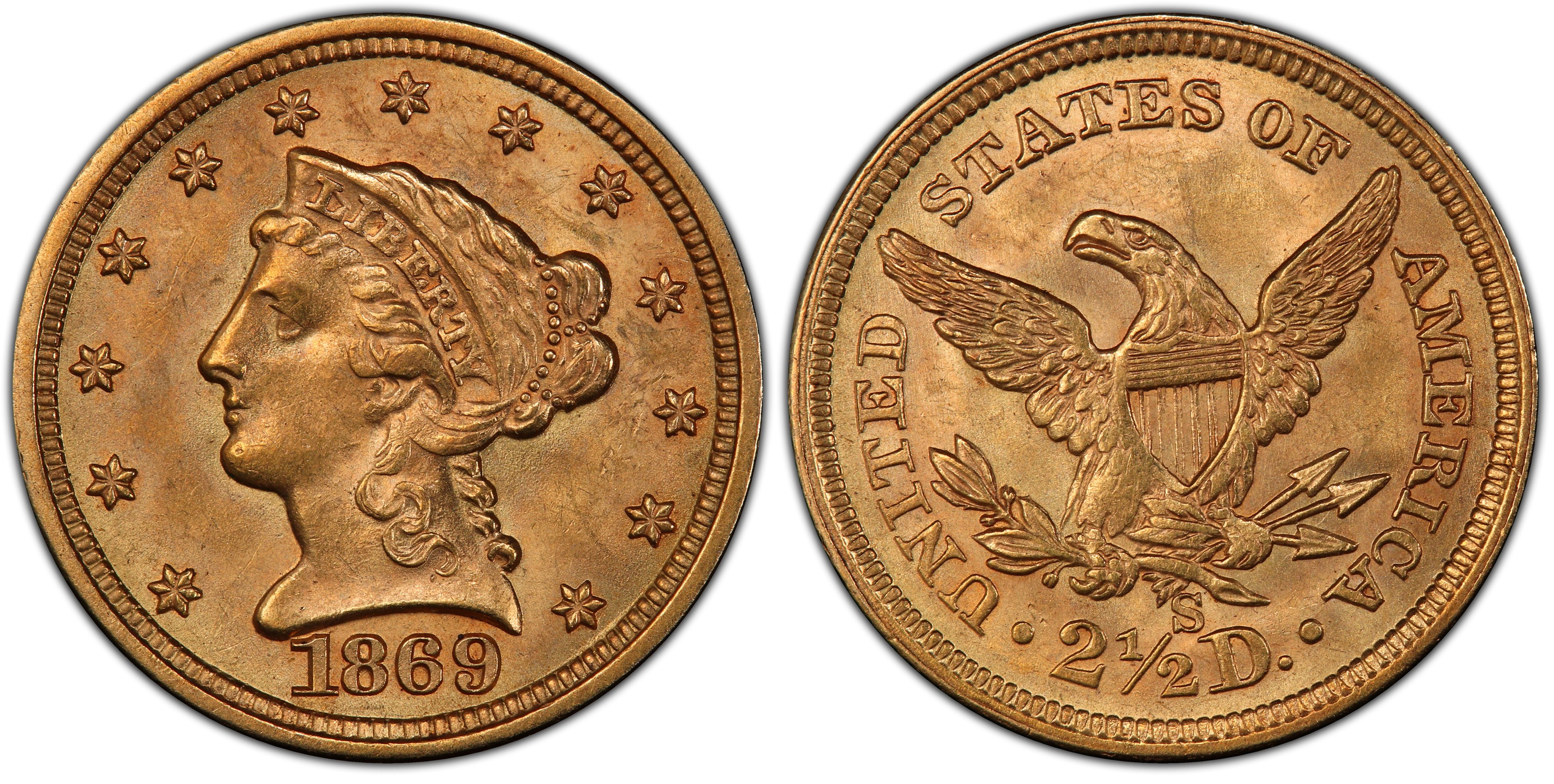
PCGS MS63
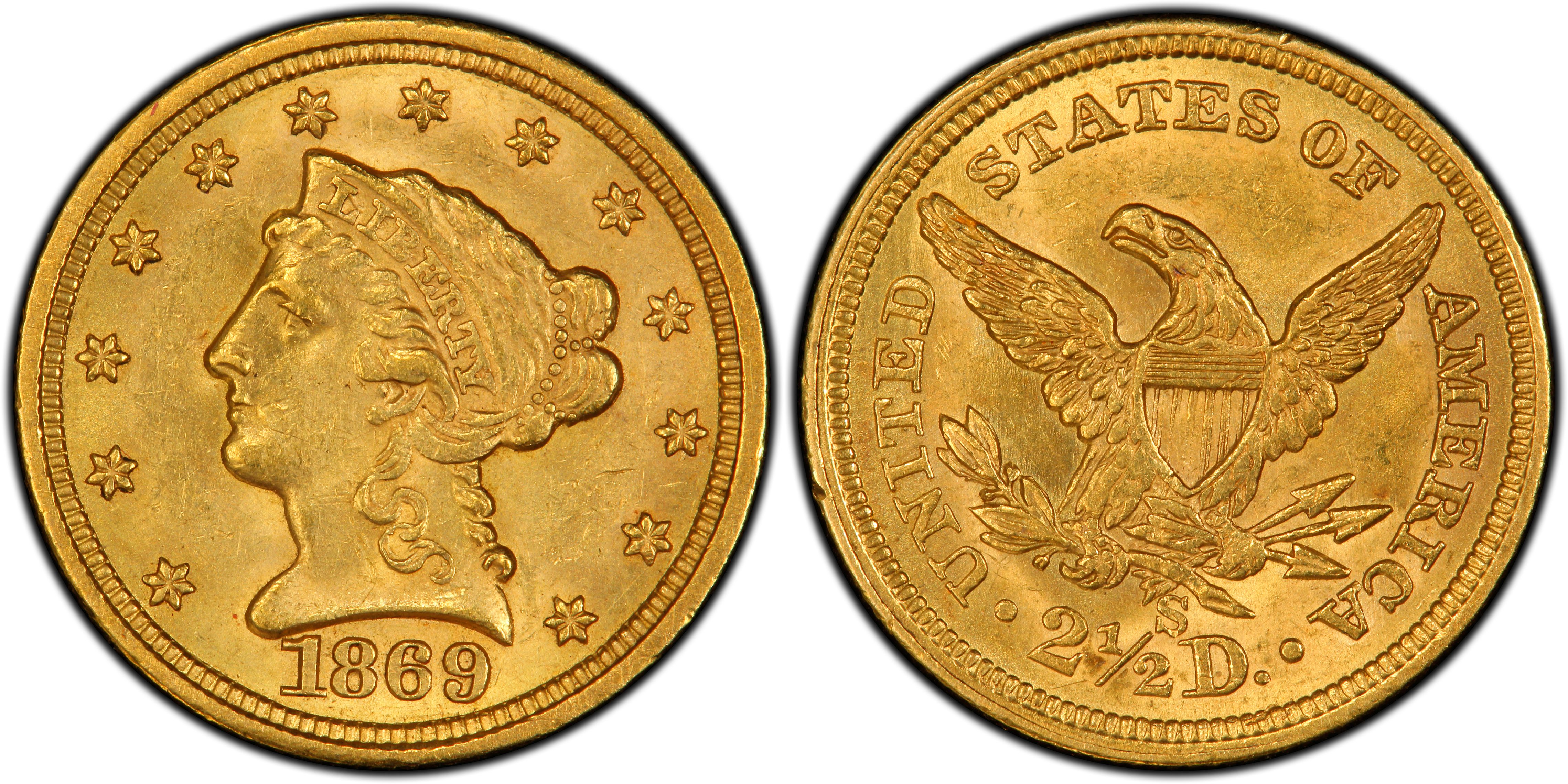
PCGS MS62+
- PCGS #:
- 7810
- Designer:
- Christian Gobrecht
- Edge:
- Reeded
- Diameter:
- 18.00 millimeters
- Weight:
- 4.18 grams
- Mintage:
- 29,500
- Mint:
- San Francisco
- Metal:
- 90% Gold, 10% Copper
- Auction Record:
- $66,000 • MS66 • 12-20-2020 • David Lawrence RC
Major Varieties
- 1869-S $2.50
Go To Grade
Current Auctions - PCGS Graded
Current Auctions - NGC Graded
For Sale Now at Collectors Corner - PCGS Graded
For Sale Now at Collectors Corner - NGC Graded
Rarity and Survival Estimates Learn More
| Survival Estimate | |
|---|---|
| All Grades | 225 |
| 60 or Better | 10 |
| 65 or Better | 2 |
| Numismatic Rarity | |
|---|---|
| All Grades | R-6.7 |
| 60 or Better | R-9.5 |
| 65 or Better | R-9.9 |
| Relative Rarity By Type All Specs in this Type | |
|---|---|
| All Grades | 82 / 147 TIE |
| 60 or Better | 57 / 147 TIE |
| 65 or Better | 17 / 147 TIE |
| Relative Rarity By Series All Specs in this Series | |
|---|---|
| All Grades | 82 / 147 TIE |
| 60 or Better | 57 / 147 TIE |
| 65 or Better | 17 / 147 TIE |
Condition Census What Is This?
| #1 MS66 PCGS grade |
| #2 MS64 PCGS grade |
| #2 MS64 PCGS grade |
| #2 MS64 PCGS grade |
| #2 MS64 PCGS grade |
| #6 MS64 estimated grade |
| #7 MS63 PCGS grade |
|
#8 MS62+ PCGS grade
|
| #8 MS62 PCGS grade |
| #10 MS62 estimated grade |
Ron Guth:
Most (perhaps all) examples of this date utilize an Old Reverse ("Hub of 1840-1858"). Please report any New Reverse examples.
David Akers (1975/88):
Scarce as a date and very rare above EF. In fact, out of 62 auction appearances in our 226 catalogue auction survey, only 10 pieces were graded AU or Unc. by the cataloguers. Most specimens I have seen were very bluntly struck and have relatively little detail on the hair around liberty's face or on the eagle's right leg and neck. It is probably a hundred times as rare as any late date quarter eagle in unc. and so the 1869-S, like so many other quarter eagles, is grossly undervalued, particularly in choice condition. If you were to go out and attempt to buy a half dozen choice 1869-S quarter eagles, even if price were no object, I feel certain that you would come up far short of your goal.