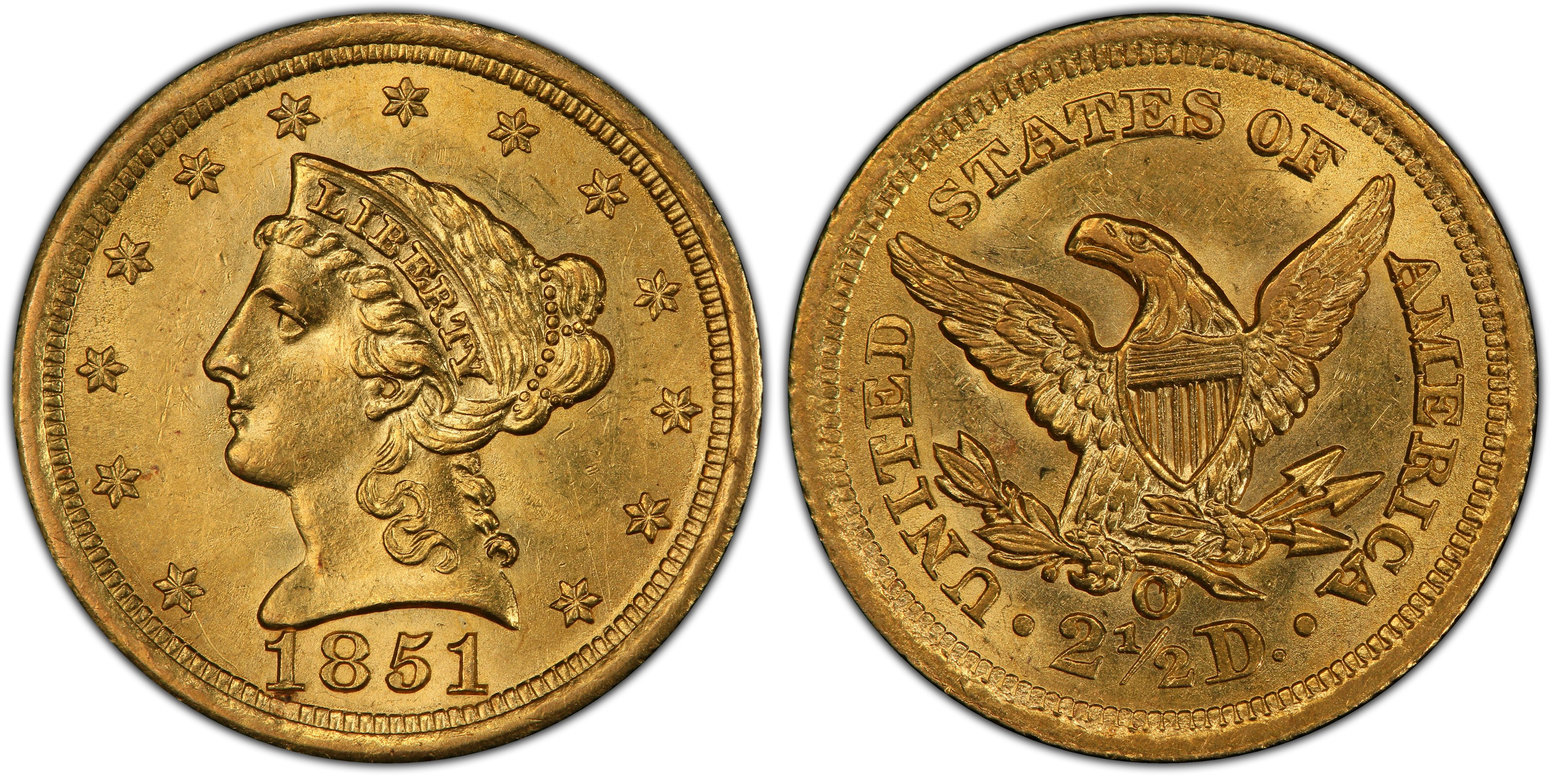
PCGS MS63
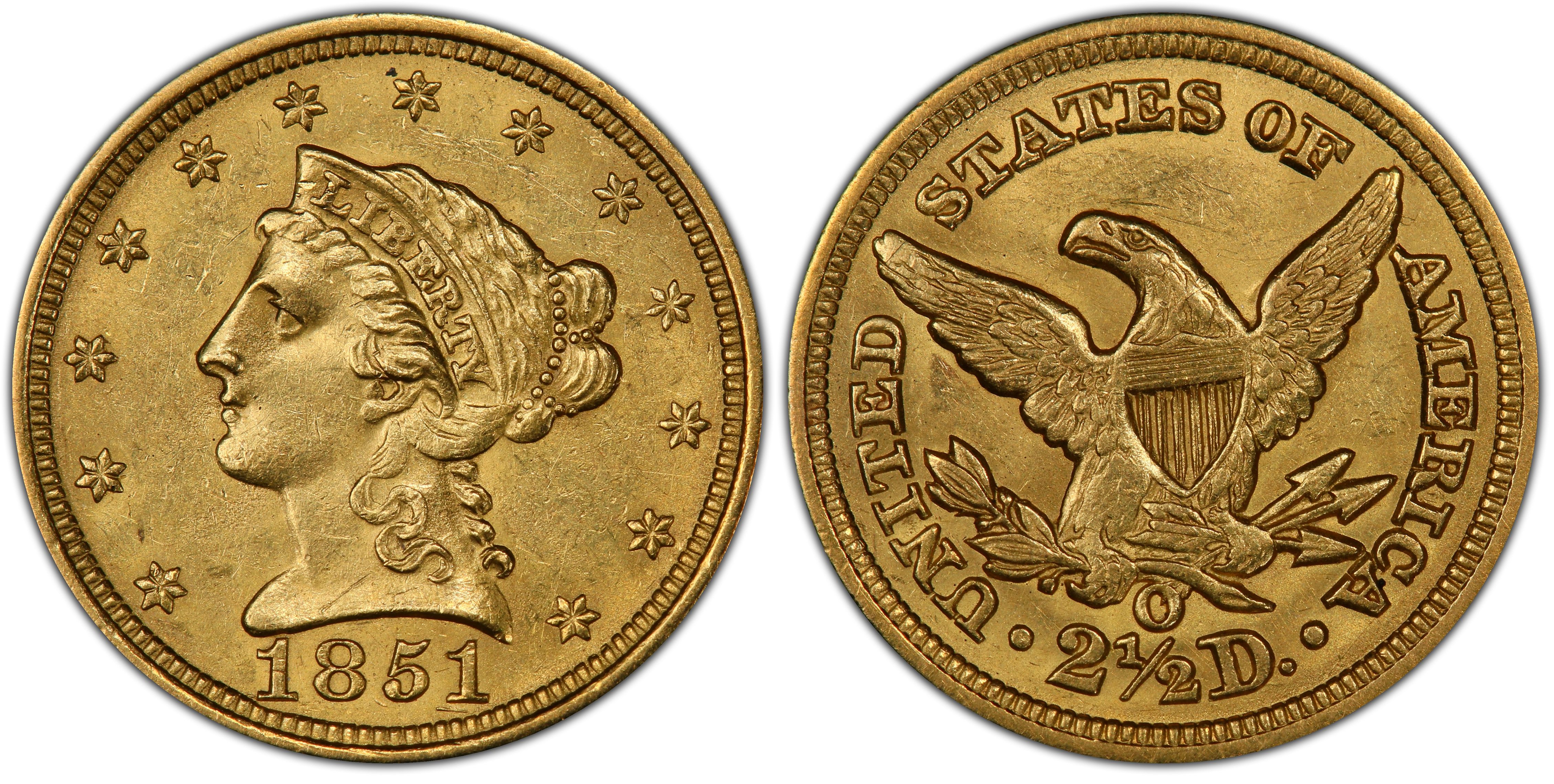
PCGS MS62
- PCGS #:
- 7762
- Designer:
- Christian Gobrecht
- Edge:
- Reeded
- Diameter:
- 18.00 millimeters
- Weight:
- 4.18 grams
- Mintage:
- 148,000
- Mint:
- New Orleans
- Metal:
- 90% Gold, 10% Copper
- Auction Record:
- $20,700 • MS64 • 05-01-2007 • Heritage Auctions
Major Varieties
- 1851-O $2.50
Rarity and Survival Estimates Learn More
| Survival Estimate | |
|---|---|
| All Grades | 250 |
| 60 or Better | 12 |
| 65 or Better | 1 |
| Numismatic Rarity | |
|---|---|
| All Grades | R-6.6 |
| 60 or Better | R-9.5 |
| 65 or Better | R-10.0 |
| Relative Rarity By Type All Specs in this Type | |
|---|---|
| All Grades | 91 / 147 TIE |
| 60 or Better | 57 / 147 TIE |
| 65 or Better | 1 / 147 TIE |
| Relative Rarity By Series All Specs in this Series | |
|---|---|
| All Grades | 91 / 147 TIE |
| 60 or Better | 57 / 147 TIE |
| 65 or Better | 1 / 147 TIE |
Condition Census What Is This?
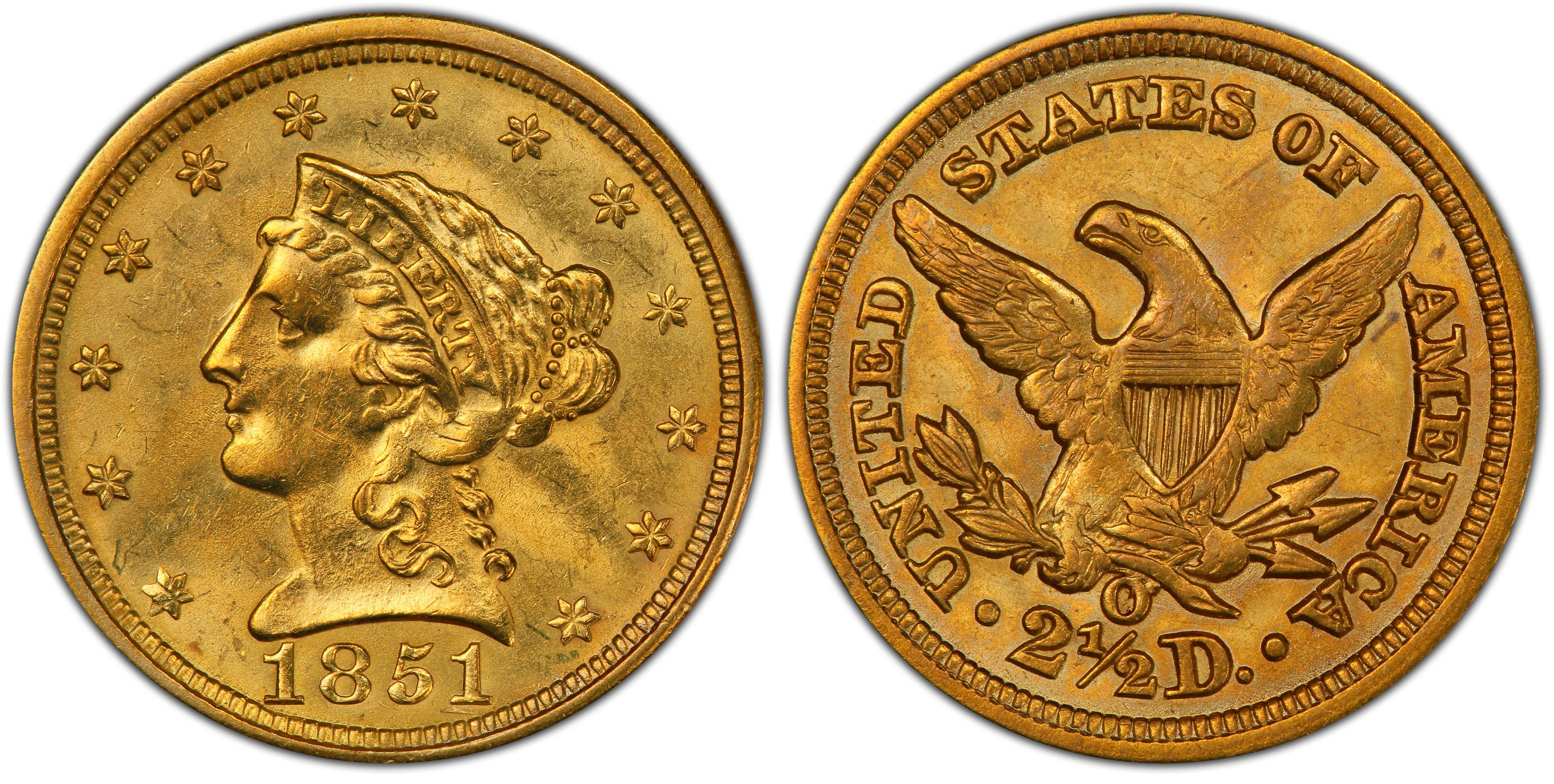 #1 PCGS MS64
Heritage May 2007, Lot 2230 - $20,700. Variety 1. Doubled date. Diagonal mark to the left of the first 1. Diagonal hash marks across cheek. Diagonal mark between stars 1 and 2. bottom radials of star 1 flattened. Bottom of Liberty’s hair and bun is flat. On the reverse, eagle detail soft throughout. |
|
#2 PCGS MS63
"The 400 Esplanade Collection" (PCGS Set Registry). |
|
#2 PCGS MS63
Paramount, November 1971, Lot 1013. I. Kleinmann to Harry W. Bass, October 7, 1972. As PCGS MS61. "The Harry W. Bass, Jr. Collection," Bowers & Merena, October 1999, Lot 449 - $7,475. As PCGS MS63 #5652481. "The Baltimore Collection, Part Two," Heritage, October 14, 2011, Lot 4679 - $10,350. Doubled date. Diagonal hash mark to the upper right of star 1. Diagonal cut in the hair pointing to the B of LIBERTY. Diagonal mark to the bottom left of star 9. Eagle’s right leg flat. Highest details of neck feather flat. Scattered orange-gold discoloration throughout. |
|
#2 PCGS MS63
“The Ronald W. Brown Acadiana Collection,” Superior, May 30 to June 1, 1993, Lot 1388 – $12,650; Heritage Auctions, August 13, 1999, Lot 7856 – $16,675. A "Kansas Collection." |
| #2 PCGS MS63 |
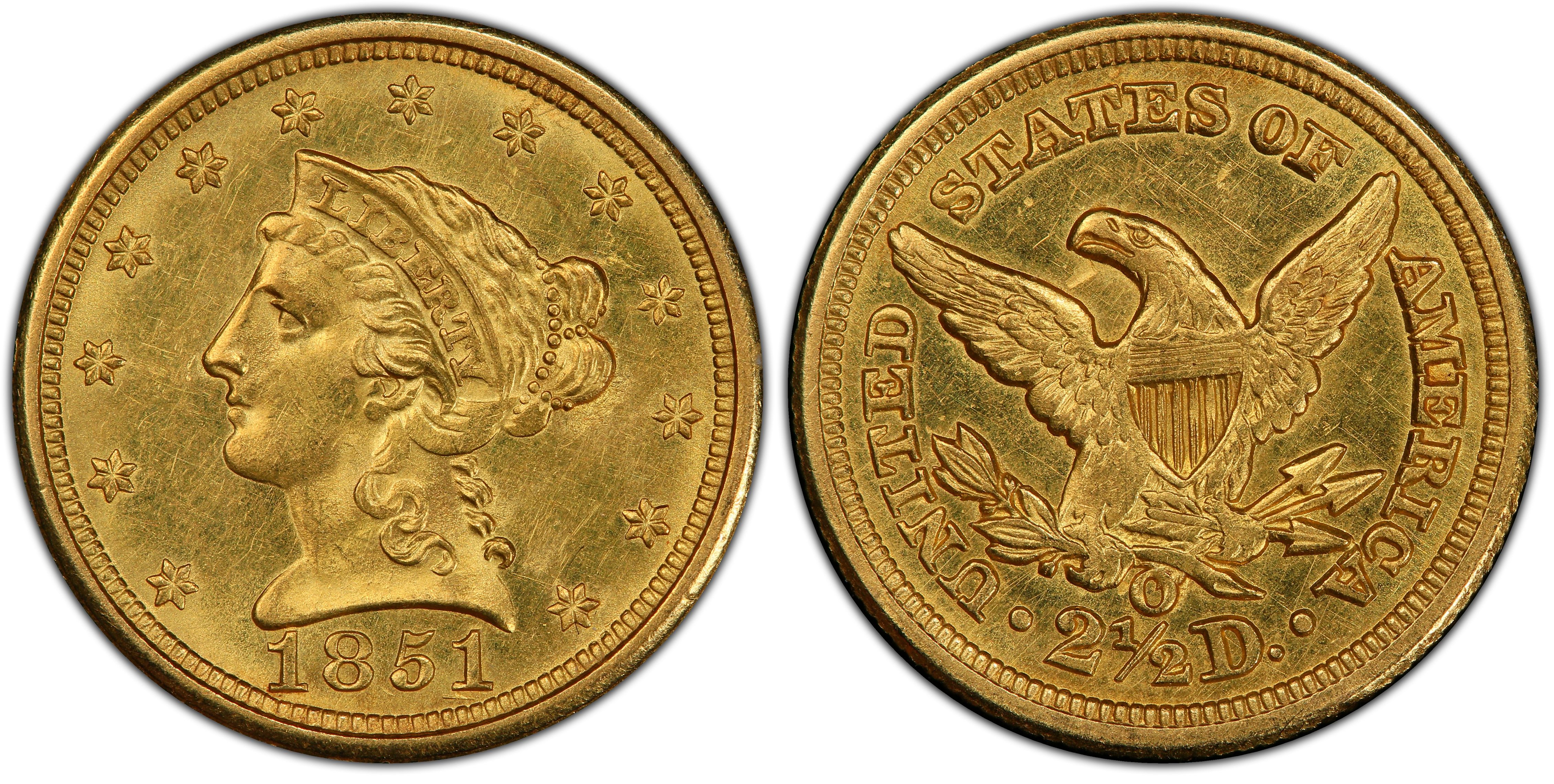 #6 PCGS MS62
Heritage Auctions, January 8, 2010, Lot 3838 – $4,600. As PCGS MS62 #81690088. “The Wasatch Collection of Liberty Quarter Eagles,” Heritage Auctions, November 1, 2016, Lot 5457 – $4,935. Variety 1. Doubled date. Planchet flaw to the left of nose and large apparent disturbance behind bun. Lower hair features softly impressed. |
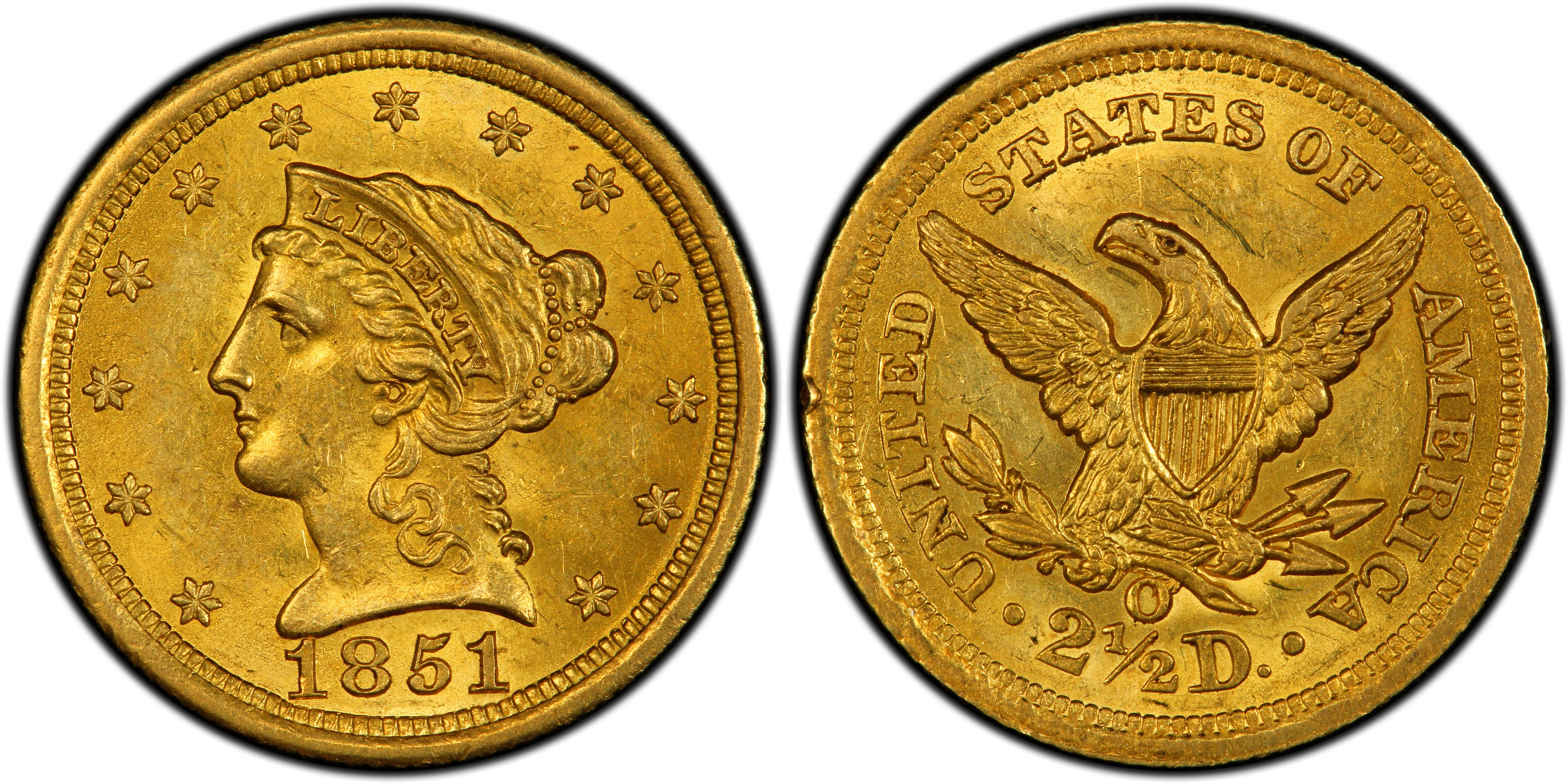 #6 PCGS MS62
Heritage Auctions, April 29, 2011, Lot 6326 – $5,475. |
|
#6 PCGS MS62
|
| #6 PCGS MS62 |
| #6 PCGS MS62 |
The 1851-O is among the more common New Orleans quarter eagles, although it is scarcer than its relatively high mintage suggests. It is most easily found in VF and EF grades. It becomes scarce in the higher AU grades and is rare in Uncirculated. There are perhaps four or five Choice to Very Choice pieces known and a single Gem.
STRIKE: The quality of strike varies greatly. The obverse is always sharper than the reverse. Some pieces show good detail on the obverse with most of the curls around the face fully detailed. Others are not as sharp on this side and may have weakness at the center that is especially prominent on the curls below the ear and the bun. The stars are usually full and sharp with strong radial lines. The reverse is almost always weak on the eagle’s right leg and the neck feathers. On some coins, the wing tips are very blunt. To accurately grade an 1851-O quarter eagle it is important to pay more attention to the obverse than the reverse because of this peculiarity of strike.
SURFACES: Most 1851-O quarter eagles have numerous marks in the fields. I have seen a number that had scratches. Others show mint-made discoloration, usually around the obverse periphery.
LUSTER: The luster is frosty with a somewhat grainy texture. It is often somewhat subdued in its appearance although some pieces are known that do show vibrant luster.
COLORATION: Coloration on this date ranges from rich orange-gold to deep green-gold hues. There are some higher grade examples known that display very attractive color. Many have been cleaned or dipped and no longer display their original shadings.
EYE APPEAL: The level of eye appeal seen on the 1851-O quarter eagles varies greatly. The typical coin is irregularly struck, shows a number of marks on the surfaces and has been dipped. There are a small number of comparatively high grade examples that are very attractive with good luster and surfaces. Collectors should be able to find an acceptable piece with patience.
DIE CHARACTERISTICS: The most notable die characteristics for this date are the repunched numerals that are described below.
In 1851, the United States Mint operated four branches, but only two—the New Orleans Mint and the main mint at Philadelphia—were connected to major city centers. Charlotte was a county seat with a population of only about 1,000 people, while the U.S. Census of 1850 reported Dahlonega’s population to be just 735. By sharp comparison, both New Orleans and Philadelphia had populations exceeding 100,000. Furthermore, the Philadelphia Mint serviced the three most populated cities in America (New York, Baltimore, and Boston), along with the entire Northeast. The New Orleans Mint served the Mississippi River Valley and handled deposits from California, Mexico, Latin America, and America’s European trading partners. Also, by the 1850s, gold production from the former Cherokee lands on the Carolinas and North Georgia was in decline.
In 1851, the New Orleans Mint struck coins in ten denominations, ranging from the newly introduced Three-Cent Silver piece up to the Double Eagle ($20). The only coins currently in production that New Orleans did not strike that year were the cent, half cent, and silver dollar. Of these three, New Orleans would only occasionally strike the Liberty Seated Silver Dollar in later years (it had done so in 1850) before regularly producing Morgan Dollars to allow the Mint to fulfill its Congressional mandate; moreover, copper coins were never struck by any branch mint until 1908, just a year before the New Orleans branch's closure.
New Orleans Mint Coin Production in 1851
- 1851-O Three-Cent Silver | 720,000
- 1851-O Liberty Seated Half Dime | 860,000
- 1851-O Liberty Seated Dime | 400,000
- 1851-O Liberty Seated Quarter | 88,000
- 1851-O Liberty Seated Half Dollar | 402,000
- 1851-O Gold Dollar | 290,000
- 1851-O Liberty Head Quarter Eagle | 148,000
- 1851-O Liberty Head Half Eagle | 41,000
- 1851-O Liberty Head Eagle | 263,000
- 1851-O Liberty Head Double Eagle | 315,000
The 1851-O Liberty Head Quarter Eagle is an excellent and affordable choice for collectors seeking a New Orleans coin for a Quarter Eagle branch mint set. Boasting the second-highest mintage in the series, it survives in sufficient numbers to be readily accessible. Most surviving Mint State examples are typically found in the MS61 or MS62 grades, offering an economical entry point into the challenging field of branch mint gold coinage.
Two 1851-O Liberty Head Quarter Eagle Varieties are Known
Despite the large mintage of 184,000 coins, Doug Winter has identified only two varieties of the 1851-O Liberty Head Quarter Eagle, one of which is found in several die states. Given the high production figure, it is possible that at least one other reverse die was employed.
Variety One: Doubled Date
Early die states of this variety show significant doubling on all four digits of the date. This occurred because the date was initially punched too low and leaned too far to the left. As the die state progresses, the doubling fades until it is only visible beneath the final "1". Examples exhibiting strong repunching on all four digits are scarce and typically command a premium over those where the doubling is restricted to the "51" or just the final digit. The mintmark is high but does not touch the olive branch or the talons, and a small point of a feather enters the mintmark. Early die states also show clash marks on the reverse; these marks appear to have been later removed by lapping the die.
Variety Two: Regular Date
The date is somewhat lower than on Variety One and lacks doubling. The first "1" touches the base of the neck, while the base of this digit is free of the denticles. There is some bulging of the die at the final two stars. The mintmark appears very similar to that of Variety One but, according to numismatist Henry Bass, it was minutely different. This variety appears to be rare.
* * *