
PCGS MS62
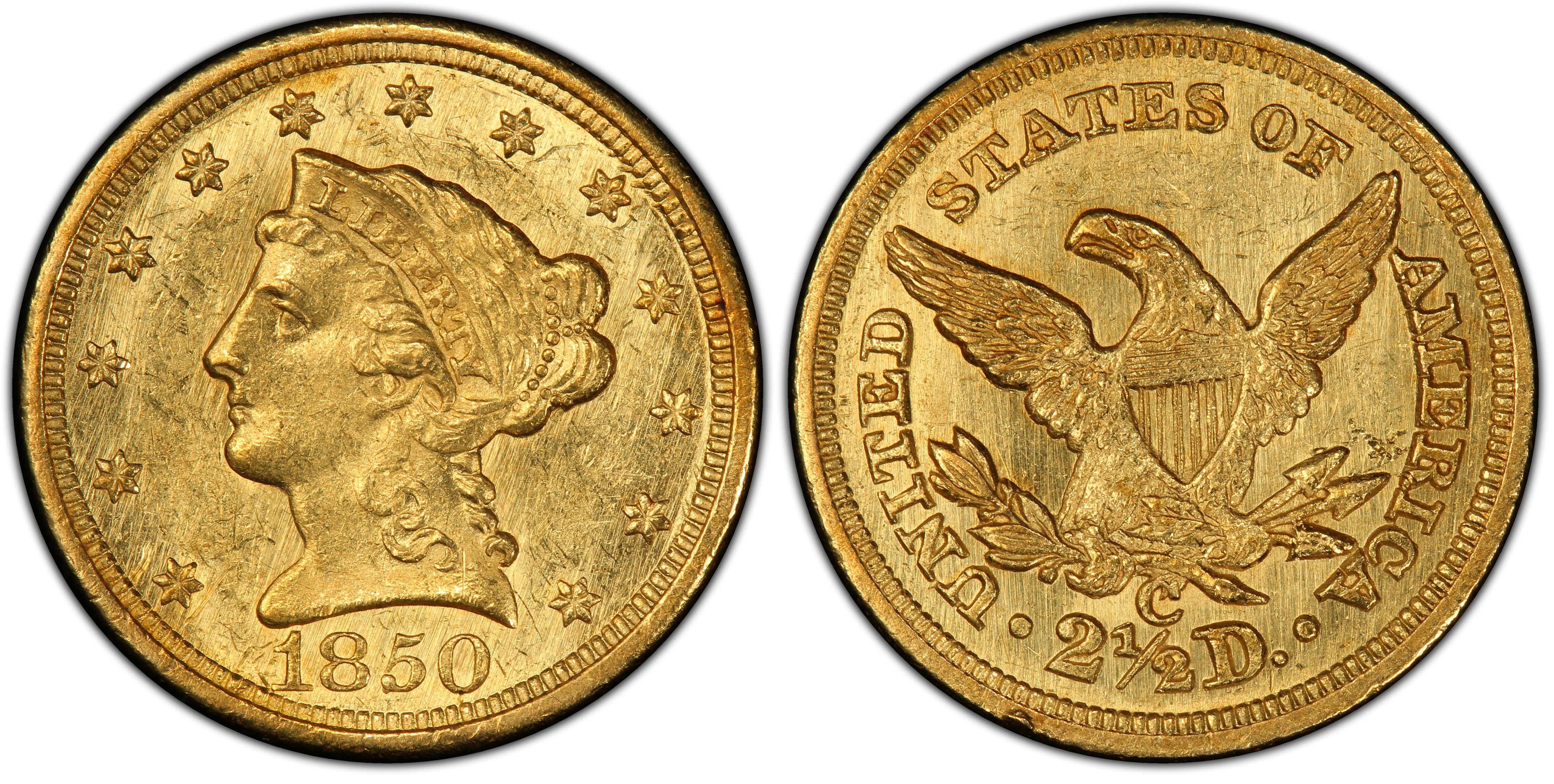
PCGS MS62
- PCGS #:
- 7756
- Designer:
- Christian Gobrecht
- Edge:
- Reeded
- Diameter:
- 18.00 millimeters
- Weight:
- 4.18 grams
- Mintage:
- 9,148
- Mint:
- Charlotte
- Metal:
- 90% Gold, 10% Copper
- Auction Record:
- $31,050 • MS61 • 01-01-1999 • Heritage Auctions
Major Varieties
- 1850-C $2.50
Rarity and Survival Estimates Learn More
| Survival Estimate | |
|---|---|
| All Grades | 160 |
| 60 or Better | 7 |
| 65 or Better | |
| Numismatic Rarity | |
|---|---|
| All Grades | R-7.4 |
| 60 or Better | R-9.6 |
| 65 or Better | R-10.1 |
| Relative Rarity By Type All Specs in this Type | |
|---|---|
| All Grades | 66 / 147 |
| 60 or Better | 43 / 147 TIE |
| 65 or Better | 1 / 147 |
| Relative Rarity By Series All Specs in this Series | |
|---|---|
| All Grades | 66 / 147 |
| 60 or Better | 43 / 147 TIE |
| 65 or Better | 1 / 147 |
Condition Census What Is This?
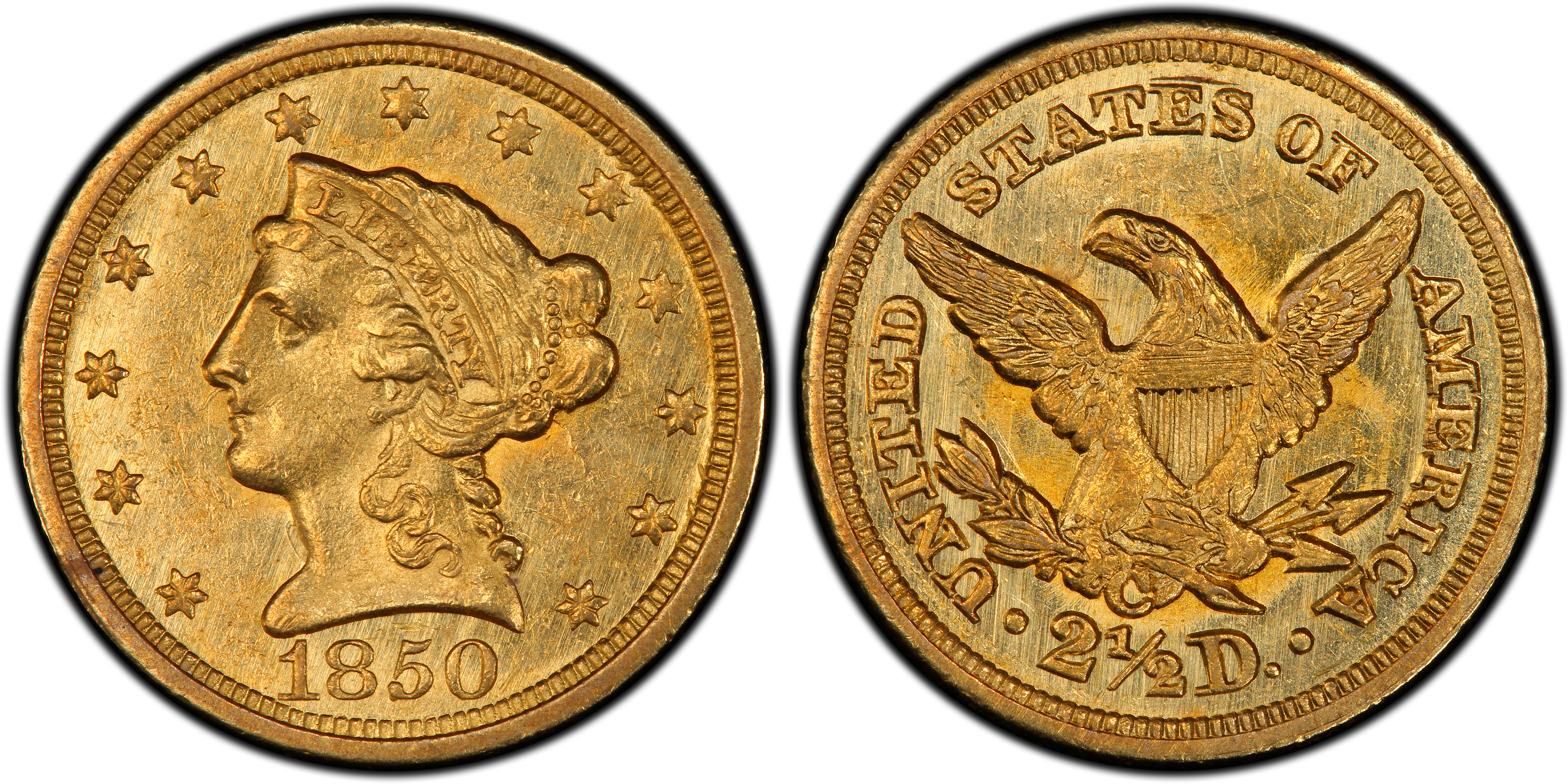 #1 PCGS MS62+
As NGC MS62 #1784513-004. “The Grand Lake Collection,” Heritage Auctions, February 2009, Lot 2504 – $14,950. Heritage Auctions, January 5, 2012, Lot 4758 – $15,549.15. Stack's Bowers, November 2012, Lot 3245 - Passed. As PCGS MS62+ #31695171. Goldberg Auctioneers, June 2014, Lot 80 – $15,863; “The Utah Collection of Charlotte Gold Coinage,” Heritage Auctions, July 13, 2021, Lot 3079 – $28,800. As PCGS MS62+ #47453870. Variety 1. Diagonal scratch from the corner of the lip. Small ticks to the right of the gap between stars 2 and 3. Tick below star 10. Minor disturbances in the lower right field. on the reverse, small ticks above first arrow. Small ticks above the eagle’s head. Bright gold silhouette around eagle. |
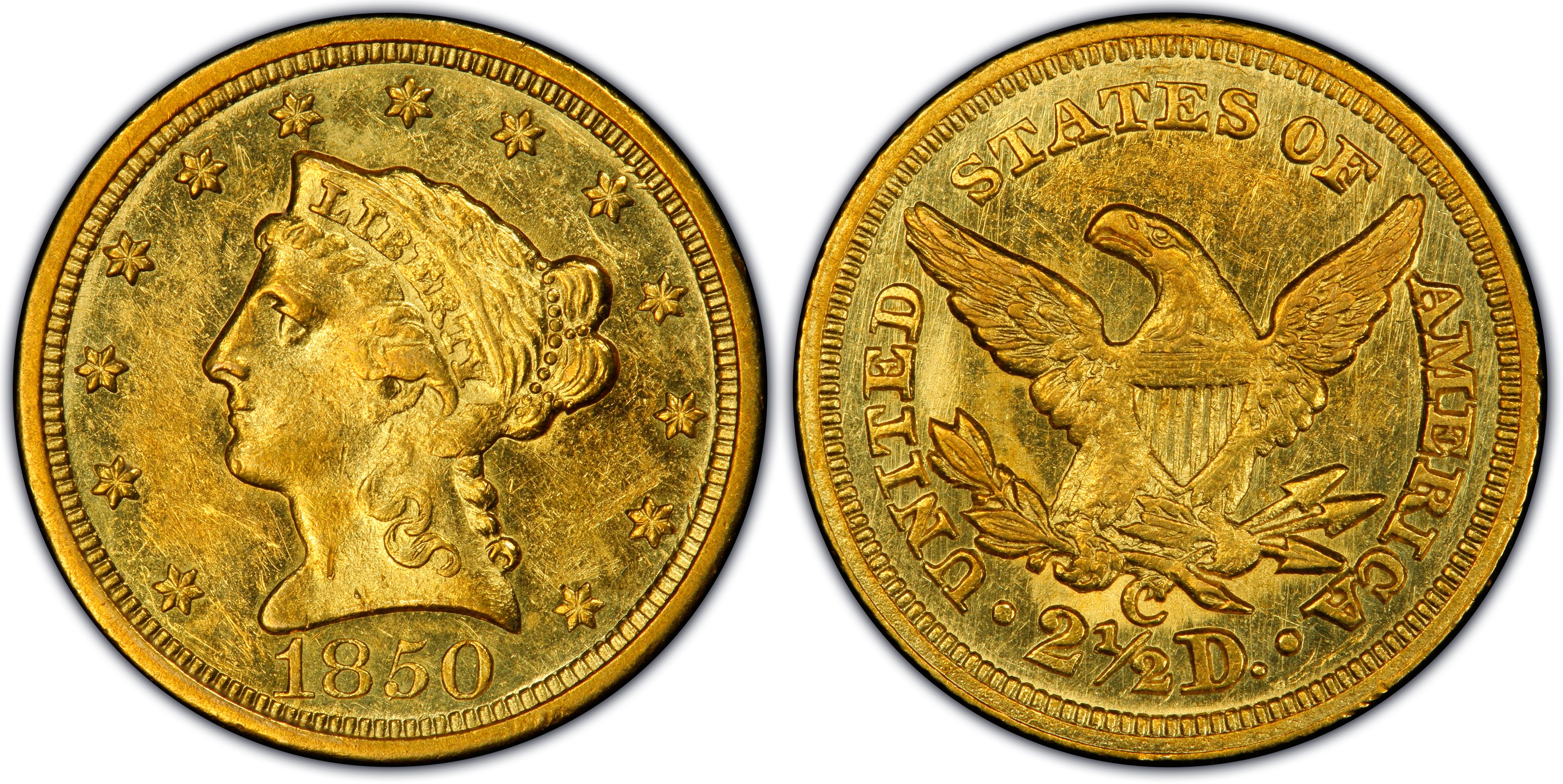 #2 PCGS MS62
Mal Varner, February 28, 1972; As PCGS AU58. “The Harry W. Bass, Jr. Collection, Part II,” Bowers and Merena, October 1999, Lot 430. As PCGS MS62. “The Johnson-Blue Collection,” Stack’s, August 8, 2010, Lot 928 – $20,700. Variety 2. Vertical hit on neck, coupled with two ticks at the bust truncation. Tick on jaw. |
|
#2 PCGS MS62
Dell Loy Hansen. |
|
#2 PCGS MS62
|
| #2 PCGS MS62 |
| #2 PCGS MS62 |
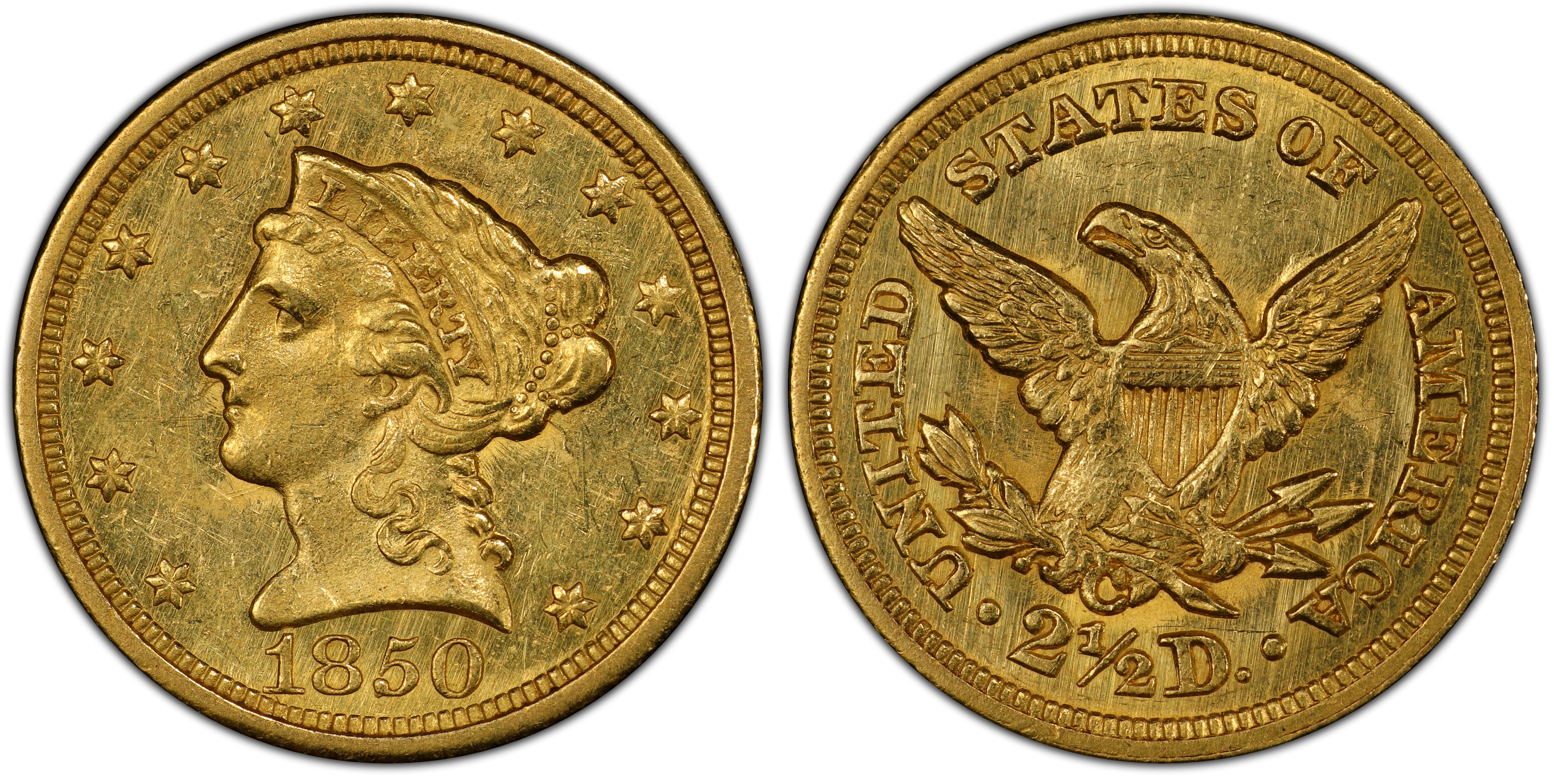 #7 PCGS MS61
As PCGS MS61 #35697115. Heritage Auctions, August 16, 2018, Lot 5221 - $10,800. As PCGS MS61 #38196278. Goldberg Auctioneers, June 3, 2020, Lot 682 - $12,000. The Quiver Collection (PCGS Set Registry). Minor ticks to the left of Libert'y nose and forehead. Planchet void near star 11. On the reverse, there is a diagonal hit across the top of the shield and a nearly vertical rim hit below S O.
|
|
#7 PCGS MS61
Heritage Auctions, January 12, 2005, Lot 30407 - $13,225. Tick to the right of star 4. Small diagonal tick on jaw. Dark copper coloration around stars 12 and 13. |
 #7 PCGS MS61
|
 #7 PCGS MS61
|
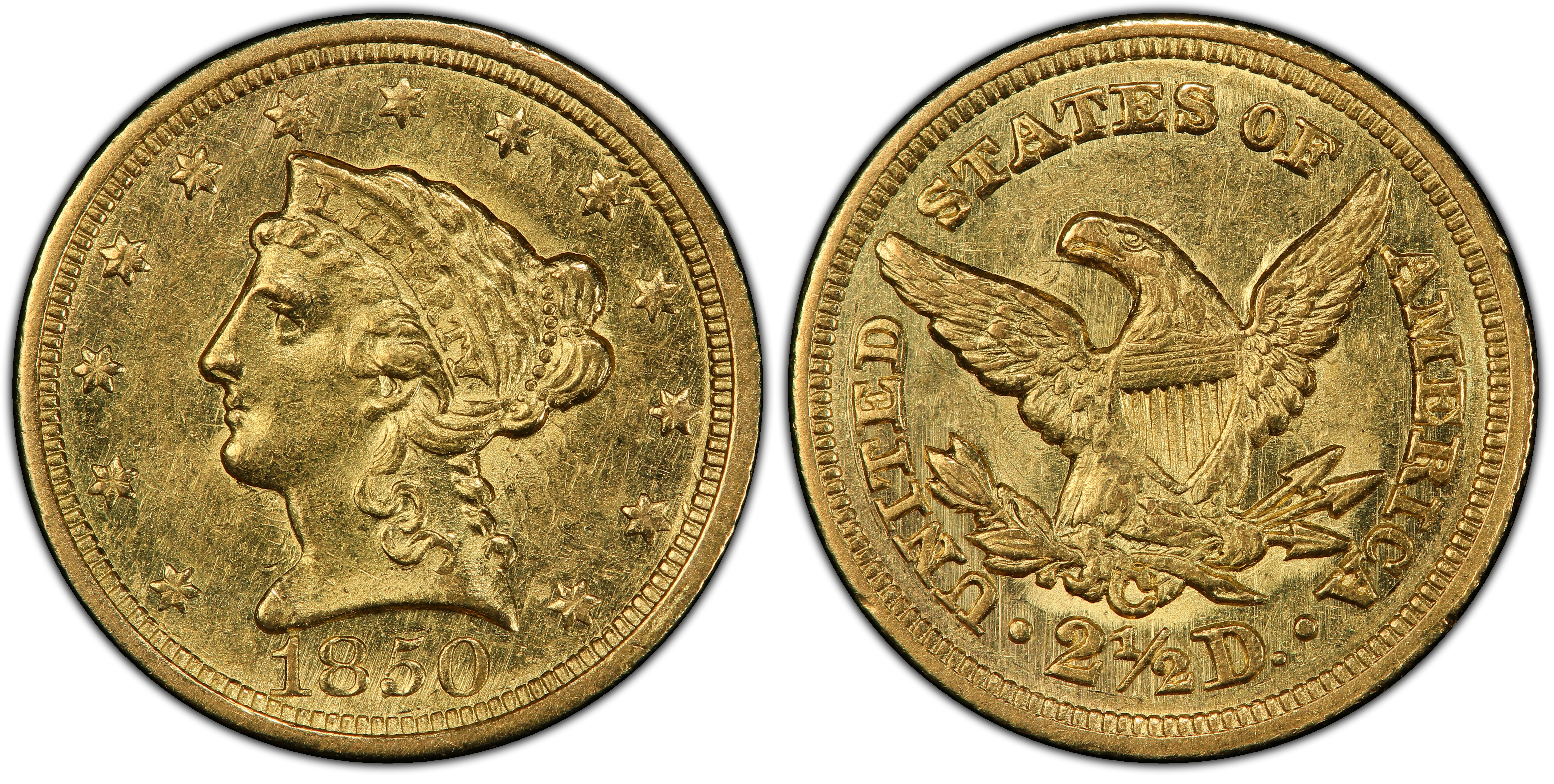 #7 PCGS MS61
|
| #7 PCGS MS61 |
| #7 PCGS MS61 |
With large quantities of gold being shipped in from California, mintages of Liberty Head Quarter Eagles at Philadelphia increased dramatically throughout the 1850s, especially in the first half of the decade. Before the million-coin mintages achieved from 1851 to 1853, the previous high-water mark for the $2.50 gold coin denomination belonged to the 1836 Classic Head Quarter Eagle, with its mintage of 547,986 coins. The Charlotte Mint did not materially benefit from the California Gold Rush; its deposits from western sources were minimal throughout the 1850s, and its Quarter Eagle production was sporadic, with no coins of the denomination being struck in 1853, 1857, or 1859. Still, Charlotte often had a production advantage over the Dahlonega Mint throughout its last full decade of operation.
The 1850-C Liberty Head Quarter Eagle had a mintage of 9,148 coins. This total was typical for the decade, as Quarter Eagle output at the Charlotte Mint during the 1850s ranged from 3,677 to 14,923 pieces but usually fell within the 7,000 to 10,000 range. The 1850-C mintage sits just above the median and mean for the seven Charlotte Mint issues of the decade.
Die Varieties and Condition Rarity
Although three die pairs were sent to the Charlotte Mint to produce this issue, only two varieties can be identified in the resulting coins. Both varieties commonly exhibit strike weakness on the eagle’s right leg:
- Variety 1: The "C" mintmark is positioned so that it slightly overlaps the eagle’s right talon.
- Variety 2: The mintmark punch is located away from the talon and is centered on the fraction bar.
The value of the 1850-C Quarter Eagle is heavily determined by condition. To date, PCGS has certified no coin finer than MS62+, making the issue very challenging for collectors seeking high-grade pieces with good eye appeal.
Classic U.S. gold coin expert Doug Winter estimates between 175 and 225 survivors of this issue in all grades, but the combined certified population (PCGS and other services) is slightly more than 275. Our own population data indicates that just under 80% of the coins we have certified fall within the Extremely Fine (XF) to About Uncirculated (AU) grade band. The number of Mint State 1850-C survivors is typical for the decade, though it represents only half the number of Mint State examples known for the 1858-C.
1850-C Liberty Head Quarter Eagle: Physical Characteristics
(per Doug Winter)
The strike seen on this date is below average. On many examples, the obverse shows pronounced weakness; the curls around the face are not fully formed, and the top of the hair may show little or no significant detail. The stars are mostly weak at their centers and display minimal detail on the radial lines. Coins known with good detail at the obverse center are quite rare and desirable, as they are much more appealing than the typical, softly struck example of this date. The reverse is always weak on the eagle’s right leg and on both claws. The neck feathers are often weak as well.
Surfaces and Luster
- Surfaces: The 1850-C Quarter Eagle is nearly impossible to locate without heavily abraded surfaces. Many exhibit deep, detracting marks, frequently seen in the left obverse field. A considerable number of examples were struck from clashed dies. Clash marks are typically found on the obverse in front of the face, behind the neck, and in the field between the hair and the final two stars. A smaller number show clash marks on the reverse below the left wing and extending from the beak to the wing. On late die state coins, an "aura" of die rust surrounds the eagle. Light mint-made roughness is often visible directly above Liberty's head.
- Luster: Two types of luster are seen on this date. The majority of 1850-C quarter eagles have a frosty texture, which is usually better in quality on the obverse than on the reverse. A smaller number display slightly reflective and inferior quality luster.
Coloration and Eye Appeal
- Coloration: It is very hard to find an 1850-C quarter eagle that has not been cleaned or dipped. The natural coloration is a distinctive medium green-gold, though some are also seen with a medium to deep coppery orange-gold hue.
- Eye Appeal: Most examples have poor overall eye appeal due to weakly struck details at the centers and heavily abraded surfaces. Additionally, the clash marks described above give many pieces a "busy" and unappealing appearance. Any 1850-C Quarter Eagle that is choice and original is very rare. DIE CHARACTERISTICS: Four small horizontal die lines jut out from the denticles above the ninth star. There are also two small vertical die lines extending from the denticles near the twelfth star. A fine line extends out from the ball of the "5" in the date toward the lower left.
* * *