
PCGS MS64
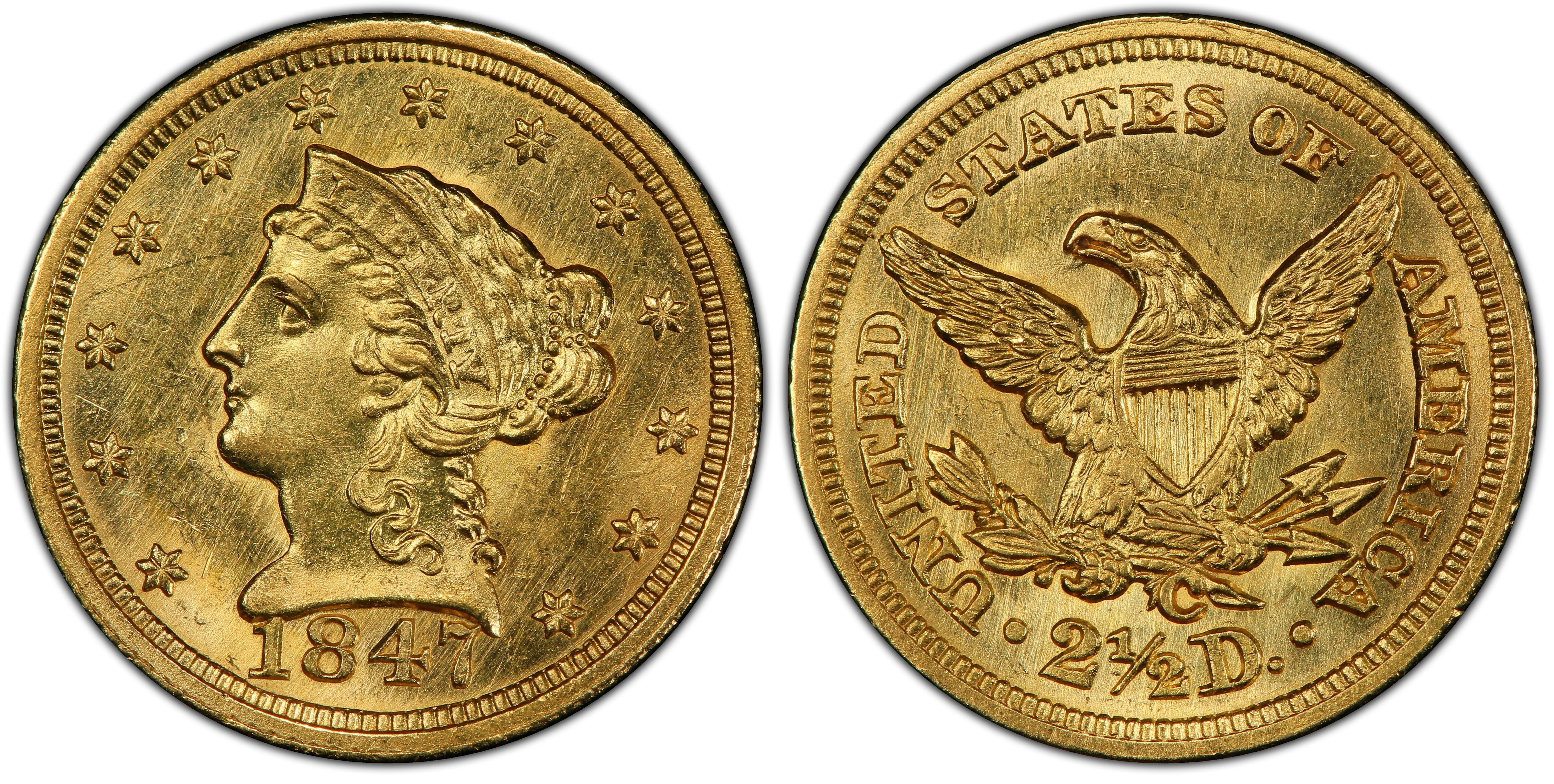
PCGS MS63
- PCGS #:
- 7745
- Designer:
- Christian Gobrecht
- Edge:
- Reeded
- Diameter:
- 18.00 millimeters
- Weight:
- 4.18 grams
- Mintage:
- 23,226
- Mint:
- Charlotte
- Metal:
- 90% Gold, 10% Copper
- Auction Record:
- $31,200 • MS64 • 07-15-2021 • Heritage Auctions
Major Varieties
- 1847-C $2.50
Rarity and Survival Estimates Learn More
| Survival Estimate | |
|---|---|
| All Grades | 325 |
| 60 or Better | 25 |
| 65 or Better | |
| Numismatic Rarity | |
|---|---|
| All Grades | R-6.3 |
| 60 or Better | R-9.0 |
| 65 or Better | R-10.1 |
| Relative Rarity By Type All Specs in this Type | |
|---|---|
| All Grades | 102 / 147 TIE |
| 60 or Better | 93 / 147 TIE |
| 65 or Better | 1 / 147 |
| Relative Rarity By Series All Specs in this Series | |
|---|---|
| All Grades | 102 / 147 TIE |
| 60 or Better | 93 / 147 TIE |
| 65 or Better | 1 / 147 |
Condition Census What Is This?
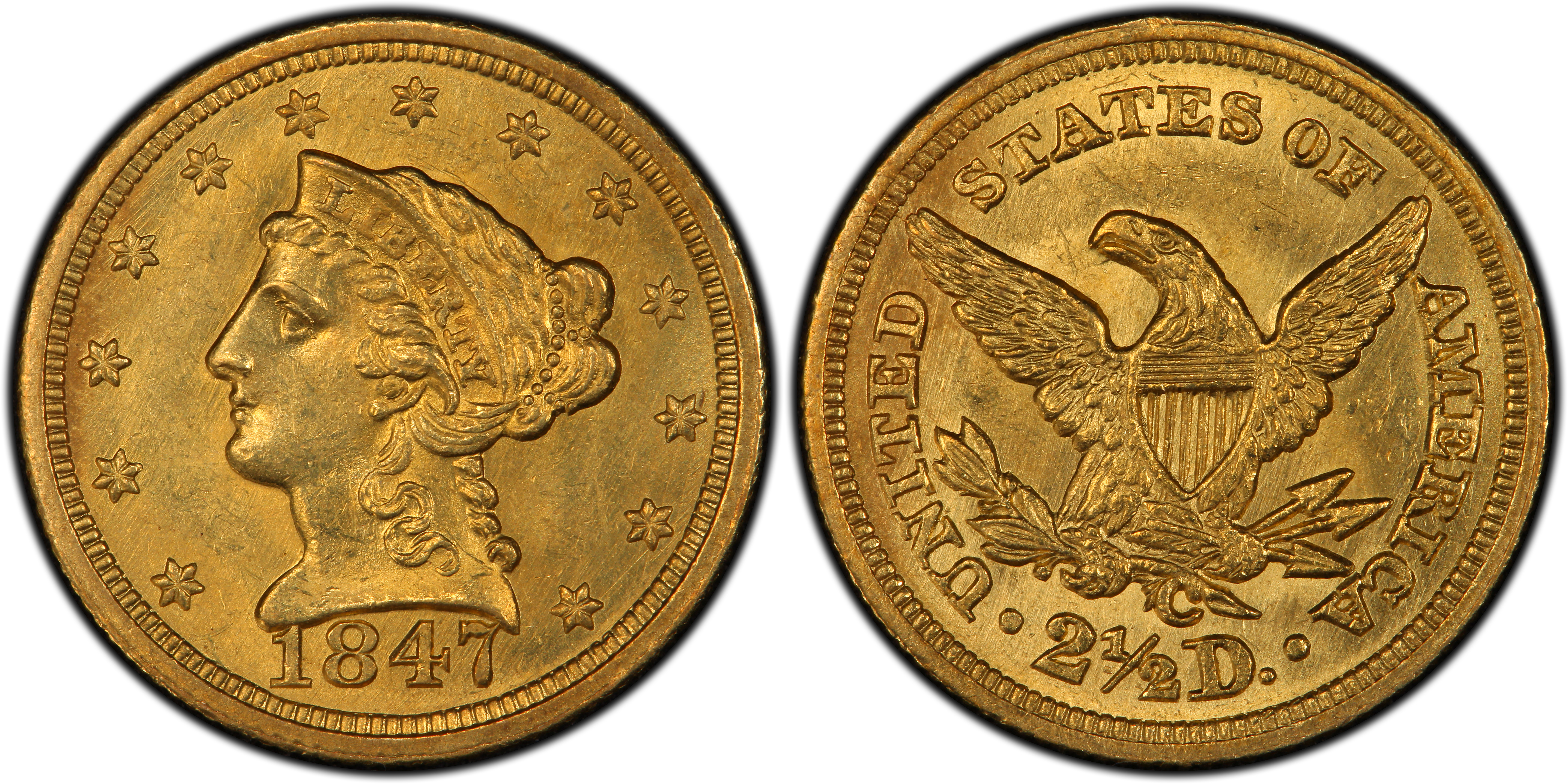 #1 PCGS MS64
As PCGS MS64 #6574988. "The Baltimore Collection, Part Two," Heritage Auctions, October 14, 2011, Lot 4662 - $17,250; Goldbergs, June 2014, Lot 1682 - $19,387.50; As PCGS MS64 #29400440. "The Utah Collection of Charlotte Gold Coinage," Heritage Auctions, July 13, 2021, Lot 3077 - $31,200. As PCGS MS64 #43136251. Dell Loy Hansen. Small tick above the upper right point of star 2. Small tick between stars 5 and 6. Triangle-shaped tick on chin. |
|
#1 PCGS MS64
Doug Winter to Stephen Winthrop, March 2003; "The Stephen Winthrop Collection," Stack's Bowers, February 2015, Lot 2071 - $30,550. Scattered die rust on the reverse (under first T of STATES, between the branch and eagle's right wing, around the denomination). |
|
#1 PCGS MS64
"The Grand Lake Collection," Heritage Auctions, February 6, 2009, Lot 2482 - $18,400. |
|
#1 PCGS MS64
|
|
#1 PCGS MS64
Heritage Auctions, November 3, 2005, Lot 2371 - $20,125. Toning in the right obverse field. Tick to the bottom right of Liberty's mouth. Spot touching denticles near star 2. |
| #1 PCGS MS64 |
|
#7 PCGS MS63
"The Della Collection," Heritage, September 2006, Lot 3146; Heritage, August 2007, Lot 1831. As PCGS MS63 #29616684. "The Augustana Collection," Stack's Bowers, August 25, 2022, Lot 7134 - $15,600. Diagonal cut on neck, below jaw. Hit in hair below ER. Tick above top arrow. |
 #7 PCGS MS63
Scattered coppery toning. One such spot touches nose and another between denticles and the top of star 6. A constellation of tiny planchet voids above the eagle's head. |
|
#7 PCGS MS63
Thin reflective streak from denticles between stars 3 and 4 towards forehead. Small tick above star 13. Small tick on the top arrow. |
| #7 PCGS MS63 |
| #7 PCGS MS63 |
| #7 PCGS MS63 |
| #7 PCGS MS63 |
| #7 PCGS MS63 |
The Philadelphia Mint prepared three die pairs for the Charlotte Mint to use in striking the 1847-C Liberty Head Quarter Eagle, but only one pair was ultimately put into use. A total of 23,226 coins were struck, making this the largest mintage of any Charlotte quarter eagle issue, exceeding the reported mintage of the 1843-C Large Date variety by just 150 pieces.
Classic U.S. gold coin specialist Doug Winter describes the sole 1847-C die marriage as having the "1" in the date touching the bust and close to the denticles, with the "7" also touching the bust but positioned far from the denticles. The reverse employs the same die used in 1846, but it was heavily lapped to remove die rust. Despite this treatment, rust is still visible below the "1" in the fraction, and late die states exhibit a crack extending from the right wing to the base of the "M" in AMERICA.
In 1975, David Akers noted that the 1847-C Liberty Head Quarter Eagle was the most common Charlotte Mint issue in the series. This statement remains true today; the 1847-C and the 1843-C Large Date are the only two Charlotte dates for which PCGS has certified over 200 coins. Currently, the PCGS population for the 1847-C is roughly 17% higher than that of the 1843-C Large Date.
While the PCGS Census reports fewer than 40 pieces in Mint State condition, the grade distribution is well spread between MS61 and MS63. To date, PCGS has certified eight coins at MS63 and six coins at the MS64 grade, with none finer.
Technical Characteristics of the 1847-C Quarter Eagle Strike
(per Doug Winter)
The 1847-C is among the best-struck issues of any denomination from the Charlotte Mint.
- Obverse: Very sharply detailed, with only a slight weakness on the curls nearest Liberty's face and ear. The stars are very sharp, with most showing completely detailed radial lines.
- Reverse: The eagle's right leg is usually weak, and the inner part of the right wing may also show some weakness.
- Borders: The border is very sharp, especially on the lettering and the denticles.
Surfaces and Luster
Surfaces: It is possible to locate an 1847-C that has reasonably clean surfaces. However, many are liberally abraded, with detracting marks seen in the fields. Mint-made striations are sometimes seen in the obverse fields.
Luster: The quality of the luster is above average. Higher-grade specimens are frosty with a slightly grainy texture.
Coloration and Eye Appeal
Coloration: Original, uncleaned pieces often show pleasing light yellow-gold or medium green-gold coloration. It is not easy to find pieces with natural color, as many have been lightened, cleaned, or processed.
Eye Appeal: This is one of the few Charlotte quarter eagles that the date collector can expect to find with good eye appeal. A number of choice pieces are known with sharp strikes, decent surfaces, good luster, and nice color. Unfortunately, such coins are becoming harder to find as more examples are cleaned.
Die Characteristics
- Die Scratches: Small raised die scratches are visible from the eleventh to the twelfth star and from the twelfth to the thirteenth. Another die scratch can be seen through the MER in AMERICA.
- Die Rust: Some coins show slight die rust patches around the date and on the reverse, mostly below the wings of the eagle.
The word LIBERTY is typically softly struck on the diadem on this issue, even on coins with full radial detail. During its use, the reverse die developed multiple instances of rust, which can be seen on some examples below the first T of STATES, between the eagle’s extended right wing and the branch, between the tip of the branch and the D, and between the second arrow tip and C of AMERICA.