
PCGS MS63
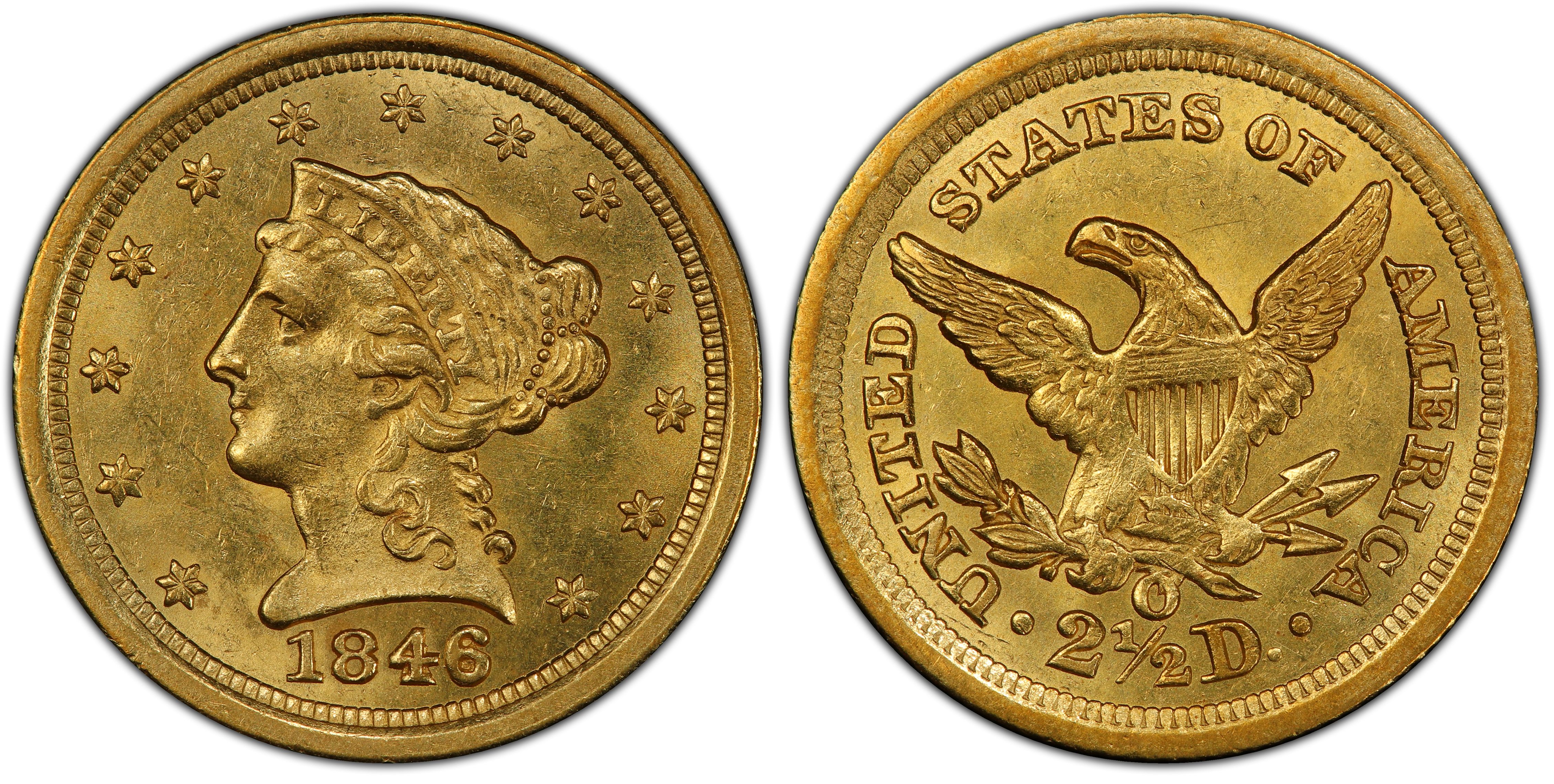
PCGS MS63
- PCGS #:
- 7743
- Designer:
- Christian Gobrecht
- Edge:
- Reeded
- Diameter:
- 18.00 millimeters
- Weight:
- 4.18 grams
- Mintage:
- 62,000
- Mint:
- New Orleans
- Metal:
- 90% Gold, 10% Copper
- Auction Record:
- $132,000 • MS64 • 05-01-1998 • David Akers
Major Varieties
- 1846-O $2.50
Rarity and Survival Estimates Learn More
| Survival Estimate | |
|---|---|
| All Grades | 175 |
| 60 or Better | 12 |
| 65 or Better | 1 |
| Numismatic Rarity | |
|---|---|
| All Grades | R-7.2 |
| 60 or Better | R-9.5 |
| 65 or Better | R-10.0 |
| Relative Rarity By Type All Specs in this Type | |
|---|---|
| All Grades | 68 / 147 TIE |
| 60 or Better | 57 / 147 TIE |
| 65 or Better | 1 / 147 TIE |
| Relative Rarity By Series All Specs in this Series | |
|---|---|
| All Grades | 68 / 147 TIE |
| 60 or Better | 57 / 147 TIE |
| 65 or Better | 1 / 147 TIE |
Condition Census What Is This?
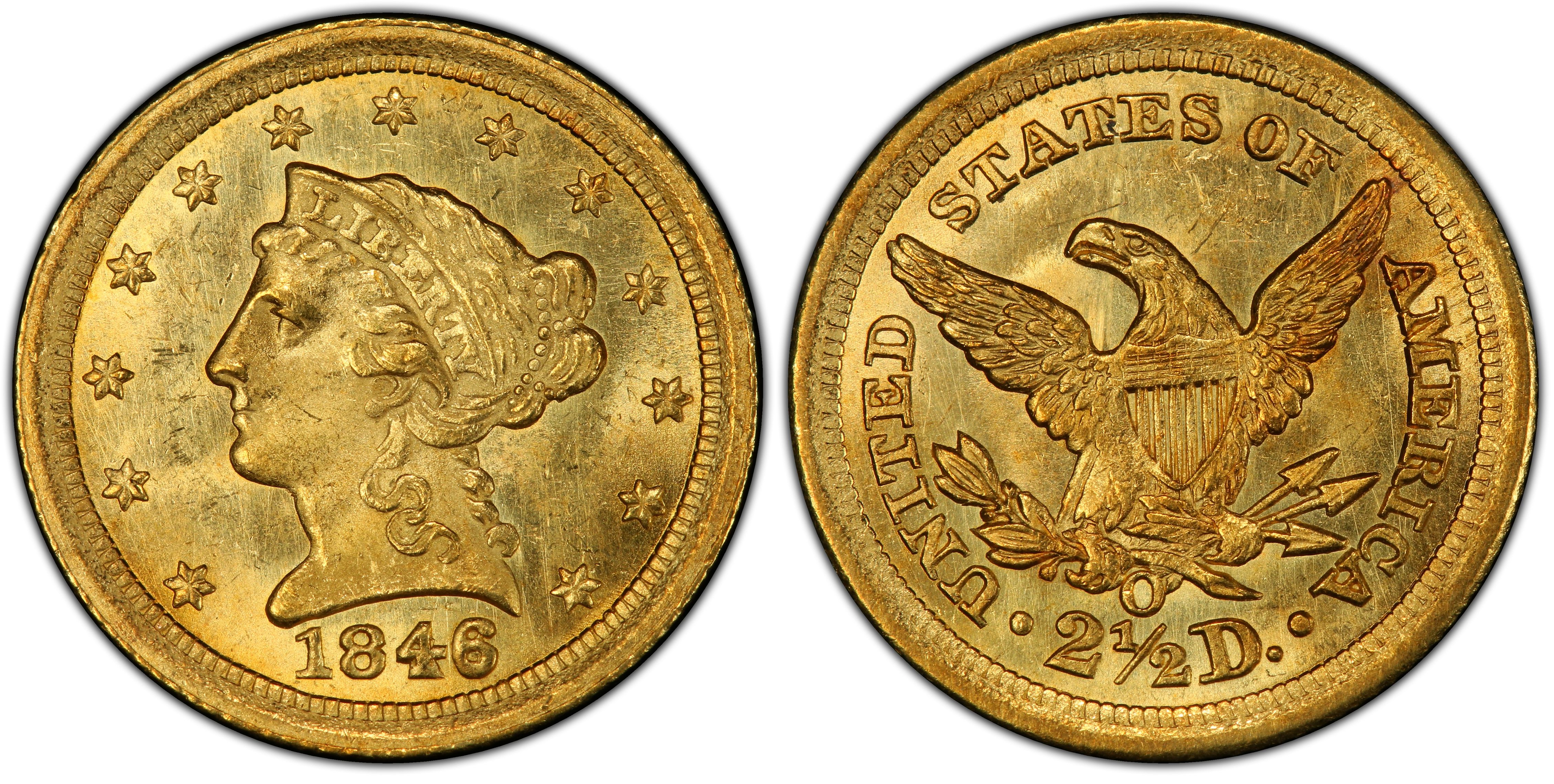 #1 PCGS MS65
James Kelly, April 1957, Lot 731 - $37.50; "The John Jay Pittman Collection," - David Akers, May 1998, Lot 1754 - $132,000; Stellar Collection. As PCGS MS65 #85120721. Del Loy Hansen. Variety 1. Lusrous. Thin curved mark on cheek. Light rim hit to the left of Libert's nose and eye. Scattered golden orange toning on the reverse rightside. Formally, NGC MS66. |
|
#2 PCGS MS64
Ed Shapiro to Harry W. Bass, Jr., December 1971; "The Harry W. Bass, Jr. Collection, Part II," Bowers & Merena, October 1999, Lot 389 - $27,025; Heritage Auctions, March 21, 2003, Lot 6197 - $21,850; Pinnacle Rarities; Doug Winter, sold privately in 2005; Kansas Collector. Veriety 1. Rim hit near 12 o'clock. Two diagonal marks in the field just above star 1. Thin hairline between stars 7 and 8. Tick between stars 10 and 11. |
|
#3 PCGS MS63
As NGC MS64 #2030779-008. Bowers and Merena, August 2009, Lot 4337; "The Baltimore Collection, Part II," Heritage Auctions, October 2011, Lot 4661 - $23,000; Heritage Auctions, August 24, 2022, Lot 4014 – $20,400. As NGC MS64 #6329481-009. Heritage Auctions, August 15 2023, Lot 3154 – $18,600. As PCGS MS63 #47725203. Variety 2. Hit to the left of ear. Curved mark between stars 2 and 3. Another tick in the left obverse field between stars 3 and 4. Cut on cheek near ear. |
|
#3 PCGS MS63
Legend Rare Coin Auctions, March 21, 2019, Lot 391 – $19,975. Variety 1. |
 #3 PCGS MS63
As PCGS MS63 #50074793: Heritage Auctions, January 7, 2004, Lot 2157 – $17,250. As PCGS MS63 #84324893. “Crescent City” Collection" (PCGS Set Registry). Copper-colored toning at 4 and 6 of the date. |
 #6 PCGS MS62
|
|
#6 PCGS MS62
Goldberg Auctioneers, February 13, 2007, Lot 2144 - $10,350; Goldberg Auctioneers, May 27, 2008, Lot 4556 - $10,637.50; Heritage, February 1, 2009, Lot 2480 - $6,900; Heritage, May 1, 2009, Lot 3613 - $8,050. Light hit to the upper right of star 1. Small diagonal tick behind Liberty's head. Two small ticks on Liberty's jaw. Softly struck centers. |
| #6 PCGS MS62 |
| #6 PCGS MS62 |
| #6 PCGS MS62 |
In 1846, New Orleans—America’s third largest city and second largest port—served as the headquarters for the U.S. Army Quartermasters and the primary staging grounds for troop mobilization after the United States declared war on Mexico. The city experienced a rapid influx of troops, and the New Orleans Mint was tasked with striking coins to support the city and region in this wartime economy.
The New Orleans Mint produced five denominations in 1846. The most extensively minted was the 1846-O Liberty Seated Half Dollar, a popular circulating denomination. The Mint also, for the first time, struck silver dollars; the 1846-O Liberty Seated Dollar was the first silver dollar produced outside of the Philadelphia Mint. New Orleans also produced gold coins in the Quarter Eagle, Half Eagle, and Eagle denominations. The mintage of the 1846-O Liberty Head Quarter Eagle was 62,000 pieces - a considerable increase from 1845.
New Orleans Mint Coin Production in 1846
- 1846-O Liberty Seated Half Dollar (#6255) | Mintage: 2,304,000 | Scarce in Mint State.
- 1846-O Liberty Seated Dollar (#6933) | Mintage: 59,000 | Scarce at MS63; rare above.
- 1846-O Liberty Head Quarter Eagle | Mintage: 62,000 |
- 1846-O Liberty Head Half Eagle (#8230) | Mintage: 16,500 | Rare in Mint State.
- 1846-O Liberty Head Eagle (#8595) | Mintage: 81,780 | Rare in Mint State.
Rarity and Survival
- According to Doug Winter and the PCGS population report, the 1846-O than the 1847-O (#7747) , 1850-O (#7758), 1851-O (#7762), and 1852-O (#7766) quarter eagles in terms of overall rarity. In higher grades, however, these dates are very similar.
- This date is most often seen in XF40 to AU58. It is scarce in the lower Mint State grades and rare in MS63 or finer.
- There are likely between 20 and 30 Mint State 1846-O Liberty Head Quarter Eagles known, including one superb example and two very choice pieces.
Die Varieties
Three varieties of the 1846-O Liberty Head Quarter Eagle are currently known.
- Variety One: The mintmark is entirely to the left of the fraction bar, and the arrow feathers do not penetrate the mintmark. This variety is easy to identify as it always has prominent raised die lines on the reverse from 1:00 to 3:00 (Dies of Bass III: 162).
- Variety Two: The right side of the mintmark is past the fraction bar, and the arrow feathers enter the mintmark. This variety is often seen with very weak centers. Two examples recovered from the SS Central America have been encapsulated by PCGS with a pinch of gold.
- Variety Three: The mintmark is high, with the tip of the arrow feather within the mintmark and pointing to its center. The fraction bar is below the right inside curve of the mintmark. Several vertical shield lines extend upwards into the horizontal lines and beyond the bottom of the shield (Dies of Bass III: 161).
Technical Characteristics
(per Doug Winter)
Strike: Approximately three-quarters of the known 1846-O quarter eagles are weakly struck.
- Obverse: Better detailed than the reverse but shows softness on the curls around the face and the top of the bun. The stars are sometimes weak at the centers, and the denticles from 1:00 to 5:00 are often softly impressed.
- Reverse: Typically very soft, especially at the center. The eagle’s right leg and claw are weak, the shield lacks complete detail, and the left claw is indistinct.
- Extremely Weak Examples: Some are known with almost no detail at the centers; these must be graded primarily by the amount of visible luster.
- Well-Struck Pieces: A small number are known with a good or sharp strike. These are extremely hard to locate and should sell for a higher level than typical strikes.
- Rotated Reverse: A small number of pieces show a rotated reverse, usually between a 45 to 90-degree orientation. While rare and interesting, specialists do not typically accord these a premium.
Surfaces and Luster
- Surfaces: The 1846-O is among the most difficult quarter eagles from this mint to locate with clean surfaces. Nearly all are heavily abraded, and many show scratches or hairlines from poor handling.
- Luster: The luster is soft and frosty, similar in quality to the 1847-O quarter eagle. A few are known with slightly reflective fields, but these usually have a dull, grainy texture and are not considered attractive.
Coloration and Eye Appeal
- Coloration: Natural coloration ranges from light yellow-gold to a deeper orange and reddish-gold. Some show a ring of deep color at the periphery, contrasting with lighter shades at the center. A number have small, deep red, mint-made spots. It is hard to find an original piece, as most have been cleaned or dipped at one time.
- Eye Appeal: The typical 1846-O quarter eagle has below-average eye appeal due to weak centers, peripheral softness, heavy marks, and the prevalence of cleaning.
Die Characteristics
- Some coins display a series of raised die lines on the obverse behind the final star.
- Many have numerous large raised die lines on the reverse, notably from above the F in OF to over the right side of the M in AMERICA.
- 1846/44-O Claim: The long-standing claim of an 1846/44-O overdate is unfounded. The mark under the "6" is better explained by the cataloger in the Bass sale: "The logotype was shifted and the repunching occurred... The repunchings are all curved or circular in appearance, indicating a repunched 6 not a 4."
* * *