1798 $2.50 Wide Date (Regular Strike)
Series: Draped Bust $2 1/2 1796-1807

PCGS MS62
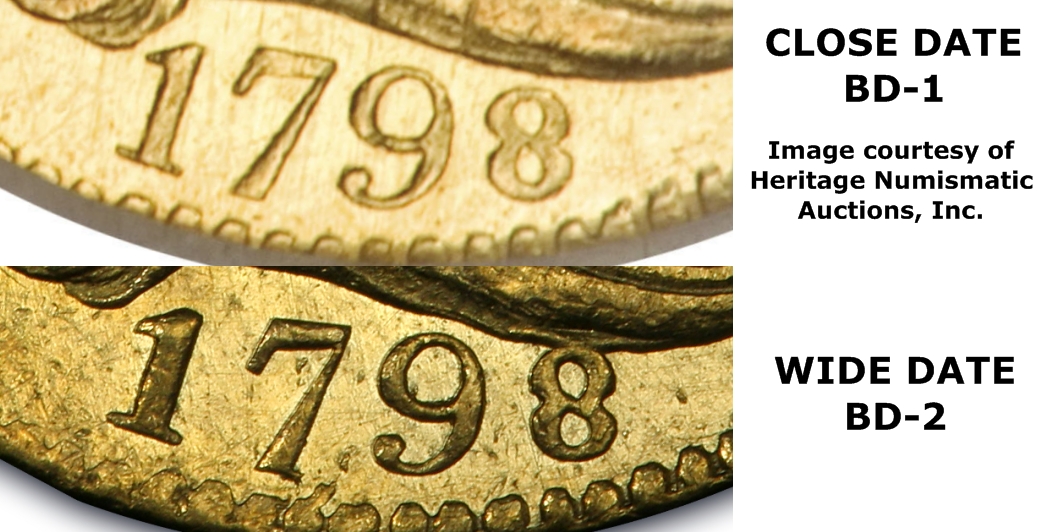
DATE COMPARISON

PCGS MS62
- PCGS #:
- 7649
- Designer:
- Robert Scot
- Edge:
- Reeded
- Diameter:
- 20.00 millimeters
- Weight:
- 4.37 grams
- Mintage:
- 1,094
- Mint:
- Philadelphia
- Metal:
- 91.7% Gold, 8.3% Copper
- Auction Record:
- $115,000 • MS62 • 01-05-2011 • Heritage Auctions
Go To Grade
Current Auctions - PCGS Graded
Current Auctions - NGC Graded
For Sale Now at Collectors Corner - PCGS Graded
For Sale Now at Collectors Corner - NGC Graded
Rarity and Survival Estimates Learn More
| Survival Estimate | |
|---|---|
| All Grades | 50 |
| 60 or Better | 8 |
| 65 or Better | 1 |
| Numismatic Rarity | |
|---|---|
| All Grades | R-8.5 |
| 60 or Better | R-9.6 |
| 65 or Better | R-10.0 |
| Relative Rarity By Type All Specs in this Type | |
|---|---|
| All Grades | 6 / 11 |
| 60 or Better | 5 / 11 |
| 65 or Better | 1 / 11 TIE |
| Relative Rarity By Series All Specs in this Series | |
|---|---|
| All Grades | 6 / 12 |
| 60 or Better | 5 / 12 TIE |
| 65 or Better | 1 / 12 TIE |
Condition Census What Is This?
| #1 MS65 PCGS grade |
|
#2 MS62 PCGS grade
|
|
#2 MS62 PCGS grade
Heritage 1/2011:5019 (as PCGS MS62 01589729), $115,000 |
| #2 MS62 PCGS grade |
| #2 MS62 PCGS grade |
| #6 MS61PCGS grade |
| #7 MS60 PCGS grade |
 #8 AU58 PCGS grade
|
| #8 AU58 PCGS grade |
| #8 AU58 PCGS grade |
David Akers (1975/88):
There are two main varieties for this year. the first has a compact date and 4 berries on the reverse. The other major variety, significantly more rare, has a widely spaced date and 5 berries on the reverse. Both varieties of this year have a unique obverse star configuration; namely 6 stars to the left, and 7 to the right. No other date of this type has a similar arrangement.
Despite the fact that there are three auction records for "proofs", I do not believe that true proofs really exist. Most likely the three pieces listed were merely pieces with full proof-like surfaces. By far, the finest 1798 quarter eagle that I have seen was a gem owned a few years ago by Stack's.
Despite the fact that there are three auction records for "proofs", I do not believe that true proofs really exist. Most likely the three pieces listed were merely pieces with full proof-like surfaces. By far, the finest 1798 quarter eagle that I have seen was a gem owned a few years ago by Stack's.
Gordon Wrubel:
There are only two die varieties of 1798 $2 1/2 dollar gold pieces. These are comprised of two distinct obverses and reverses: The Close Date with a 4 Berry reverse, Bass-Dannreuther, BD-1, and the Wide Date with a 5 Berry reverse, BD-2. While both varieties are rare, the Bass-Dannreuther research has shown that the former, BD-1, is about TWICE as rare as the latter, BD-2, in all grades including Mint State.
Quickfinder Notes: Of course the two varieties can be distinguished by counting the berries in the branch held in the eagles left claw. But the obverse dies are also distinctive. The Close Date has the digits rather closely spaced and the 8 is CLEAR OF THE BUST. The Wide Date has noticeably wider spaced digits and the 8 is EMBEDDED IN THE BUST drapery.
Quickfinder Notes: Of course the two varieties can be distinguished by counting the berries in the branch held in the eagles left claw. But the obverse dies are also distinctive. The Close Date has the digits rather closely spaced and the 8 is CLEAR OF THE BUST. The Wide Date has noticeably wider spaced digits and the 8 is EMBEDDED IN THE BUST drapery.