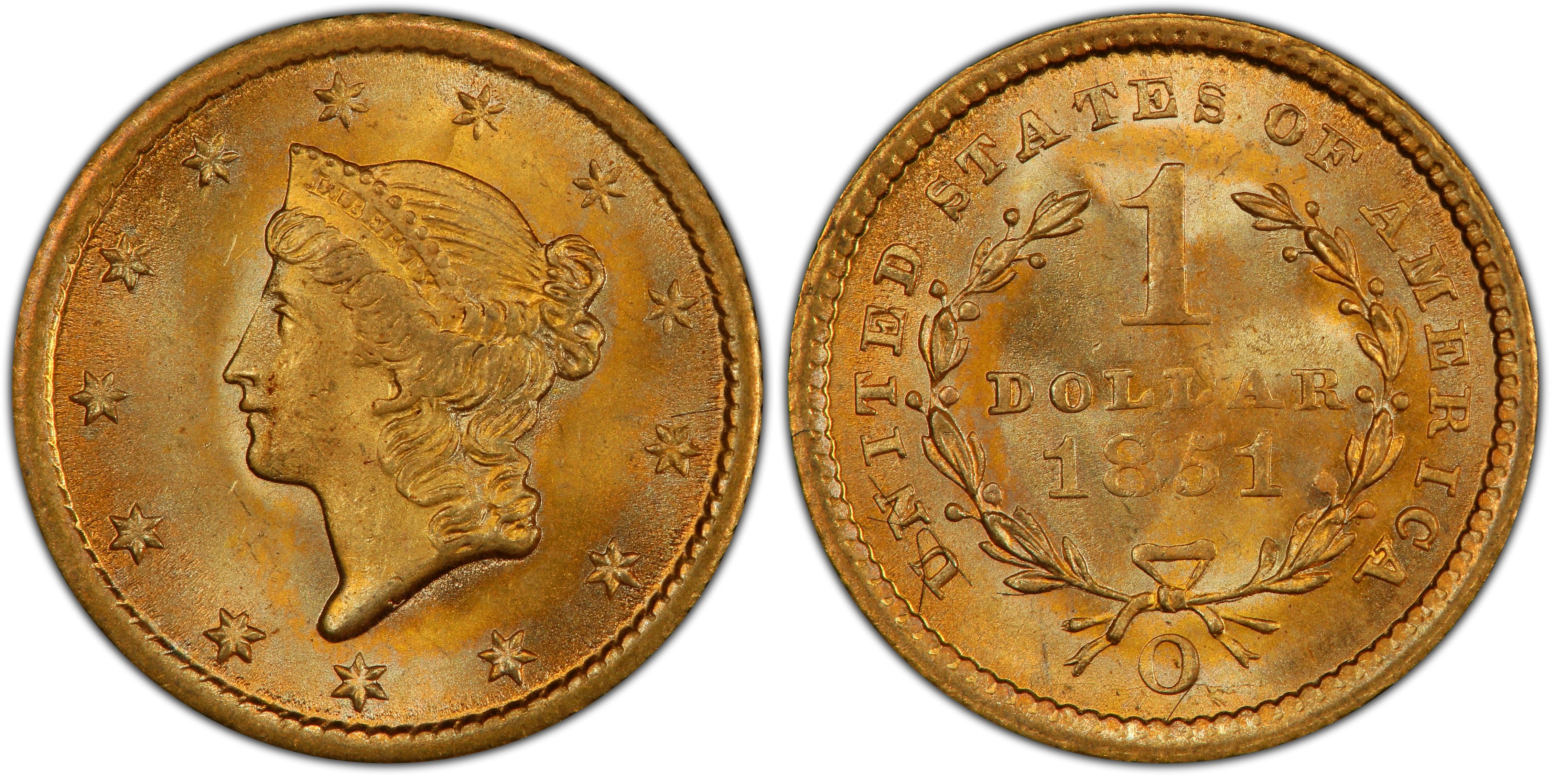
PCGS MS66

PCGS MS65+
- PCGS #:
- 7516
- Designer:
- James Barton Longacre
- Edge:
- Reeded
- Diameter:
- 12.70 millimeters
- Weight:
- 1.70 grams
- Mintage:
- 290,000
- Mint:
- New Orleans
- Metal:
- 90% Gold, 10% Copper
- Auction Record:
- $25,875 • MS66 • 12-13-2005 • Heritage Auctions
Major Varieties
- 1851-O G$1
Go To Grade
Current Auctions - PCGS Graded
Current Auctions - NGC Graded
For Sale Now at Collectors Corner - PCGS Graded
For Sale Now at Collectors Corner - NGC Graded
Rarity and Survival Estimates Learn More
| Survival Estimate | |
|---|---|
| All Grades | 1,300 |
| 60 or Better | 350 |
| 65 or Better | 15 |
| Numismatic Rarity | |
|---|---|
| All Grades | R-4.8 |
| 60 or Better | R-6.3 |
| 65 or Better | R-9.3 |
| Relative Rarity By Type All Specs in this Type | |
|---|---|
| All Grades | 20 / 26 TIE |
| 60 or Better | 18 / 26 |
| 65 or Better | 10 / 26 |
| Relative Rarity By Series All Specs in this Series | |
|---|---|
| All Grades | 62 / 81 TIE |
| 60 or Better | 54 / 81 |
| 65 or Better | 21 / 81 TIE |
Condition Census What Is This?
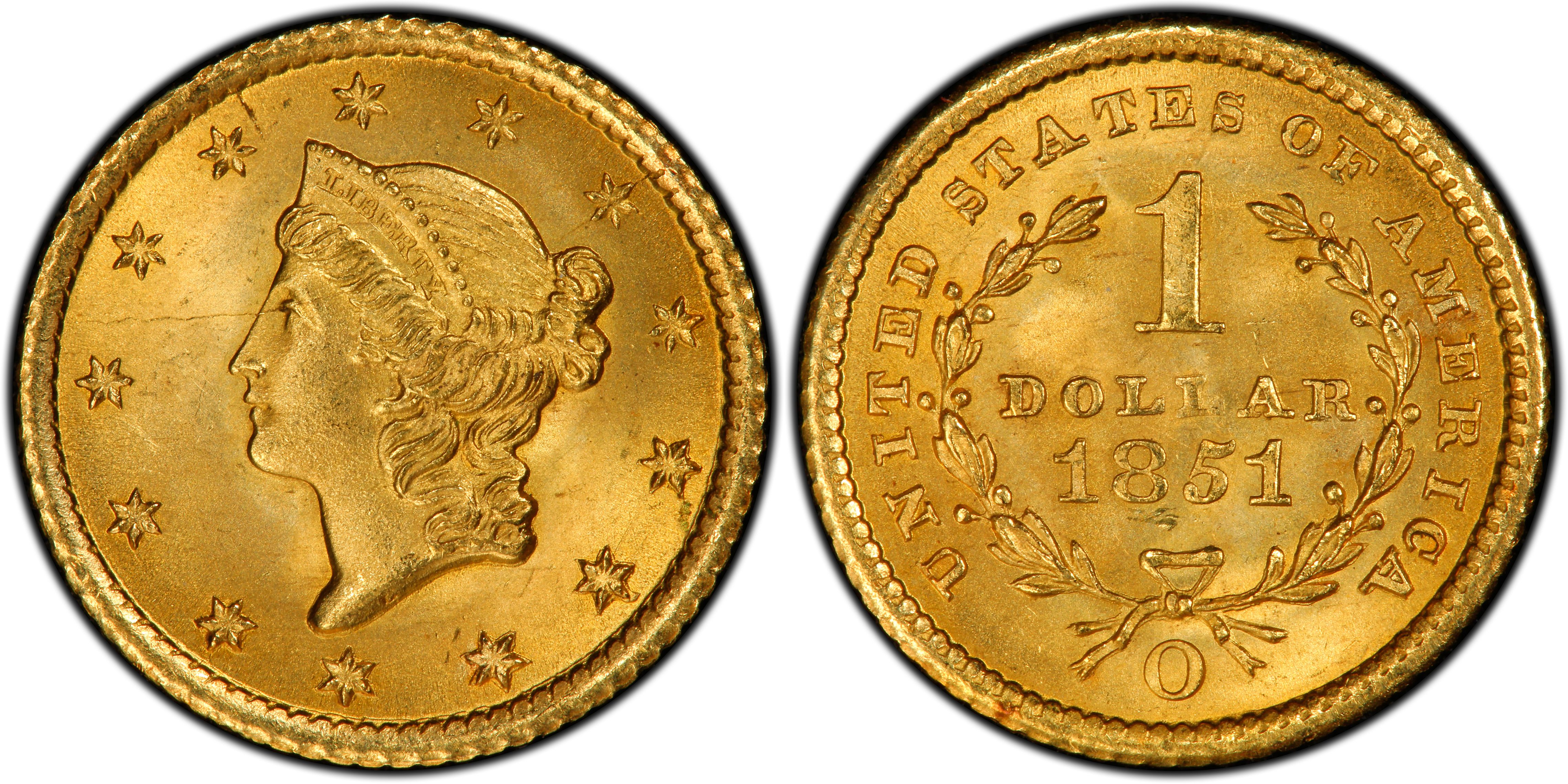 #1 MS66+ PCGS grade
|
| #2 MS66 PCGS grade |
| #2 MS66 PCGS grade |
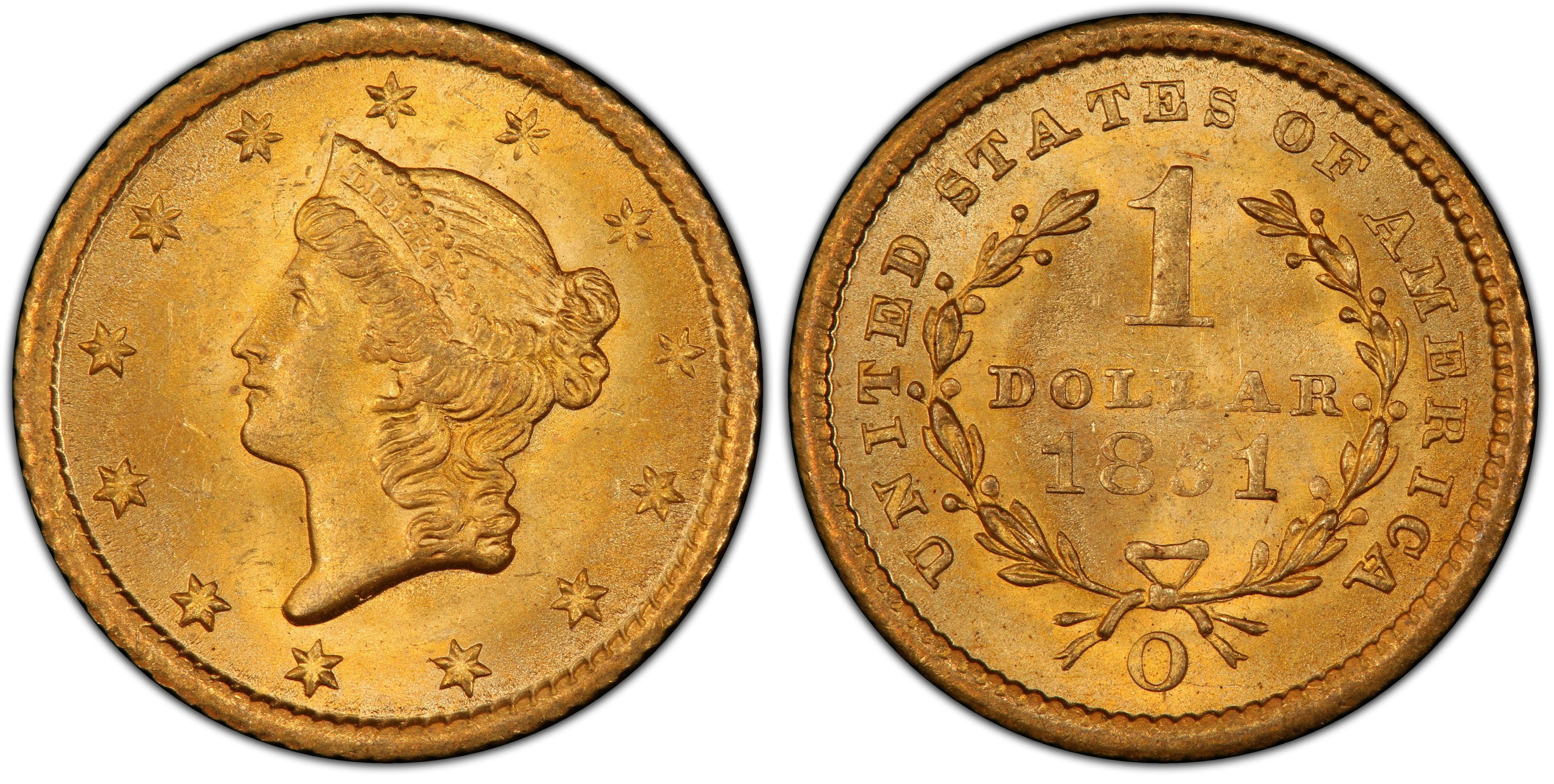 #4 MS65+ PCGS grade
|
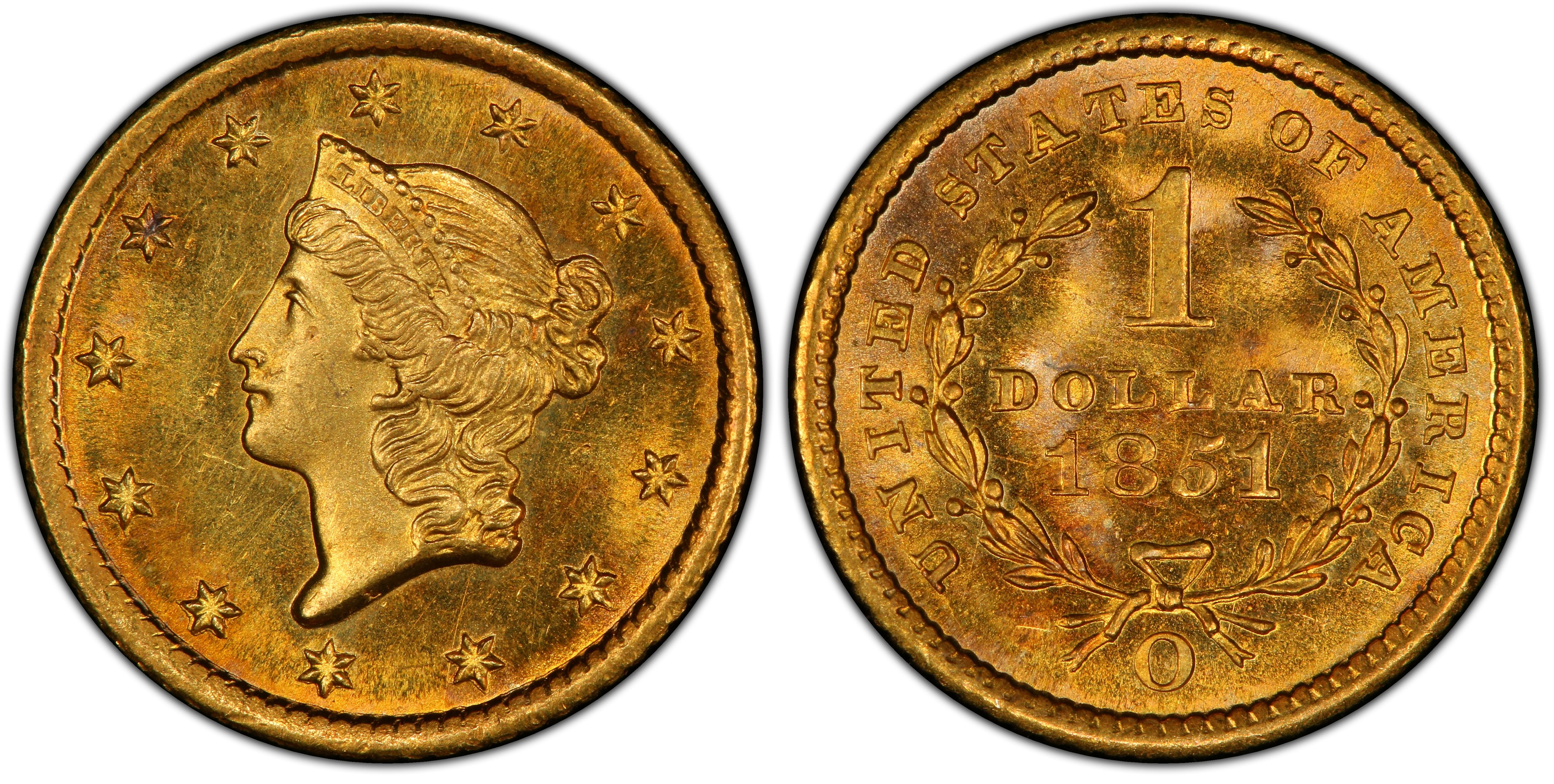 #4 MS65+ PCGS grade
|
| #4 MS65+ PCGS grade |
 #7 MS65 PCGS grade
|
| #7 MS65 PCGS grade |
| #7 MS65 PCGS grade |
| #7 MS65 PCGS grade |
David Akers (1975/88):
When available, this date, like the 1953-O, sells for a common date price. However, the data clearly indicates that it is two or three times as rare as the common Philadelphia Mint Type I gold dollars from the standpoint of total number of pieces available and condition.
Doug Winter:
The 1851-O Has a mintage figure that is tied with the 1853-O as the highest production figure of any gold dollaar from this mint. It is the most common of the six New Orleans gold dollars and has become far more available in high grades due to a small hoard of Gems located in 2004.
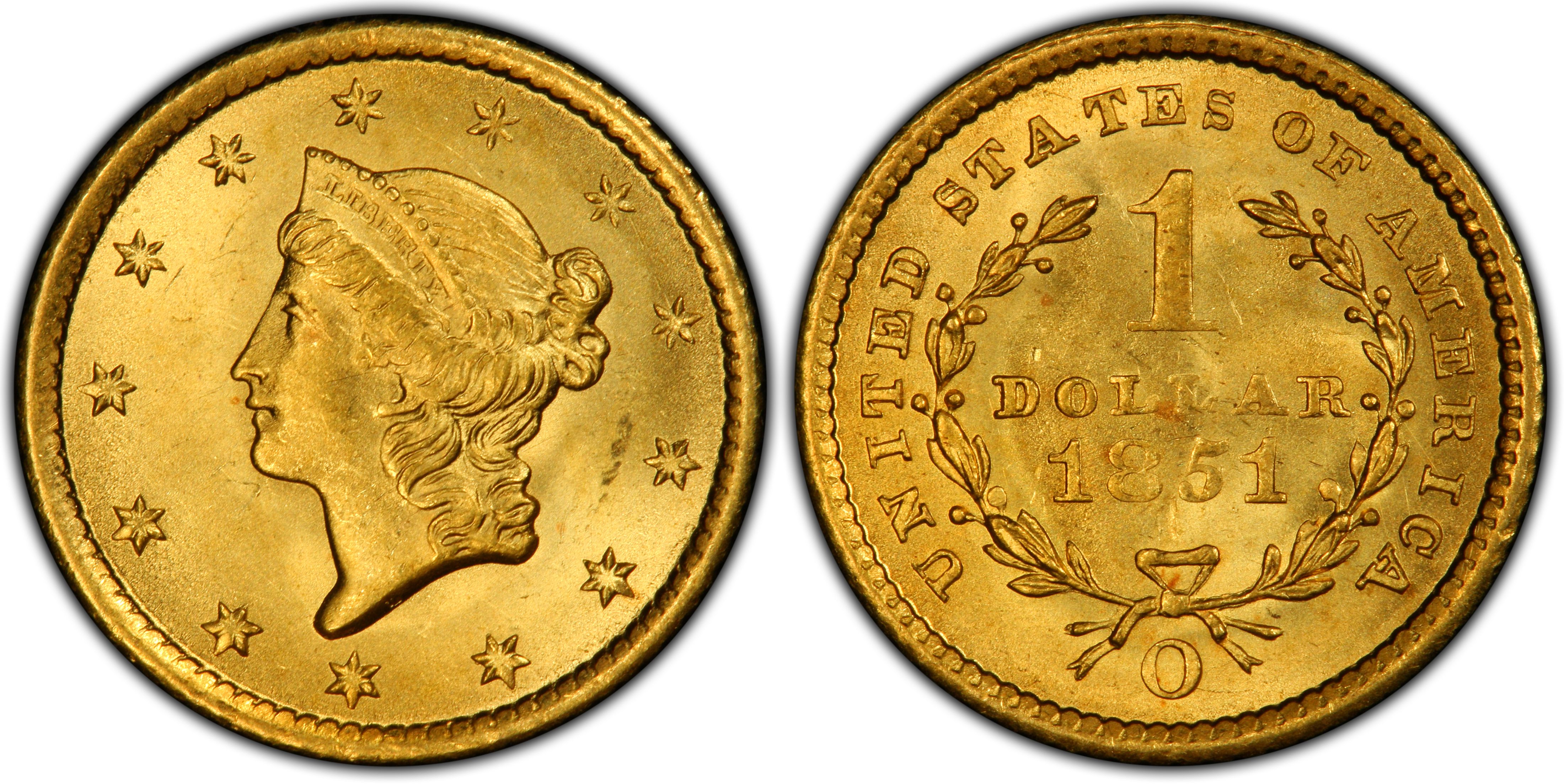
Strike: This issue does not come with as sharp a strike as seen on the two earlier gold dollars from New Orleans. The obverse is often slightly weak at the center with some of the hair strands above the ear of Liberty not fully impressed. The obverse border is quite sharp with the stars' radial lines complete. The reverse is not as well struck. Many 1851-O gold dollars are weak at the center with flatness on the LLA in DOLLAR as well as on the 85 in the date.
Surfaces: Most are heavily abraided. This is generally a well-made issue that does not have any mint-made defects or dark spotting seen on other New Orleans gold dollars of this type.
Luster: The luster is typically frosty in texture and is better than on other New Orleans gold dollars. I have seen a few slightly prooflike examples but these are usually washed-out in appearance and not attractive.
Coloration: The coloration seen on 1851-O gold dollars ranges widely. The most often seen hues are orange-gold and greenish-gold and pieces typically show combinations of these. It is still relatively easy to find examples that have not been dipped and which show very good color.
Eye Appeal: There are some extremely nice 1851-O gold dollars known that feature good color, luster and surfaces. It is difficult, however, to find a a piece that is well struck and even gems are likely to show weakness at the centers as mentioned above.
Die Characteristics: many 1851-O gold dollars show inner rings of roughness (possibly from die wear) at the peripheries of the obverse and reverse. The stars at 1:00 and 2:00 often appear more delicate than others as a result of die lapping.
Major varieties: There are two minor varieties known to me. Given the relative high original mintage figure for this date, it is likely that others exist.
Variety One: The stars are thinner at 12:00 to 2:00 than at the rest of the periphery. On this variety, the strike usually is weak at the center of the reverse.
Variety Two: The stars are full all the way around the periphery. On this variety, the strike is usually stronger at the center of the reverse.
It is not known which is the scarcer of these two varieties.
Strike: This issue does not come with as sharp a strike as seen on the two earlier gold dollars from New Orleans. The obverse is often slightly weak at the center with some of the hair strands above the ear of Liberty not fully impressed. The obverse border is quite sharp with the stars' radial lines complete. The reverse is not as well struck. Many 1851-O gold dollars are weak at the center with flatness on the LLA in DOLLAR as well as on the 85 in the date.
Surfaces: Most are heavily abraided. This is generally a well-made issue that does not have any mint-made defects or dark spotting seen on other New Orleans gold dollars of this type.
Luster: The luster is typically frosty in texture and is better than on other New Orleans gold dollars. I have seen a few slightly prooflike examples but these are usually washed-out in appearance and not attractive.
Coloration: The coloration seen on 1851-O gold dollars ranges widely. The most often seen hues are orange-gold and greenish-gold and pieces typically show combinations of these. It is still relatively easy to find examples that have not been dipped and which show very good color.
Eye Appeal: There are some extremely nice 1851-O gold dollars known that feature good color, luster and surfaces. It is difficult, however, to find a a piece that is well struck and even gems are likely to show weakness at the centers as mentioned above.
Die Characteristics: many 1851-O gold dollars show inner rings of roughness (possibly from die wear) at the peripheries of the obverse and reverse. The stars at 1:00 and 2:00 often appear more delicate than others as a result of die lapping.
Major varieties: There are two minor varieties known to me. Given the relative high original mintage figure for this date, it is likely that others exist.
Variety One: The stars are thinner at 12:00 to 2:00 than at the rest of the periphery. On this variety, the strike usually is weak at the center of the reverse.
Variety Two: The stars are full all the way around the periphery. On this variety, the strike is usually stronger at the center of the reverse.
It is not known which is the scarcer of these two varieties.