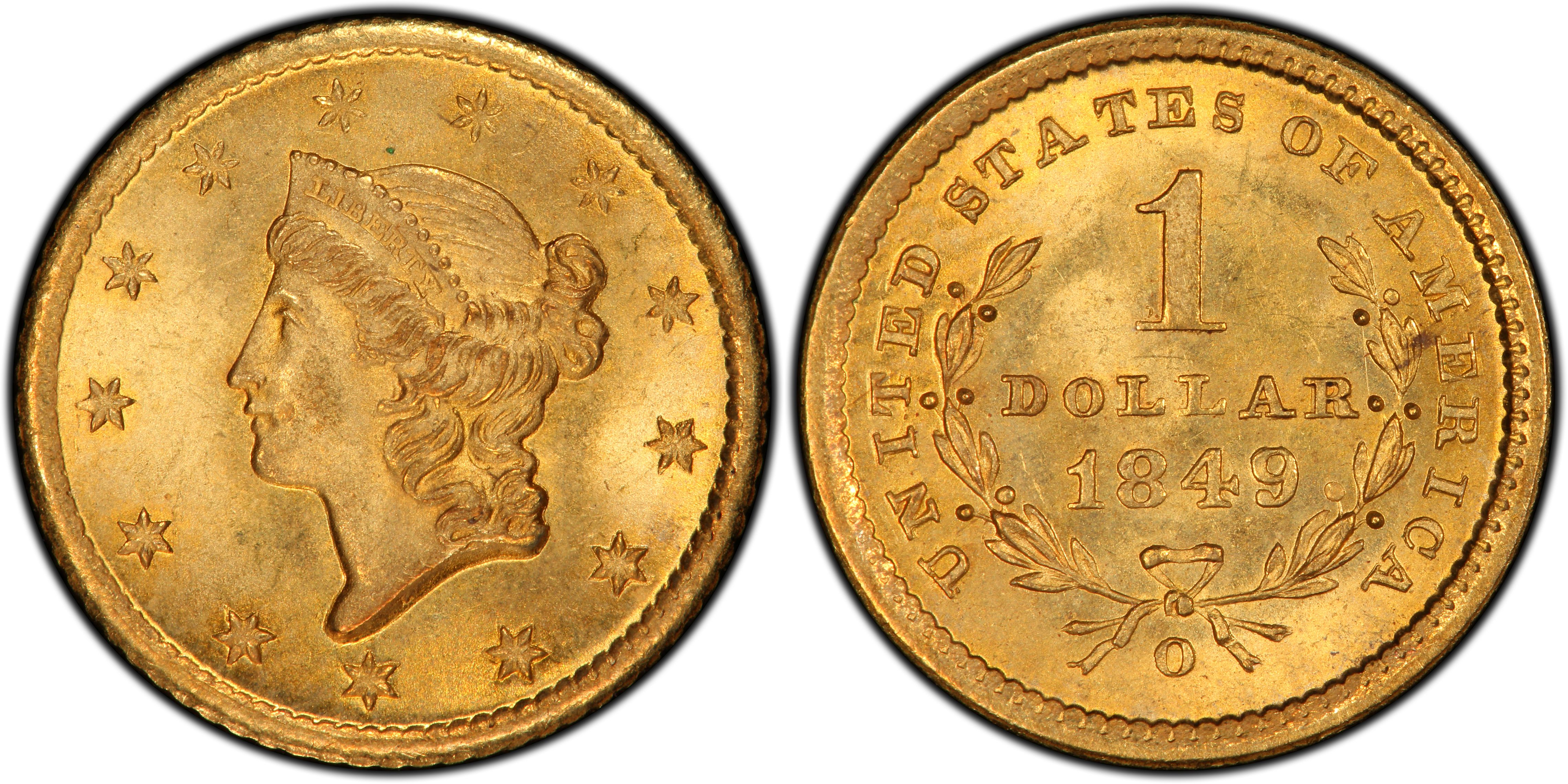
PCGS MS65+

PCGS MS65+
- PCGS #:
- 7508
- Designer:
- James Barton Longacre
- Edge:
- Reeded
- Diameter:
- 12.70 millimeters
- Weight:
- 1.70 grams
- Mintage:
- 215,000
- Mint:
- New Orleans
- Metal:
- 90% Gold, 10% Copper
- Auction Record:
- $32,900 • MS65+ • 08-16-2015 • Heritage Auctions
Major Varieties
- 1849-O G$1
Rarity and Survival Estimates Learn More
| Survival Estimate | |
|---|---|
| All Grades | 875 |
| 60 or Better | 250 |
| 65 or Better | 5 |
| Numismatic Rarity | |
|---|---|
| All Grades | R-5.2 |
| 60 or Better | R-6.6 |
| 65 or Better | R-9.7 |
| Relative Rarity By Type All Specs in this Type | |
|---|---|
| All Grades | 19 / 26 |
| 60 or Better | 16 / 26 |
| 65 or Better | 7 / 26 |
| Relative Rarity By Series All Specs in this Series | |
|---|---|
| All Grades | 59 / 81 |
| 60 or Better | 49 / 81 TIE |
| 65 or Better | 11 / 81 TIE |
Condition Census What Is This?
|
#1 PCGS MS65+
"Col" E.H.R. Green; Eric P. Newman and B.G. Johnson (St. Louis Stamp & Coin Co.); Eric P. Newman, $17.50; Eric P. Newman Numismatic Education Society. As NGC MS65 #2046370-027. "Selections from the Eric P. Newman Collection, Part V," Heritage Auctions, November 14, 2014, Lot 3172 - $11,816.98. As PCGS MS65+ #39271635. Legend Rare Coin Auctions, July 15, 2021, Lot 231 - $31,725. As PCGS MS65+ #39271635. "The Bender Family Collection, Part I," Heritage Auctions, August 24, 2022, Lot 3809 - $25,200. "The Monroe Collection" (PCGS Set Registry). Variety 1. |
|
#1 PCGS MS65+
Heritage Auctions, October 2011, Lot 4599 - $29,900; As PCGS MS65+ #24463212: “The Duckor Family Collection of Gold Dollars,” Heritage Auctions, August 12, 2015, Lot 4239 - $32,900. As PCGS MS65+ #40276026. “Important Selections of the Bob R. Simpson Collection, Part IV,” Heritage Auctions, February 23, 2021, Lot 3081 - $27,600. "The 400 Esplanade Collection" (PCGS Set Registry). Variety 1. Frosty luster. Small copper spot above Liberty’s head. Dimple at mouth. Grease stain on the upper right side of the wreath. |
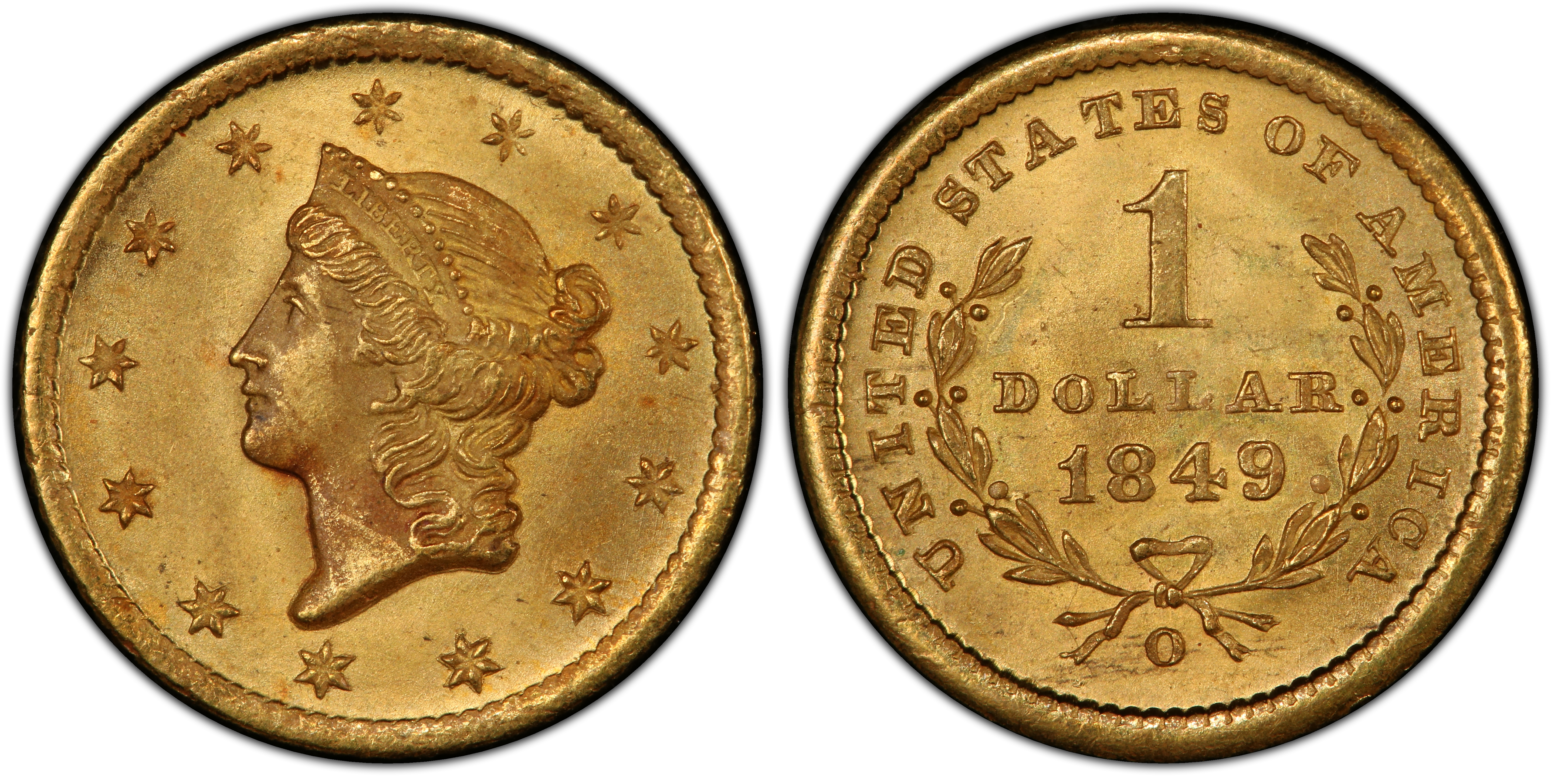 #1 PCGS MS65+
As PCGS MS65+ #25693401. Legend Rare Coin Auctions, June 25, 2015, Lot 389 - Passed; Heritage Auctions, January 7, 2016, Lot 5513 - $17,625. As PCGS MS65+ #82618366. Dell Loy Hansen; "The D.L. Hansen New Orleans Set" (PCGS Set Registry). Light copper spotting. Two pin-sized spots at stars 12 and 13 (bottom and bottom right). |
 #1 PCGS MS65+
|
|
#5 PCGS MS65
"The Davies and Niewoehner Collections," Paramount, February 1975, Lot 408. As PCGS MS65 #3473548. "The Harry W. Bass, Jr. Collection, Part II," Bowers and Merena, October 1999, Lot 33; "The Carolina Classics Collection," Heritage Auctions, August 16, 2024, Lot 5476 - $9,900; Heritage Auctions, January 17, 2025, Lot 5473 - $10,800. "The R.A. Napier Collection" (PCGS Set Registry). Variety 1. Diagonal die line behind Liberty's neck. Small tick in Liberty's hair above TY. |
 #5 PCGS MS65
"Col" E.H.R. Green; Eric P. Newman and B.G. Johnson (St. Louis Stamp & Coin Co.); Eric P. Newman, $17.50; Eric P. Newman Numismatic Education Society. As NGC MS65 #2046370-028: "Selections from the Eric P. Newman Collection, Part V," Heritage Auctions, November 2014, Lot 3173 - $11,750; Heritage Auctions, March 28, 2024, Lot 3069 - $12,000. As PCGS MS65 #58719009. Variety 3. Advanced die cracks are visible on the obverse: one extends from the rim to the bust truncation between stars 1 and 2, another runs from the rim at star 4 to the nose, a third goes from star 6 to the hair, and a fourth travels from the rim between stars 7 and 8 to the hair. The final crack goes from the rim, through star 11 to star 12, and then back to the rim. On the reverse, there are two notable dark spots: one near 6 o'clock at the rim and another at the "M" of "AMERICA." |
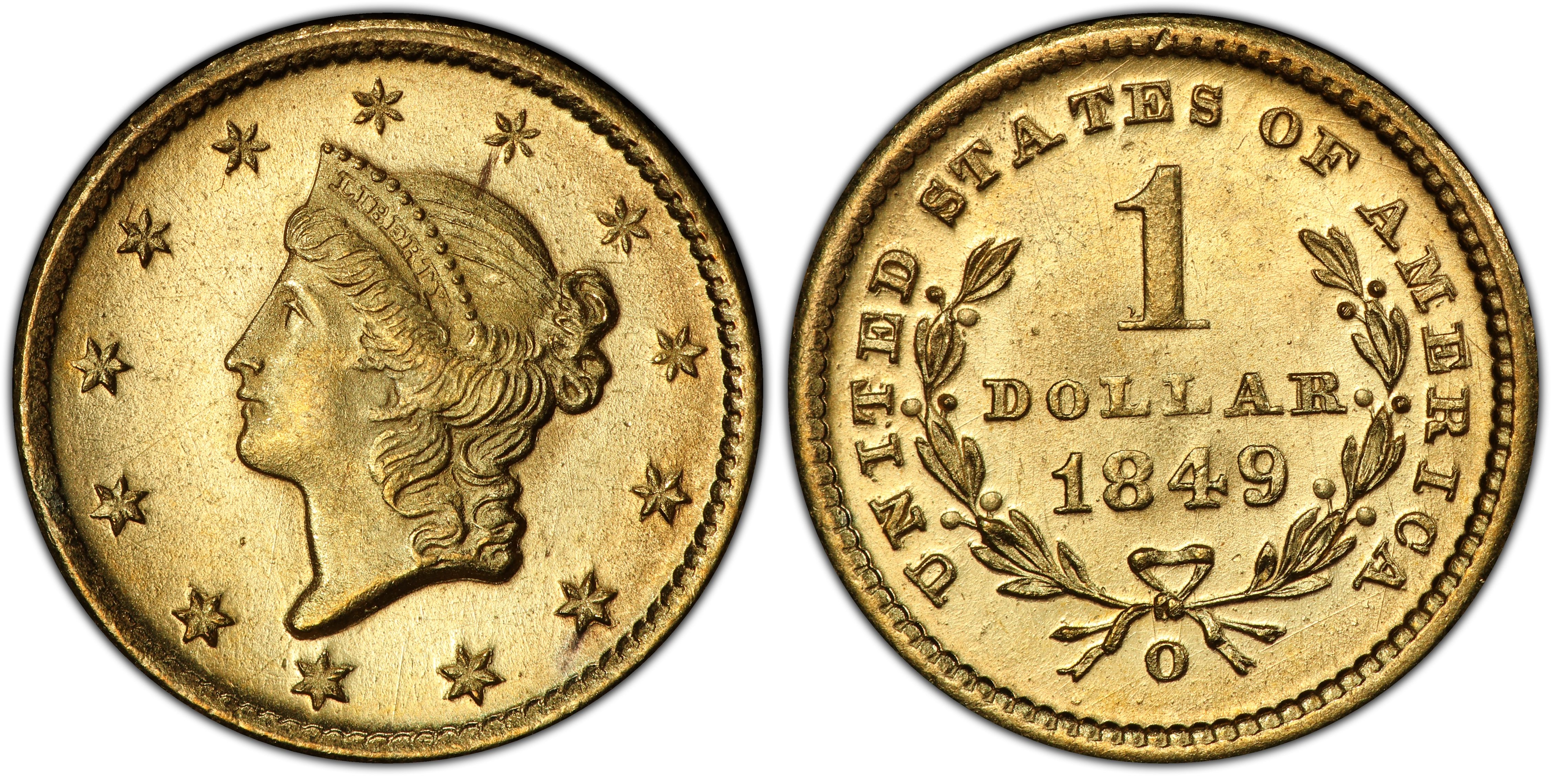 #5 PCGS MS65
As PCGS MS65 #6585325. Heritage Auctions, April 26, 2018, Lot 4304 - $12,600. As PCGS MS65 #35447404 Variety 1. Stain at star 8 to hair. Rim hit at 12 o'clock on the reverse. |
 #5 PCGS MS65
|
| #5 PCGS MS65 |
| #5 PCGS MS65 |
The Gold Dollar was the smallest circulating gold coin denomination struck by the United States Mint and the first new denomination introduced into circulation since the passage of the Coinage Act of 1792. It was one of two coin types authorized by the Coinage Act of March 3, 1849.
The Gold Dollar was authorized to contain 0.048375 troy ounces of fine gold. The coin, which had a diameter of 13mm, was slightly smaller than the then-circulating Liberty Seated Half Dime (15.5mm), but was slightly heavier (1.672 grams vs. 1.34 grams). While the Gold Dollar was significantly lighter and theoretically more portable than the silver dollar, its extreme smallness hindered its durability, circulation, and public acceptance.
The other authorized coin, the $20 "Double Eagle," was a massive 34mm gold coin weighing 33.436 grams and containing 0.9675 troy ounces of gold. The Double Eagle was meant to debut alongside the Gold Dollar but was delayed until 1850 due to a series of calamities that befell Mint Chief Engraver James Barton Longacre during the design process. Both coin types were introduced to facilitate the circulation of the huge influx of California gold that was flooding the Eastern and Western economies.
1849 Issues and Wreath Varieties
In 1849, Gold Dollars were struck at four mints: Philadelphia, Charlotte (C), Dahlonega (D), and New Orleans (O). The 1849 Philadelphia (#7502 and #7503) and 1849-O Gold Dollars (#7508) are the most common of the four issues.
All 1849-O Gold Dollars were struck with the Open Wreath reverse design. The other major reverse type, the Closed Wreath, features a wreath that extends closer to the top of the digit "1" in the denomination. The Closed Wreath design comprises the overwhelming majority of surviving 1849-C Gold Dollars (#7505) and was also struck in significant numbers at Philadelphia. Conversely, the Open Wreath 1849-C (#7506) is the rarest coin struck at the Charlotte Mint, with only four examples known today.
The New Orleans Mint struck 215,000 1849-O Gold Dollars and the coin saw heavy circulation, filling a gap caused by the disappearance of silver coins from circulation. This disappearance was caused by an imbalance of value of silver relative to gold, with silver coins being worth more than their face value. A few hundred examples survived in Mint State, possibly due to widespread hoarding of specie during the Civil War. Gold and Silver coins only returned to circulation gradually afterwards, with the Specie Payment Resumption Act of 1875 marking a major step towards economic normalcy. By then, the size of the coin collecting hobby in America had grown somewhat and it is likely that at least some Mint State coins survive today because they were pulled out of circulation in the latter part of the 19th century.
1849-O Gold Dollar Varieties
Numismatist Doug Winter enumerates three varieties of the 1849-O in his recent work, Gold Coins of the New Orleans Mint, 1839-1909 (Fifth Edition: 2025). All three are distinguished by differences in mintmark placement, but varieties one and three also exhibit clear characteristics that do not require measuring the exact location of the "O."
- Variety 1: Shows rotated repunching visible for the letters ME of AMERICA. There is also slight repunching offset to the left for the R in DOLLAR. The mintmark is centrally aligned with the left edge of the stem of the "L" in DOLLAR.
- Variety 2: On uncirculated pieces, a diagonal die line begins above the "A" in DOLLAR and continues to just above the center of the left leg of the "M" in AMERICA. The mintmark is also positioned lower than on varieties 1 and 3.
- Variety 3: The ribbon and bow on the reverse are heavily lapped, resulting in the removal of key design details.
Physical and Technical Characteristics Strike
The 1849-O Gold Dollar is typically found with weakness in the center of the reverse. Denticles are often weakly defined, and the rims frequently exhibit a rounded appearance. The Mint's use of the dies was aggressive, leading to profound die damage on some examples. Collector Eric P. Newman once described one such coin as having "About 28 cracks + break."
Surfaces and Luster
- Surfaces: Minor ticks and contact marks are common, limiting most Mint State 1849-O Gold Dollars to the lower range of Mint State grades.
- Luster: Surfaces can range from granular to semi-prooflike. Liberty's portrait on the obverse often exhibits a frosted appearance.
Coloration and Eye Appeal
- Coloration: A greenish-gold color is typical for this date, though some examples will exhibit touches of orange-gold. Copper spots, while not prevalent, are found from time to time, even on high-end examples.
- Eye Appeal: The inherent softness found on the typical reverse tends to hold the 1849-O back somewhat. While examples from MS64 and higher with strong eye appeal exist, other New Orleans issues generally boast a higher percentage of nicer coins.
* * *
Regency XII Preview | Legend Rare Coin Auctions | June 25, 2015
(Starts at 10:21)