
PCGS PR64
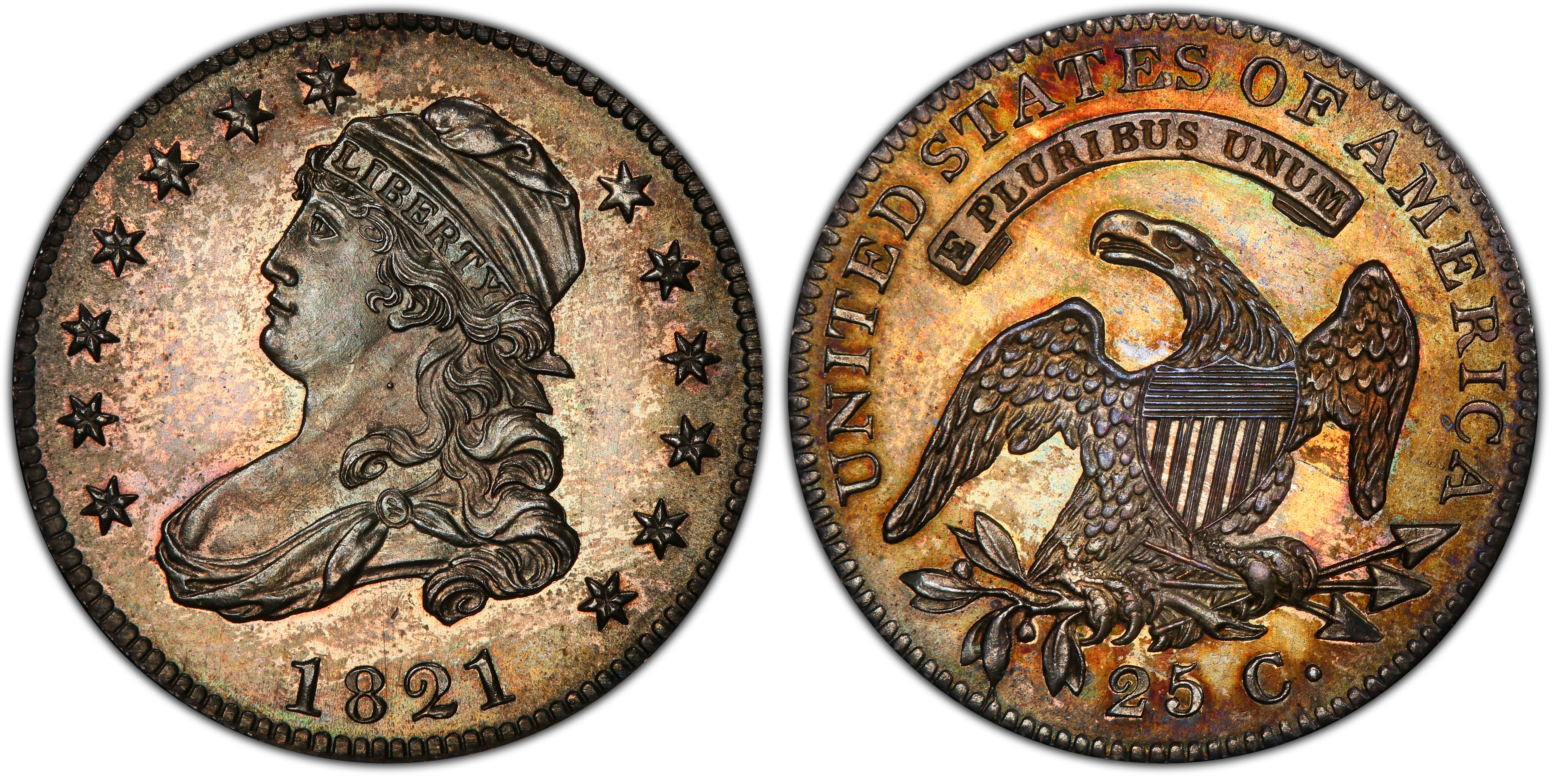
PCGS PR64
- PCGS #:
- 5366
- Designer:
- John Reich
- Edge:
- Reeded
- Diameter:
- 27.50 millimeters
- Weight:
- 6.74 grams
- Mintage:
- 15
- Mint:
- Philadelphia
- Metal:
- 89.2% Silver, 10.8% Copper
- Auction Record:
- $252,000 • PR64 • 08-24-2023 • Stack's Bowers
Major Varieties
- 1821 25C
Rarity and Survival Estimates Learn More
| Survival Estimate | |
|---|---|
| All Grades | 2 |
| 60 or Better | 2 |
| 65 or Better | 1 |
| Numismatic Rarity | |
|---|---|
| All Grades | R-9.9 |
| 60 or Better | R-9.9 |
| 65 or Better | R-10.0 |
| Relative Rarity By Type All Specs in this Type | |
|---|---|
| All Grades | 2 / 9 TIE |
| 60 or Better | 2 / 9 TIE |
| 65 or Better | 1 / 9 TIE |
| Relative Rarity By Series All Specs in this Series | |
|---|---|
| All Grades | 3 / 16 TIE |
| 60 or Better | 3 / 16 TIE |
| 65 or Better | 1 / 16 TIE |
Condition Census What Is This?
 #1 PR67 PCGS grade
Thomas Cleneay Collection - S.H. & Henry Chapman 12/1890:1332 - John G. Mills Collection - S.H. & Henry Chapman 4/1904:994 - George H. Earle Collection - Henry Chapman 6/1912:3054 - Louis E. Eliasberg, Sr. Collection - Bowers & Merena 4/1997:1383, $121,000 - Dr. Gene Sherman, sold privately on 3/6/2001 - D. Brent Pogue Collection - Stack’s/Bowers & Sotheby’s 5/2015:1066, $235,000 |
| #2 PR66 estimated grade |
| #3 PR64 estimated grade |
| #4 PR63 estimated grade |
| #4 PR63 estimated grade |
Proof 1821 Quarter Dollars are exceedingly rare, with perhaps as few as four examples known to researchers. The undisputed Proof in the National Numismatic Collection at the Smithsonian Institution is one of them. A second is the D. Brent Pogue PCGS PR67 that sold in 2015 for a record $235,000. A third example appeared in the Norweb sale as a one-sided Proof; it is now in an NGC PR65 holder. A fourth example appeared in the Eugene Gardner sale as an NGC PR65. A fifth candidate is the Robison example, but it has not reappeared on the market since 1999, when it sold for a mere $9,775 (compared to the $48,875 Gardner paid for his example in the same year -- nonetheless, Rory Rea et al list this example as a PR60).
Clearly, there are not 12-16 Proof 1821 Quarters, as previous authors have claimed. In truth, this is one of the rarest of all early U.S. Proof coins.
LOT 1066 1821 Capped Bust Quarter