1831 25C Large Letters (Regular Strike)
Series: Capped Bust Quarters 1815-1838

PCGS MS65

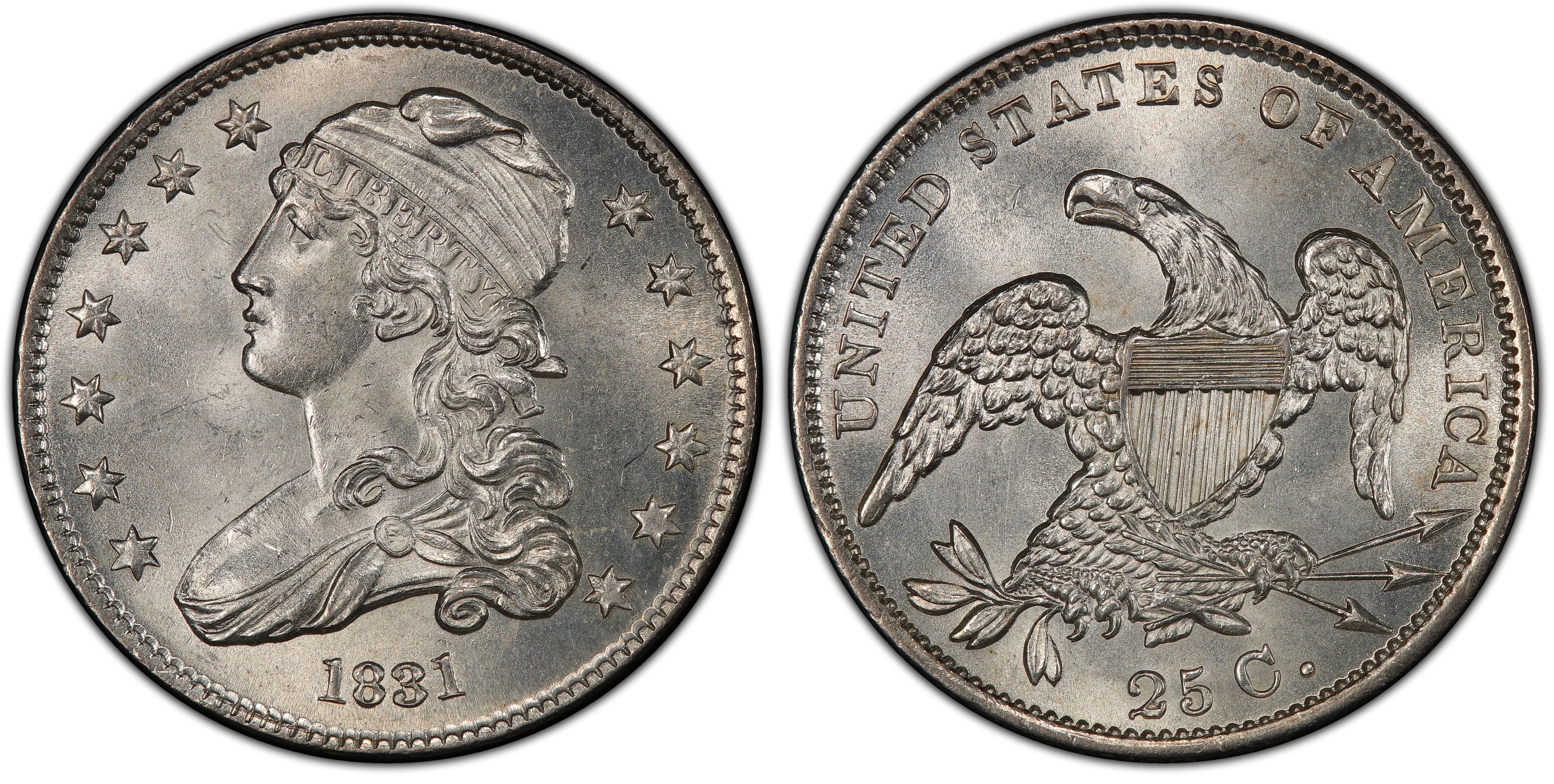
PCGS MS65
- PCGS #:
- 5349
- Designer:
- John Reich
- Edge:
- Reeded
- Diameter:
- 24.30 millimeters
- Weight:
- 6.74 grams
- Mintage:
- 398,000
- Mint:
- Philadelphia
- Metal:
- 89.2% Silver, 10.8% Copper
- Auction Record:
- $16,100 • MS65 • 01-01-2009 • Heritage Auctions
Major Varieties
- 1831 25C Small Letters
- 1831 25C Small Letters, PL
- 1831 25C Large Letters
- 1831 25C Large Letters, PL
Go To Grade
Current Auctions - PCGS Graded
Current Auctions - NGC Graded
For Sale Now at Collectors Corner - PCGS Graded
For Sale Now at Collectors Corner - NGC Graded
Rarity and Survival Estimates Learn More
| Survival Estimate | |
|---|---|
| All Grades | 875 |
| 60 or Better | 20 |
| 65 or Better | 4 |
| Numismatic Rarity | |
|---|---|
| All Grades | R-5.2 |
| 60 or Better | R-9.1 |
| 65 or Better | R-9.8 |
| Relative Rarity By Type All Specs in this Type | |
|---|---|
| All Grades | 1 / 9 |
| 60 or Better | 1 / 9 |
| 65 or Better | 3 / 9 TIE |
| Relative Rarity By Series All Specs in this Series | |
|---|---|
| All Grades | 9 / 24 |
| 60 or Better | 11 / 24 |
| 65 or Better | 7 / 24 TIE |
Condition Census What Is This?
| #1 MS65 PCGS grade |
| #1 MS65 PCGS grade |
| #1 MS65 PCGS grade |
| #1 MS65 PCGS grade |
| #1 MS65 PCGS grade |
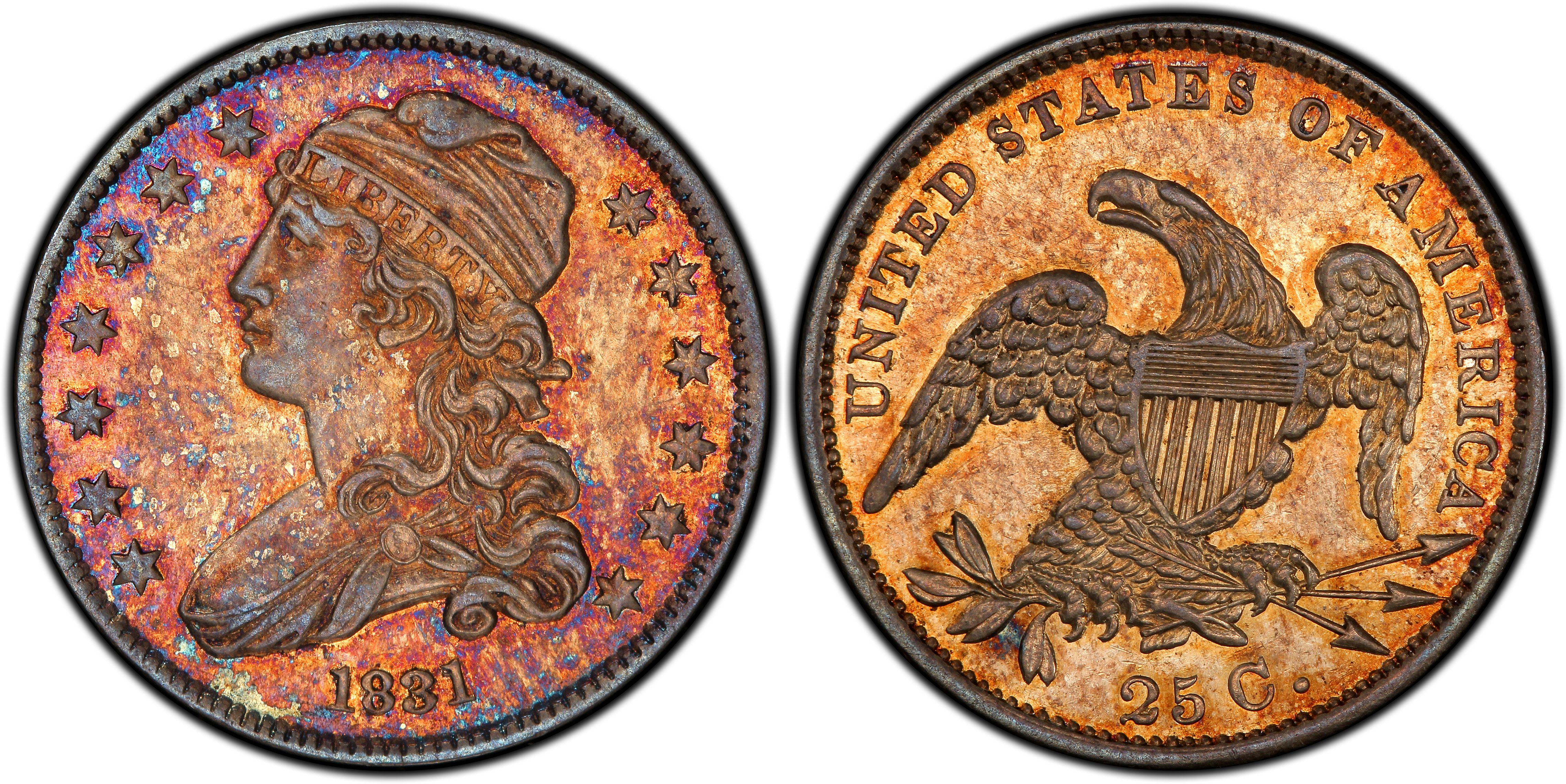 #6 MS64 PCGS grade
Heritage 4/2015:4092, $8,812.50 |
|
#6 MS64 PCGS grade
Heritage 9/2013:6346, $7,637.50 |
|
#6 MS64 PCGS grade
American Numismatic Rarities 1/2004:1411 - Eugene H. Gardner Collection - Heritage 6/2014:30353, $10,575 |
| #6 MS64 PCGS grade |
| #6 MS64 PCGS grade |
In 1831, four obverses and five reverses were combined for seven Capped Bust Quarter die pairs. These seven are generally grouped according to the size of the letters in the reverse legend, with Browning 1 through 4 known as “Small Letters”, and Browning 5 through 7 known as “Large Letters”. However, there is much more to the story than suggested by this simple and traditional Small vs. Large classification.
1831 is the first year of issue for the Capped Bust, “Small Size” Quarter type. And after a two year break, it appears that the resumption of the quarter denomination had a little trouble getting back to speed. Not only do we see the “Small” and “Large” letter sets, but a variety of number punches, including four different styles of “2” among the five reverses. Browning 1 shows a small, curl based 2, B-2 a small, flat based 2, B-3 and B-4 a “medium” sized square base 2, and B-5 through B-7 a large, curled base 2 that saw continued use through 1838.
With the exception of Browning 3, 1831 “Small Letters” Quarters are regularly available in upper Mint State grades. However, 1831 “Large Letters” Quarters are notably scarcer as a group, with Mint State examples likely to be B-5, and no surviving examples of B-7 known above the circulated grades.
1831 is the first year of issue for the Capped Bust, “Small Size” Quarter type. And after a two year break, it appears that the resumption of the quarter denomination had a little trouble getting back to speed. Not only do we see the “Small” and “Large” letter sets, but a variety of number punches, including four different styles of “2” among the five reverses. Browning 1 shows a small, curl based 2, B-2 a small, flat based 2, B-3 and B-4 a “medium” sized square base 2, and B-5 through B-7 a large, curled base 2 that saw continued use through 1838.
With the exception of Browning 3, 1831 “Small Letters” Quarters are regularly available in upper Mint State grades. However, 1831 “Large Letters” Quarters are notably scarcer as a group, with Mint State examples likely to be B-5, and no surviving examples of B-7 known above the circulated grades.
Gordon Wrubel:
Quickfinder Notes: 1831 was the year of transition to the new close collar reduced diameter(24mm versus 28mm) quarter coinage. In order to get the best striking results from his design, William Kneass tried two different letter sizes for the reverse die. The letters on the Large Letter reverse appear to be TALLER than they are WIDE and are placed CLOSE the rim. Even more apparent, both Ts in STATES are MUCH LARGER than the adjacent letters. The Small Letter reverse can be distinguished not only by their smaller size, as they are about as WIDE as they are TALL, and are placed noticeably FARTHER AWAY from the rim. In total population, the Small Letter variety is about five times more common than the Large Letter variety. The Mint State population difference is even more striking with about eight times as many examples graded as the Large Letter variety.