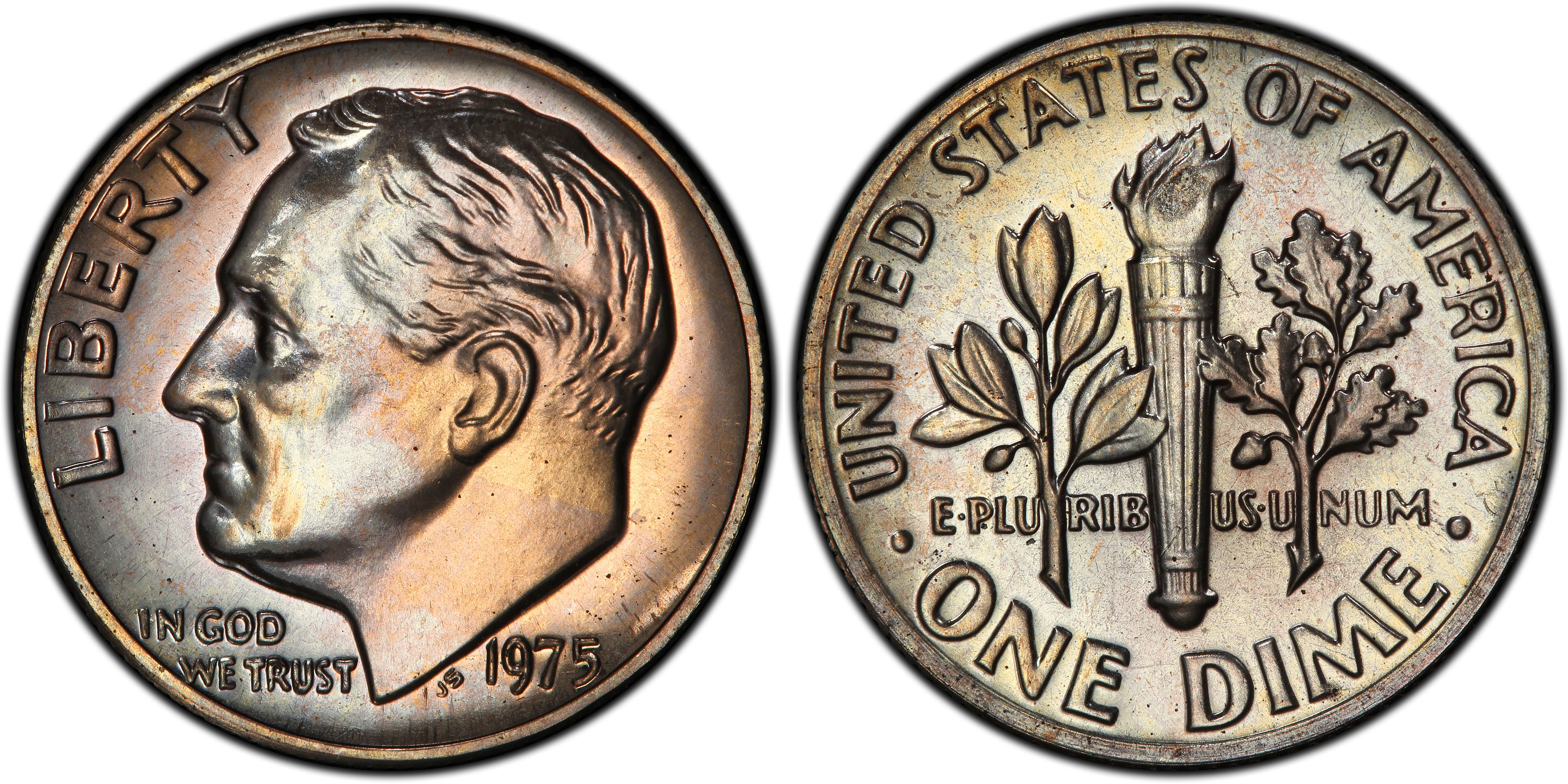
PCGS PR67
- PCGS #:
- 5254
- Designer:
- John R. Sinnock
- Edge:
- Reeded
- Diameter:
- 17.90 millimeters
- Weight:
- 2.27 grams
- Mintage:
- 2,845,450
- Mint:
- Philadelphia
- Metal:
- 75% Copper, 25% Nickel over a pure Copper center
- Auction Record:
- $456,000 • PR68 • 09-08-2019 • Heritage Auctions
Rarity and Survival Estimates Learn More
| Survival Estimate | |
|---|---|
| All Grades | 2 |
| 60 or Better | 2 |
| 65 or Better | N/A |
| Numismatic Rarity | |
|---|---|
| All Grades | R-9.9 |
| 60 or Better | R-9.9 |
| 65 or Better | |
| Relative Rarity By Type All Specs in this Type | |
|---|---|
| All Grades | 1 / 2 |
| 60 or Better | 1 / 2 |
| 65 or Better | 1 / 2 |
| Relative Rarity By Series All Specs in this Series | |
|---|---|
| All Grades | 1 / 2 |
| 60 or Better | 1 / 2 |
| 65 or Better | 1 / 2 |
Condition Census What Is This?
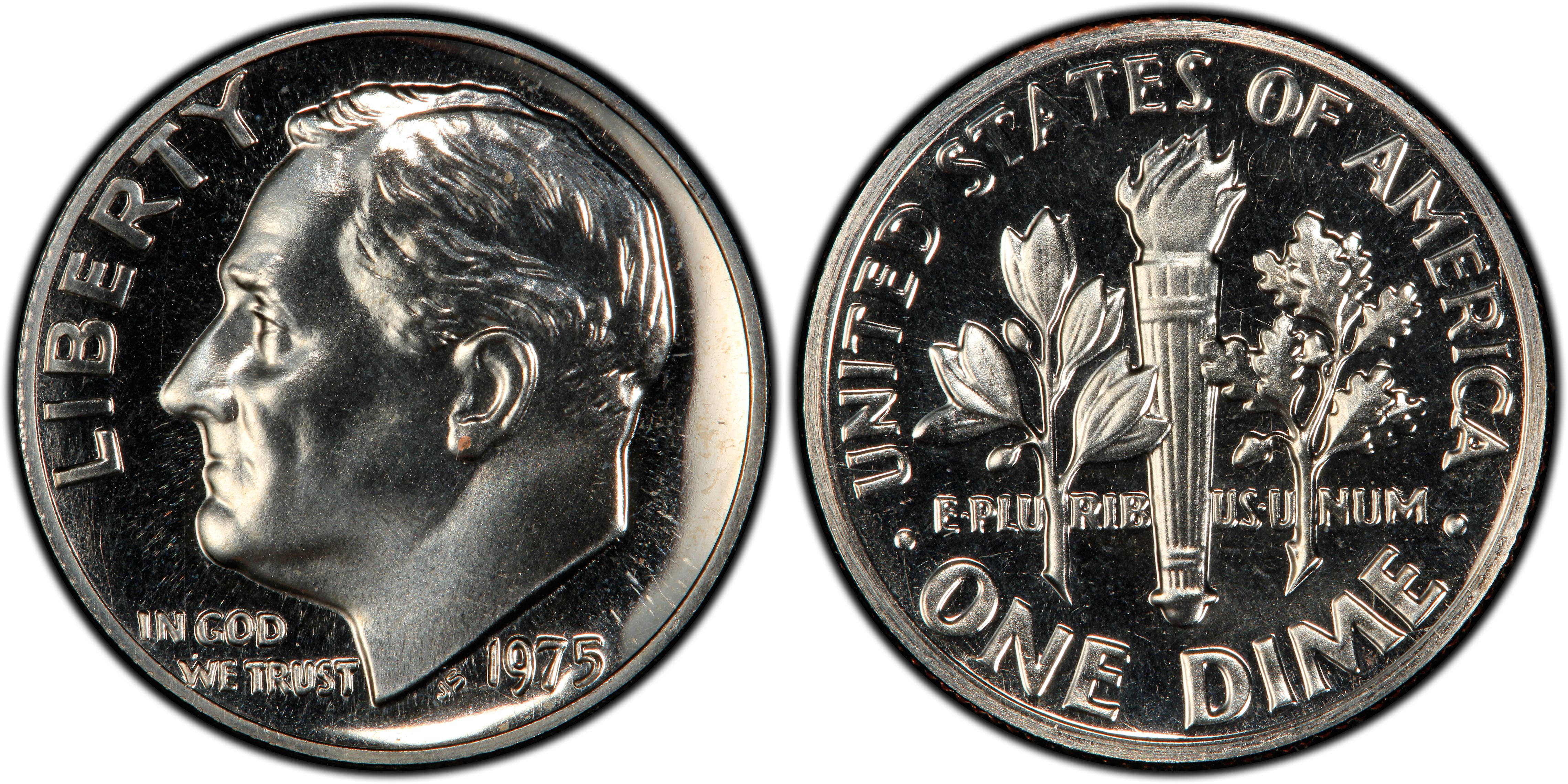 #1 PCGS PR68
Unknown California Proof Set buyer; Fred Vollmer – $38,550; Unknown intermediaries; Ken Goldman; Sold in OGP; Stack’s Bowers, August 13, 2011, Lot 7297 – $349,600; As PCGS PR68 #20519253: “The Paulos Family Collection, Part II,“ Heritage Auctions, September 6, 2019, Lot 4715 – $456,000; "The Halcyon Colletion" (PCGS Set Registry). |
|
#2 PCGS PR67
Unknown California Proof Set buyer (possibly "Ruth E."); Fred Vollmer to "Ohio dairy farmer" for $18,200; GreatCollections, October 27, 2024, Lot 1655587 – $506,250. Discovery coin. Steel blue, aubergine, and gold toning. |
The 1975 "No S" Proof Roosevelt Dime
The 1975 "No S" Proof Roosevelt Dime (PCGS #5254) is one of the most elusive and expensive modern rarities in U.S. numismatics. With only two known examples, its scarcity is legendary. In 2019, one of these specimens realized an astonishing $456,000 at auction; a more recent 2024 appearance pushed the coin's value over $500,000. Because of this high value, clickbait videos often circulate online, leading many to believe they have found a third example in their pocket change. However, there is a critical technical distinction that determines whether a 1975 Roosevelt Dime is a common coin or a life-changing rarity.
Proof Strikes vs. Business Strikes
To be clear: the "No S" rarity is a Proof coin. Proofs are struck using a specialized process involving polished planchets and dies. They are struck individually at high pressure and were originally sold only in official Proof Sets. Since 1968, when the San Francisco Mint began striking Proof coins, all Proof versions of circulating U.S. coins have been struck there and carry the "S" mintmark. On the "No S" Proof, this mintmark is notably absent.
Business strikes, by contrast, are common. In 1975, the United States Mint produced circulating Roosevelt Dimes at its Philadelphia and Denver facilities. The Denver coins carry a "D" mintmark, but the Philadelphia coins do not. Traditionally, the main Mint in Philadelphia did not use mintmarks; it was only in 1980 that the "P" mintmark was adopted for all denominations except the Lincoln Cent. In 1975, Philadelphia struck 585,673,900 Roosevelt Dimes for circulation. None of these carry a mintmark.
While a Proof may lose some brilliance over time, it will usually retain the distinctive mirror-like "fabric" that differentiates it from the "satin" or dull finish of a business strike. Unfortunately for most hunters, the non-mintmarked 1975 dimes found in loose change were never intended to have a mintmark in the first place.
The Origins of the "No S" Error
The existence of "No S" Proof coins is a result of how Proof dies were handled. Beginning in 1968, all dies for Proof coins were prepared at the Philadelphia Mint. This was done by adding an "S" mintmark to a Proof die before shipping it to San Francisco. Occasionally, a die escaped this process. This led to similar "No S" errors in 1968, 1970, and 1983 Roosevelt Dimes, 1971 Jefferson Nickels (#4204), and 1990 Lincoln Cents (#93506). However, while those other years have certified populations ranging from 24 to 242, the 1975 remains the king of the series with only two.
There are two plausible conjectures for why the 1975 is so uniquely rare:
- The Early Catch: The error was discovered at the Mint in time to stop the press, but a handful escaped.
- The Intentional Error: The coins may have been deliberately made. This theory is supported by the emergence of other "impossible" Proof errors from San Francisco in that era, such as a 1970-S Washington Quarter struck over a 1900 Barber Quarter. This is the less likely scenario, however.
A History of Discovery
The "No S" 1975 Roosevelt Dime has a well-publicized but piecemeal provenance. The first example was discovered in a 1975 Proof Set in 1977. The second was found several years later. The "discovery coin" was sold in 1979 to Proof specialist Fred Vollmer, who then placed it with a private collector. Remarkably, despite their fame, neither coin appeared at public auction until the discovery coin was featured in the 2011 ANA sale by Stack's Bowers.
What to Do If You Believe You Have Found One
The two known 1975 "No S" Proofs are fully brilliant and lack the "cameo" contrast (frosted devices) found on many Proof issues of that period. If a third example were discovered with "cameo" frost, it would suggest that multiple die pairs were put into service without mintmarks or that a significant number of "No S" Proofs were struck, and that the cameo frost faded away. If you possess a 1975 Roosevelt Dime that exhibits the deep mirrors of a Proof strike but lacks the "S," PCGS certification is an absolute necessity. However, bear in mind that it has been fifty years since these coins were produced, and no new example has surfaced since 1984. Statistically, more people have won hundreds of millions in the Powerball than have found this elusive dime.
* * *