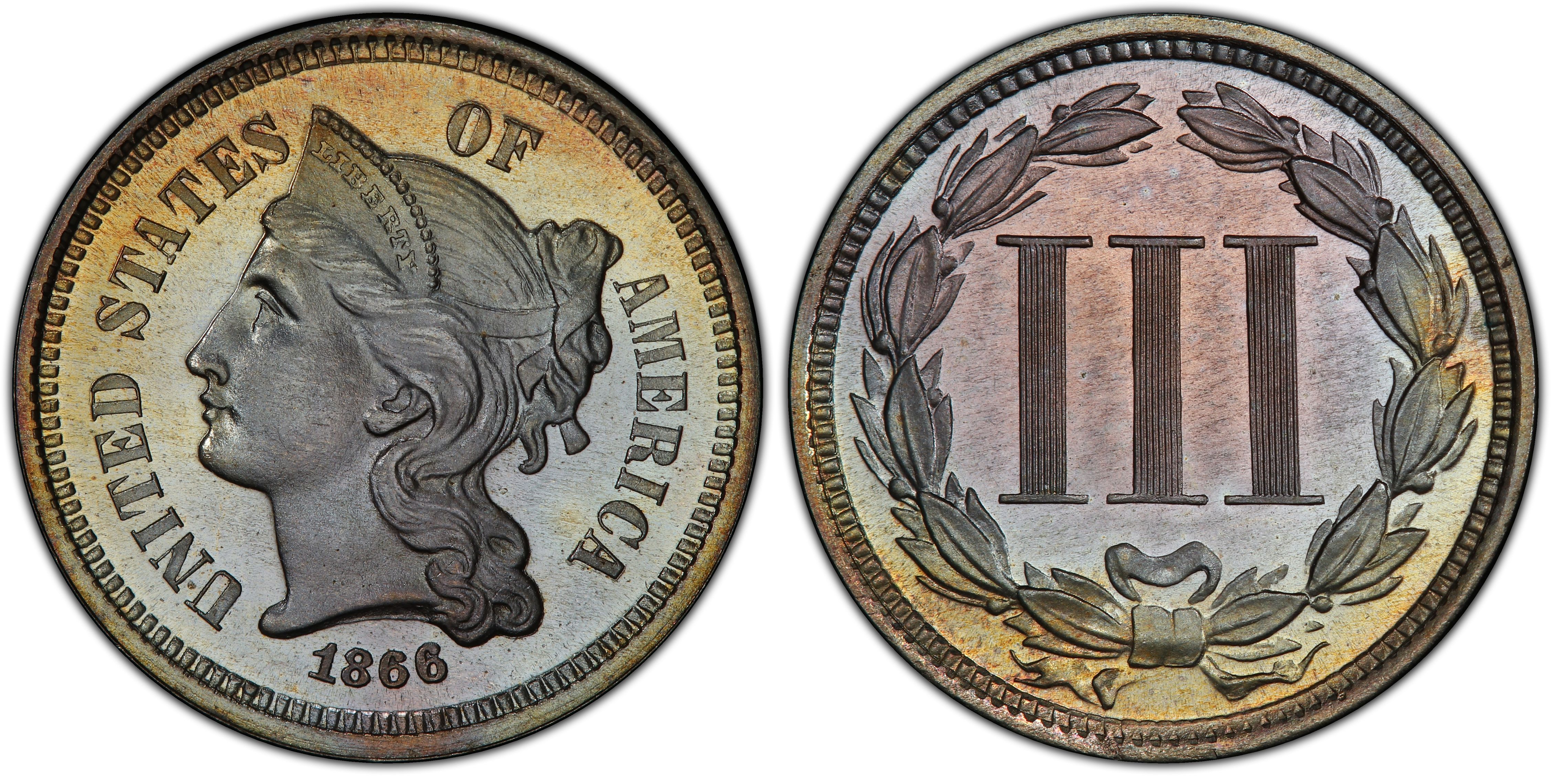
PCGS PR67

PCGS PR66
- PCGS #:
- 3762
- Designer:
- James Barton Longacre
- Edge:
- Plain
- Diameter:
- 17.90 millimeters
- Weight:
- 1.94 grams
- Mintage:
- 725
- Mint:
- Philadelphia
- Metal:
- 75% Copper, 25% Nickel
- Auction Record:
- $8,625 • PR66 • 02-13-2008 • Heritage Auctions
Rarity and Survival Estimates Learn More
| Survival Estimate | |
|---|---|
| All Grades | 650 |
| 60 or Better | 640 |
| 65 or Better | 175 |
| Numismatic Rarity | |
|---|---|
| All Grades | R-5.7 |
| 60 or Better | R-5.7 |
| 65 or Better | R-7.2 |
| Relative Rarity By Type All Specs in this Type | |
|---|---|
| All Grades | 7 / 26 TIE |
| 60 or Better | 8 / 26 |
| 65 or Better | 2 / 26 TIE |
| Relative Rarity By Series All Specs in this Series | |
|---|---|
| All Grades | 7 / 26 TIE |
| 60 or Better | 8 / 26 |
| 65 or Better | 2 / 26 TIE |
Condition Census What Is This?
|
#1 PCGS PR67
Stack's Bowers, August 20, 2019, Lot 5124 - $4,080. Gold and green toning washes over the obverse. Gold toning spot below second A of AMERICA. Reverse carries over the same colors but adds rose color at the center. |
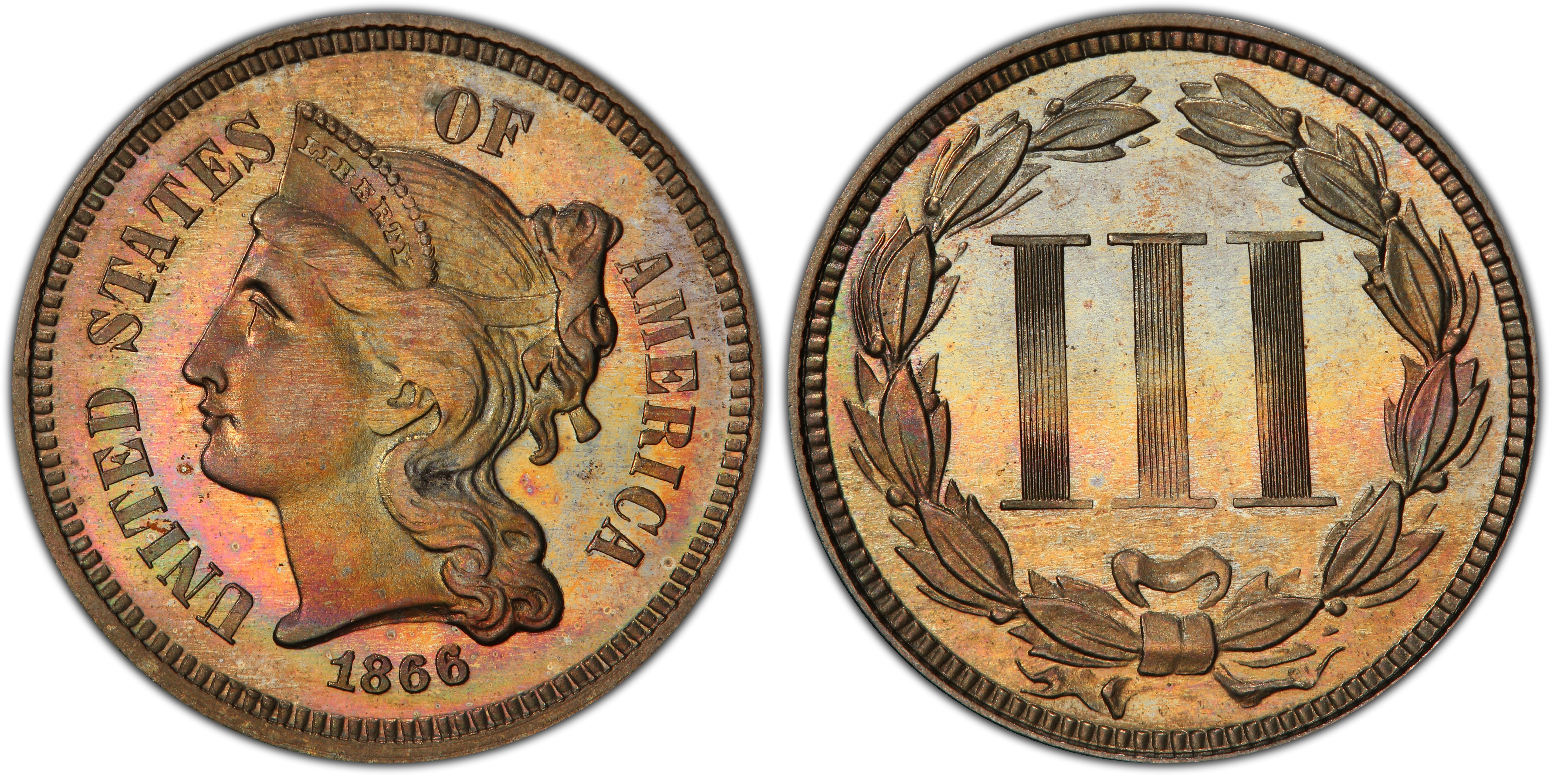 #1 PCGS PR67
"The 70shark Collection" (PCGS Set Registry). Richly toned on both sides. The obverse is dominated by vibrant rose, magenta, and green hues, with a single toning spot noted at the denticles above the second 'A' in AMERICA. The reverse displays a subtle crescent toning pattern, featuring green across the upper portion that blends into gold, orange, and rose tones below. |
1866 Three-Cent Nickel Proof: Mintage and Varieties
According to the standard references, the Philadelphia Mint struck a minimum of 725 1866 Three-Cent Nickel Proofs (#3762, CAM #83762, DCAM #93762). However, in United States Proof Coins: Volume II: Nickel (2023), numismatist John Dannreuther estimates a slightly higher issue of 800 pieces.
The production involved one obverse die and two reverse dies. The predominant die pair is JD-1, which Dannreuther estimates was used for 85% of the 1866 Proof Three-Cent Nickel production. Allan Gifford, in The Ultimate Guide to U.S. Three Cent Nickels: 1865 to 1889 (2003) writes that the reverse is rotated 4% clockwise.
The JD-2 pair, discovered by Gary Rosner, is notable for its full detail and the presence of distinct die chips in the left-side denticles.
Collecting the 1866 Three-Cent Nickel Proof.
While some researchers estimate the actual mintage could range as high as 800 to 1,200 pieces, the PCGS Population Report provides a clear look at the number and grade distribution of surviving specimens in our holders. Using the 725 mintage figure as a baseline, 44.3% of the mintage has been PCGS certified. Of those, 30% grade at Proof 64 and 36% at Proof 65. The issue becomes conditionally scarce in grades finer than Proof 66.
The breakdown of contrast designations is equally compelling:
- Brilliant vs. Cameo: Non-Cameo (Brilliant) pieces outnumber Cameos 1.34 to 1.
- Deep Cameo: These remain elusive, with fewer than 10% of all graded coins earning the DCAM designation.
Vintage Market Snippet
In the March 1965 issue of The Numismatist, dealer Donald E. Brigandi offered "gem Proof" examples of the 1866 Three-Cent Nickel for just $195 each.
* * *