
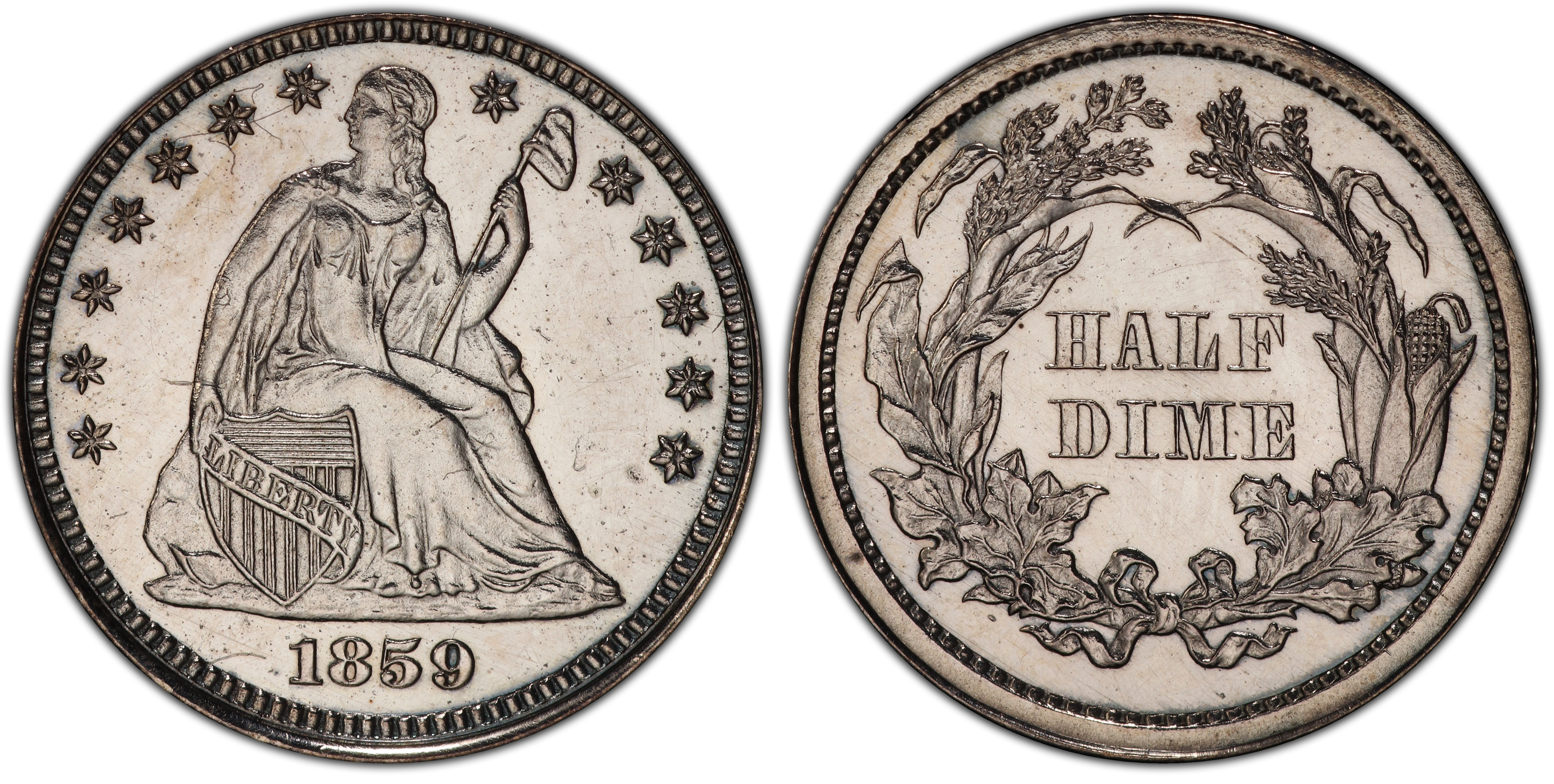
PCGS PR61
- PCGS #:
- 11954
- Designer:
- N/A
- Edge:
- Reeded
- Diameter:
- 15.90 millimeters
- Weight:
- 1.24 grams
- Mintage:
- N/A
- Mint:
- Philadelphia
- Metal:
- 90% Silver, 10% Copper
- Auction Record:
- $70,500 • PR65 • 06-23-2014 • Heritage Auctions
Go To Grade
Current Auctions - PCGS Graded
Current Auctions - NGC Graded
For Sale Now at Collectors Corner - PCGS Graded
For Sale Now at Collectors Corner - NGC Graded
Condition Census What Is This?
|
#1 PR65 PCGS grade
Thomas L. Elder, sold privately in 1907 - John H. Clapp Collection, sold intact in 1942 - Louis E. Eliasberg, Sr. Collection - Bowers & Merena 5/22/1996:1009, $29,700 - Eugene H. Gardner Collection - Heritage 6/2014:30221, $70,500 |
|
#2 PR64 PCGS grade
Heritage 4/2014:5553, $36,718.75 |
| #3 PR63 PCGS grade |
| #3 PR63 PCGS grade |
| #3 PR63 PCGS grade |
P. Scott Rubin:
The Pattern 1859 Proof Half Dime known as Judd-232 is a very rare coin with at most 15 specimens known. This coin is identical in design to the Pattern Dime of the same year, Judd-233. It is obvious that both of these issues were never made to be used as coinage. This is because the combination of designs used on the obverse and reverse lacked the legend “United States of America” on either side.
Since both the Pattern 1859 Half Dime and Dime were produced only in Proof condition it seems obvious that these coins, known as Transitional Patterns, were made for sale to collectors. These are two of the very few Pattern issues that have been collected with regular issue coinage by collectors for over one hundred years.
The Pattern 1859 Proof Half Dime is a coin that usually appears at auction about once every two years, however in 2014 three specimens were offered. This has only happened one time before (as far as I know) when sixty years ago -- in 1954 -- three specimens were offered in the same year.
Since both the Pattern 1859 Half Dime and Dime were produced only in Proof condition it seems obvious that these coins, known as Transitional Patterns, were made for sale to collectors. These are two of the very few Pattern issues that have been collected with regular issue coinage by collectors for over one hundred years.
The Pattern 1859 Proof Half Dime is a coin that usually appears at auction about once every two years, however in 2014 three specimens were offered. This has only happened one time before (as far as I know) when sixty years ago -- in 1954 -- three specimens were offered in the same year.