1828 1/2C 12 Stars, BN (Regular Strike)
Series: Classic Head Half Cents 1809-1835
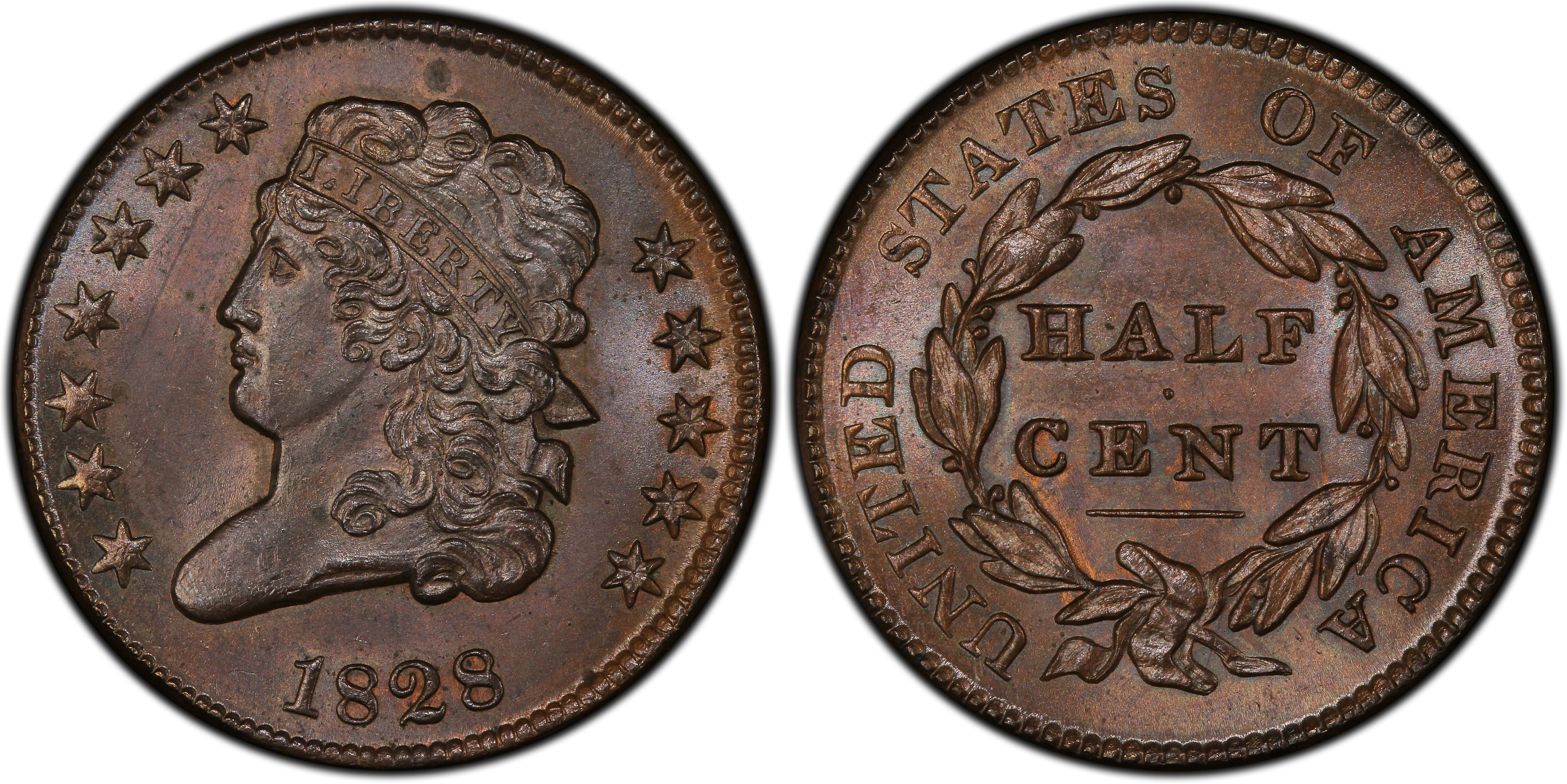
PCGS MS65BN
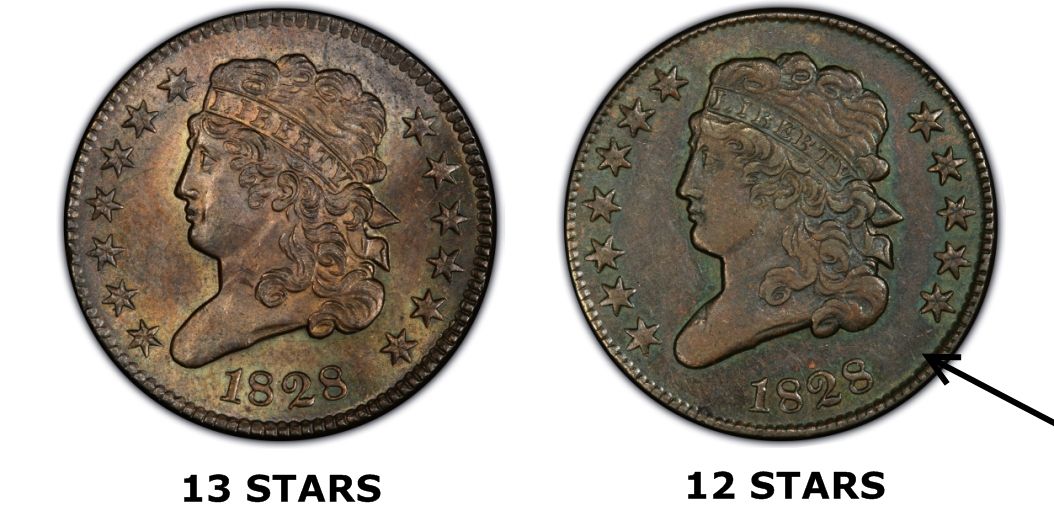
13 vs. 12 STARS

PCGS MS64+BN
- PCGS #:
- 1150
- Designer:
- John Reich
- Edge:
- Plain
- Diameter:
- 23.50 millimeters
- Weight:
- 5.44 grams
- Mintage:
- 606,000
- Mint:
- Philadelphia
- Metal:
- Copper
- Auction Record:
- $4,600 • MS63 • 09-06-2011 • Goldberg Auctioneers
Major Varieties
Rarity and Survival Estimates Learn More
| Survival Estimate | |
|---|---|
| All Grades | 600 |
| 60 or Better | 50 |
| 65 or Better | 2 |
| Numismatic Rarity | |
|---|---|
| All Grades | R-5.8 |
| 60 or Better | R-8.5 |
| 65 or Better | R-9.9 |
| Relative Rarity By Type All Specs in this Type | |
|---|---|
| All Grades | 6 / 16 |
| 60 or Better | 4 / 16 TIE |
| 65 or Better | 2 / 16 TIE |
| Relative Rarity By Series All Specs in this Series | |
|---|---|
| All Grades | 6 / 16 |
| 60 or Better | 4 / 16 TIE |
| 65 or Better | 2 / 16 TIE |
Condition Census What Is This?
|
#1 PCGS MS65BN
“The Wyatt Collection,” Superior, September 1985, Lot 188; As PCGS MS65BN CAC #30451297. “The James R. McGuigan Collection,” Heritage Auctions, August 2022, Lot 3098 – $16,800; Bruce Gimelson; "The Garrison Collection," Heritage Auctions, January 10, 2024, Lot 3064 – $16,800. Toning spot at 12 o'clock. Two diagonal streaks across the left obverse field. |
|
#2 PCGS MS64+BN
|
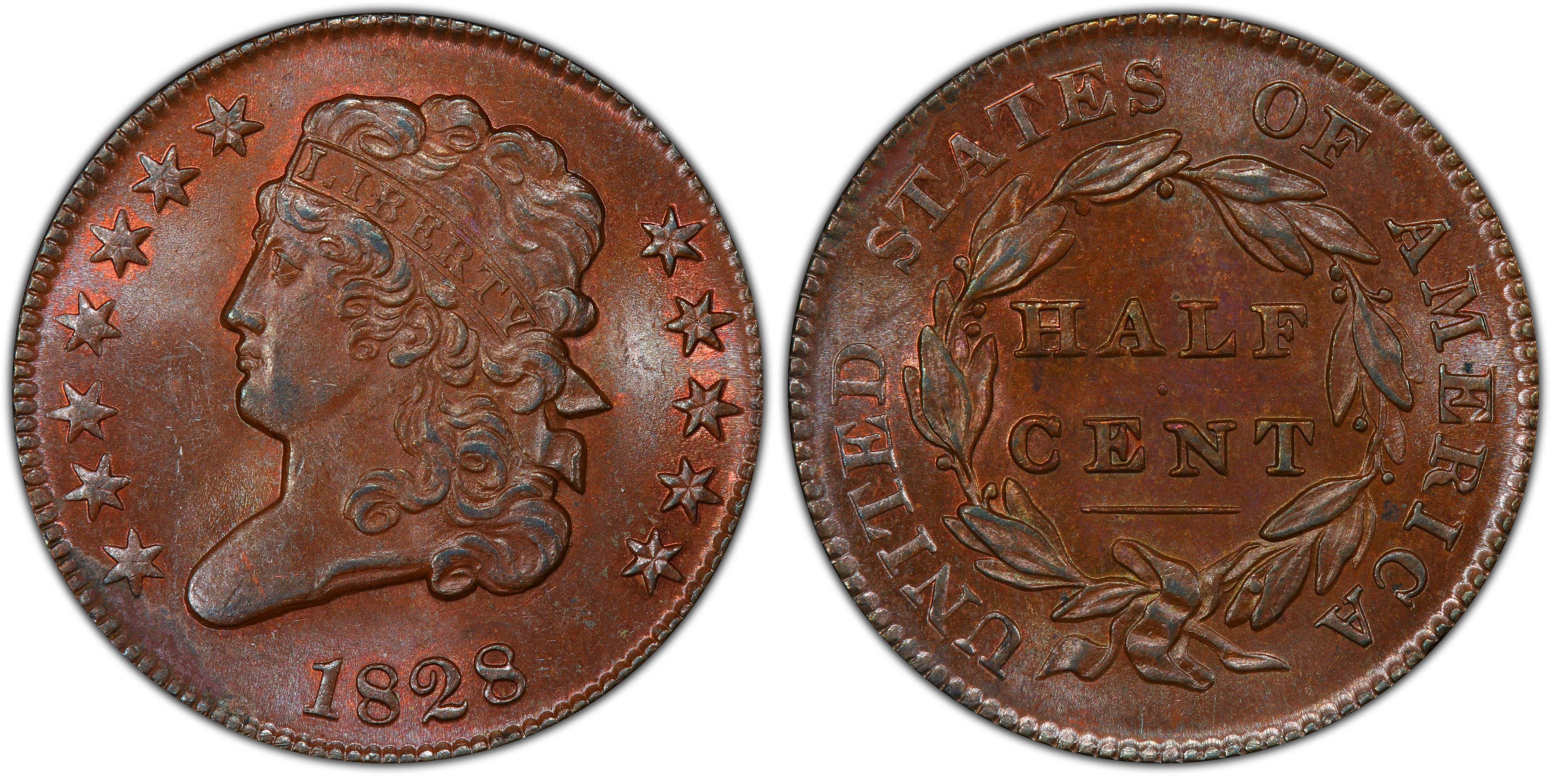 #3 PCGS MS64BN
|
|
#3 PCGS MS64BN
"The Green Tea Collection," Goldberg Auctioneers, February 19, 2018, Lot 167 - $2,115. Cluster of hits on Liberty's cheek. Carbon spot below the tip of Liberty's lower ribbon. Reddish toning above H of HALF. |
 #3 PCGS MS64BN
Heritage Auctions, June 8, 2016, Lot 3031 - $2,350. Toning spot between ER of AMERICA. |
|
#3 PCGS MS64BN
Heritage Auctions, September 8, 2011, Lot 3103 – $4,312.50. Toning around star 8 and above HA of HALF. |
|
#3 PCGS MS64BN
Heritage Auctions, August 11, 2011, Lot 3031 – $2,850. Small fleck to the left of the lips. Toning spot at 6 o'clock on the reverse. |
|
#3 PCGS MS64BN
Heritage Auctions, February 23, 2005, Lot 5090 - $2,530. |
|
#3 PCGS MS64BN
Heritage Auctions, August 18, 2004, Lot 5061 - $2,760. |
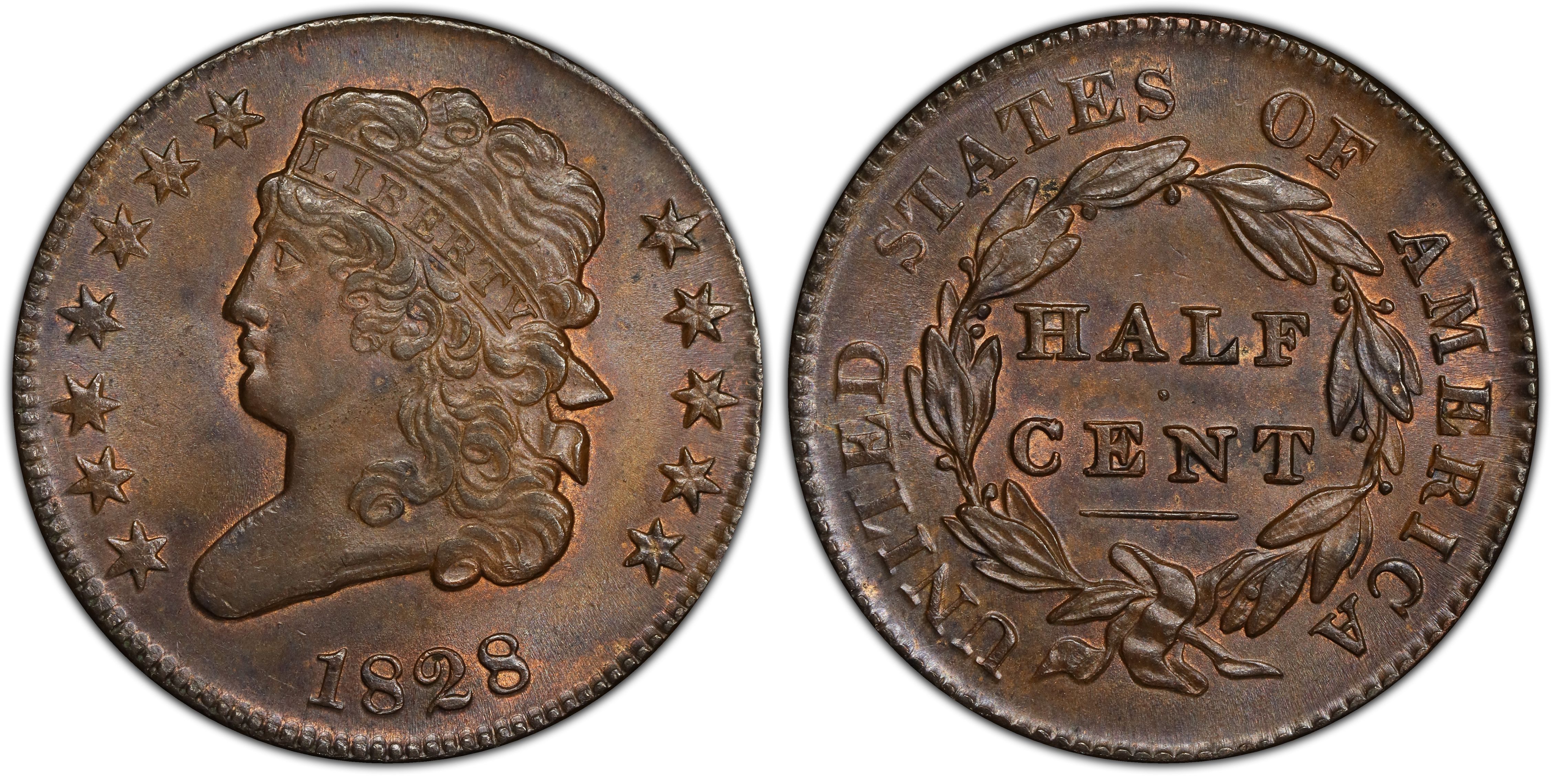 #3 PCGS MS64BN
|
 #3 PCGS MS64BN
|
 #3 PCGS MS64BN
|
| #3 PCGS MS64BN |
| #3 PCGS MS64BN |
| #3 PCGS MS64BN |
| #3 PCGS MS64BN |
| #3 PCGS MS64BN |
1828 Classic Head Half Cent, Cohen-2, 12 Stars
Eckberg 1-A. Breen-3. PCGS (as 12 stars: BN #1150, RB#1151; as 12 Stars, Cohen-2: BN #35264, RB #35265). Guide Book variety: “12 Stars.” Rarity-1.
The 1828 Classic Head Half Cent, 12 Stars is one of two Guide Book varieties for the year and one of three die marriages overall. It is cataloged as Cohen-2 in Roger S. Cohen, Jr.’s American Half Cents (1982) and as Eckberg 1-A in Bill Eckberg’s The Half Cent, 1793–1857 (2019). Notably, the 12-star configuration is unique to this single die marriage, whereas the 13-star version was produced using two distinct pairings.
The 12 Stars variety is as distinct as it is curious. While the date is shifted slightly to the right, sufficient space remains for the traditional 13th star; yet, the reason for this engraver's blunder—and why the Mint released such a large quantity of the type—remains a mystery.
According to the PCGS Population Report, the 12 Stars variety accounts for approximately 21% of the total 1828 population. However, its true scarcity is realized when evaluating coins with Red Brown (RB) color. At this level of condition rarity, the 13 Stars variety outnumbers the 12 Stars by a factor of nearly 38:1. The survival rate of Red and Red Brown 13-star examples was aided tremendously by Benjamin Collins’ 1884 discovery of a hoard containing several thousand Mint State Red specimens. These remained available in roll quantities as late as the 1950s.
Evidence of this long-standing discrepancy in scarcity is found in the 1951–1952 4th Edition of the Guide Book, where Uncirculated (presumably brown) 1828 12 Stars Half Cents were listed at $7.50 (approximately $96 adjusted for 2026 inflation), while the more common 13 Stars were priced at just $5.00 ($64). These are truly "long ago" prices. Today, a PCGS MS63BN example of the 12 Stars variety typically commands over $2,000, while a 13 Stars example in the same grade generally brings $550 to $800.
Diagnostic pickup points include:
- Configuration: 12 stars are arranged in a 7×5 formation.
- Date Position: Date shifted to the riight, while the 13 stars variety features a more centered date.
- Empty Space: A prominent gap exists at the bottom of the right side where the 13th star would typically be located.
- Reverse: Top of H in HALF is closed.
- Pronounced Doubling on the Serif of C
* * *