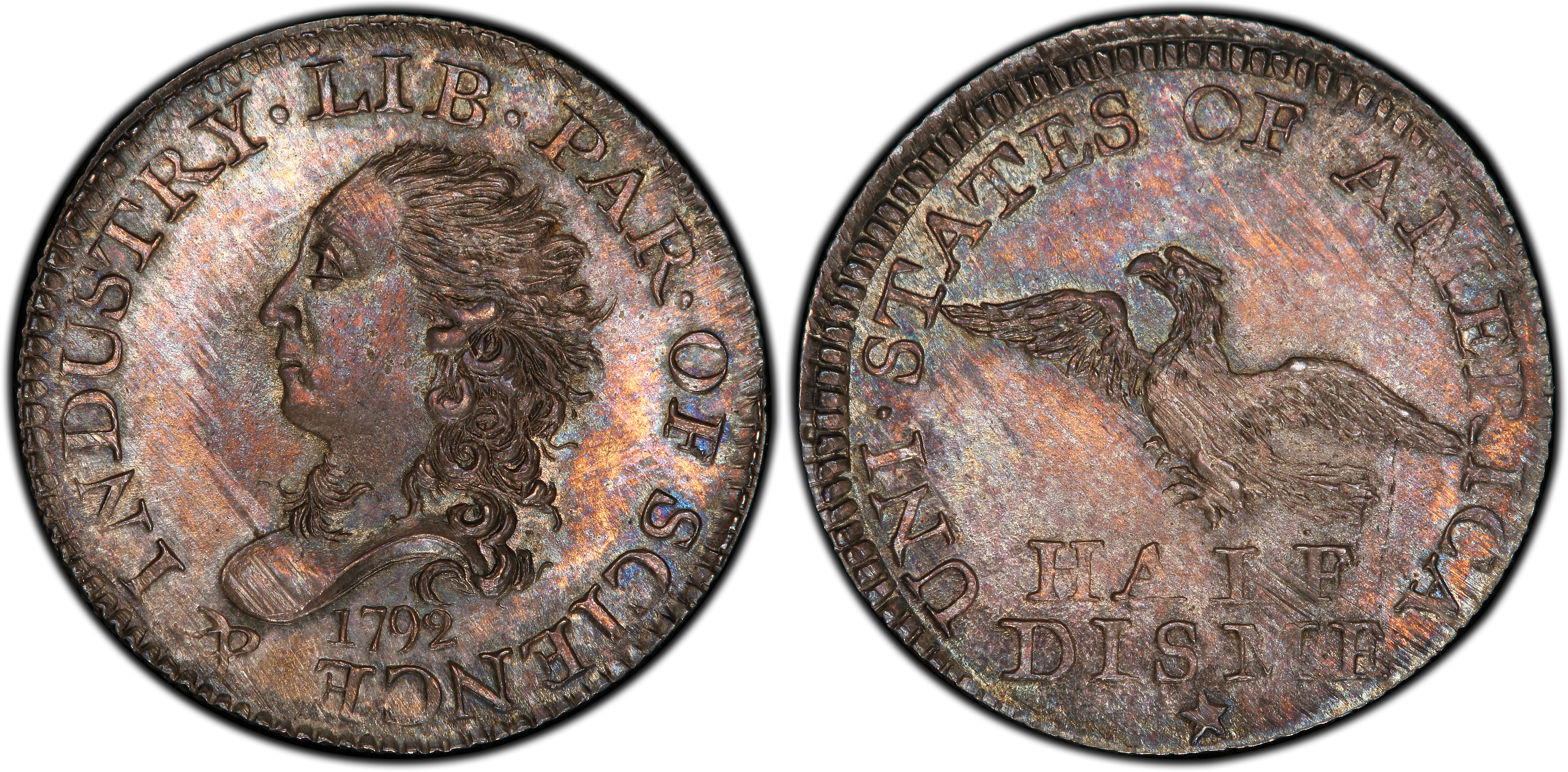
PCGS MS66

PCGS VF30
- PCGS #:
- 11020
- Designer:
- Unknown
- Edge:
- Diagonally reeded
- Diameter:
- 17.50 millimeters
- Weight:
- 1.35 grams
- Mintage:
- 1,500
- Mint:
- Philadelphia
- Metal:
- 89.2% Silver, 10.8% Copper
- Auction Record:
- $1,145,625 • MS68 • 01-01-2013 • Stack's Bowers
Major Varieties
- 1792 H10C
Rarity and Survival Estimates Learn More
| Survival Estimate | |
|---|---|
| All Grades | 275 |
| 60 or Better | 35 |
| 65 or Better | 7 |
| Numismatic Rarity | |
|---|---|
| All Grades | R-6.5 |
| 60 or Better | R-8.8 |
| 65 or Better | R-9.6 |
| Relative Rarity By Type All Specs in this Type | |
|---|---|
| All Grades | 1 / 1 |
| 60 or Better | 1 / 1 |
| 65 or Better | 1 / 1 |
| Relative Rarity By Series All Specs in this Series | |
|---|---|
| All Grades | 1 / 1 |
| 60 or Better | 1 / 1 |
| 65 or Better | 1 / 1 |
Condition Census What Is This?
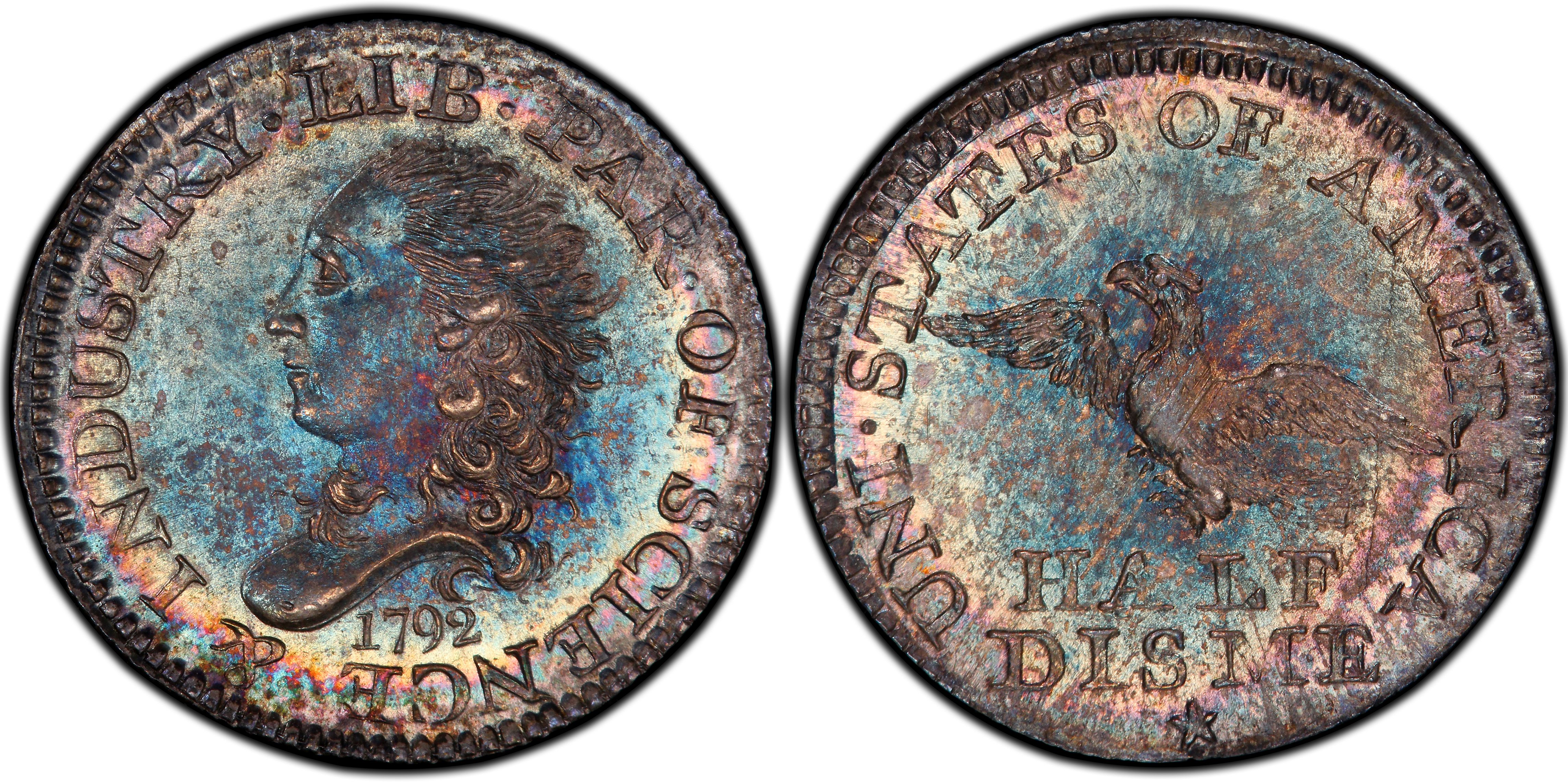 #1 PCGS MS68
David Rittenhouse, held be family until 1919. “ANA Convention Auction,” Henry Chapman, October 1919, Lot 249 - $56; George L. Tilden; “The George L. Tilden Collection,” Thomas Elder, June 1921, Lot 2029 - $62; private collector, who apparently stored the coin in a Wayte Raymond album; unnamed museum in New England; Stack’s, October 1988, Lot 536 - $68,750; unknown intermediaries; Jay Parrino, early 1990s, as agent for the following; the anonymous “Knoxville Collection,” early 1990s to 2003; private collector, 2003 to January 2007. As PCGS MS67 #07432311. Steve Contursi to Cardinal Collection Educational Foundation in 2007 - $1,500,000. As NGC MS68 #1947783-001. “The Cardinal Collection,” Stack’s Bowers, January 22, 2013, Lot 13093 – $1,145,625; sold in 2018 for $1,985,000 million to Brian Hendelson. As PCGS MS68 #25043688. |
|
#2 PCGS MS66
(Possibly) "The Thomas Cleneay Collection," S.H. & H. Chapman, December 9, 1890, Lot 1627 - $28.50. As "Gem Uncirculated 65/65." Mid-American Rare Coin Auctions, May 1987, Lot 721 - $60,000. As "MS65." "The Chalkey-Ryer Collection," Superior, January 1990, Lot 2354 - $137,500. As PCGS MS65 #6174822. Heritage Auctions, January 9, 2014, Lot 5176 - $528,750. As PCGS MS66 #81936443. Heritage Auctions, January 5, 2017, Lot 5563 - $493,500; Dell Loy Hansen; "The D.L. Hansen Collection" (PCGS Set Registry). Pete Smith, Joel Orosz, and Leonard Augsburger suggest possible connection to the Cleneay sale but cannot match the coin with certainty. |
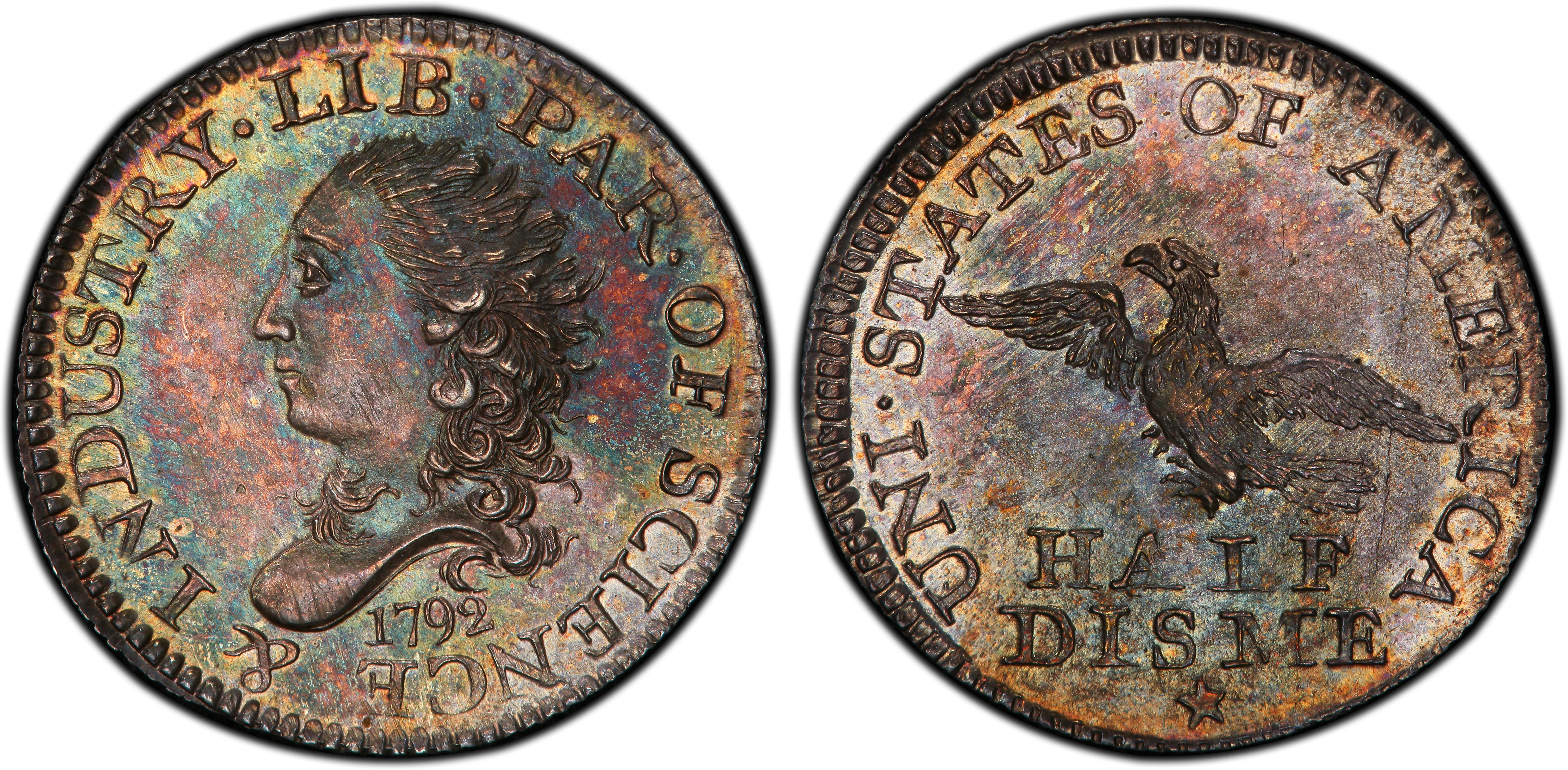 #2 PCGS MS66
David Rittenhouse (reportedly traced back to the family by Dr. Judd); Dr. J. Hewitt Judd; Jimmy Hayes - $4,500. As "Superb Gem Uncirculated." "Auction ‘80," Paramount, August 1980, Lot 592 - $90,000; “The Jimmy Hayes Collection of United States Silver Coins,” Stack’s, October 1985, Lot 3 - $57,500; Greg Robers; Clifford Mishler; Stack’s Bowers, August 14, 2013, Lot 4043 – $793,125; A pertnership between John Albanese, Kevin Lipton, Ryan Carroll and Anthony Terranova; Cardinal Collection Educational Foundation. Antique toning. Lintmark on cheek. |
| #2 PCGS MS66 |
 #5 PCGS MS64
Stack's Bowers, June 22, 2018, Lot 1221 - $250 Reserve Not Met. |
|
#5 PCGS MS64
As MS65. "The Bartlett Collection," Bowers & Ruddy, November 1979, Lot 2359. PCGS MS60. Bowers & Merena, September 1995, Lot 1177 - $38.500; Bowers & Merena, January 2005, Lot 327 - Passed. As MS64. Stack’s, July 2008, Lot 4148 - $373,750; Stack's, Janaury 26, 2010, Lot 3139 - Passed; Stack's Bowers, March 2013, Lot 2025 - $470,000; Heritage, June 2015, Lot 3839 - $329,000. Slate grey color. Faint adjustment marks along the rims. Reverse is struck slightly off-center. |
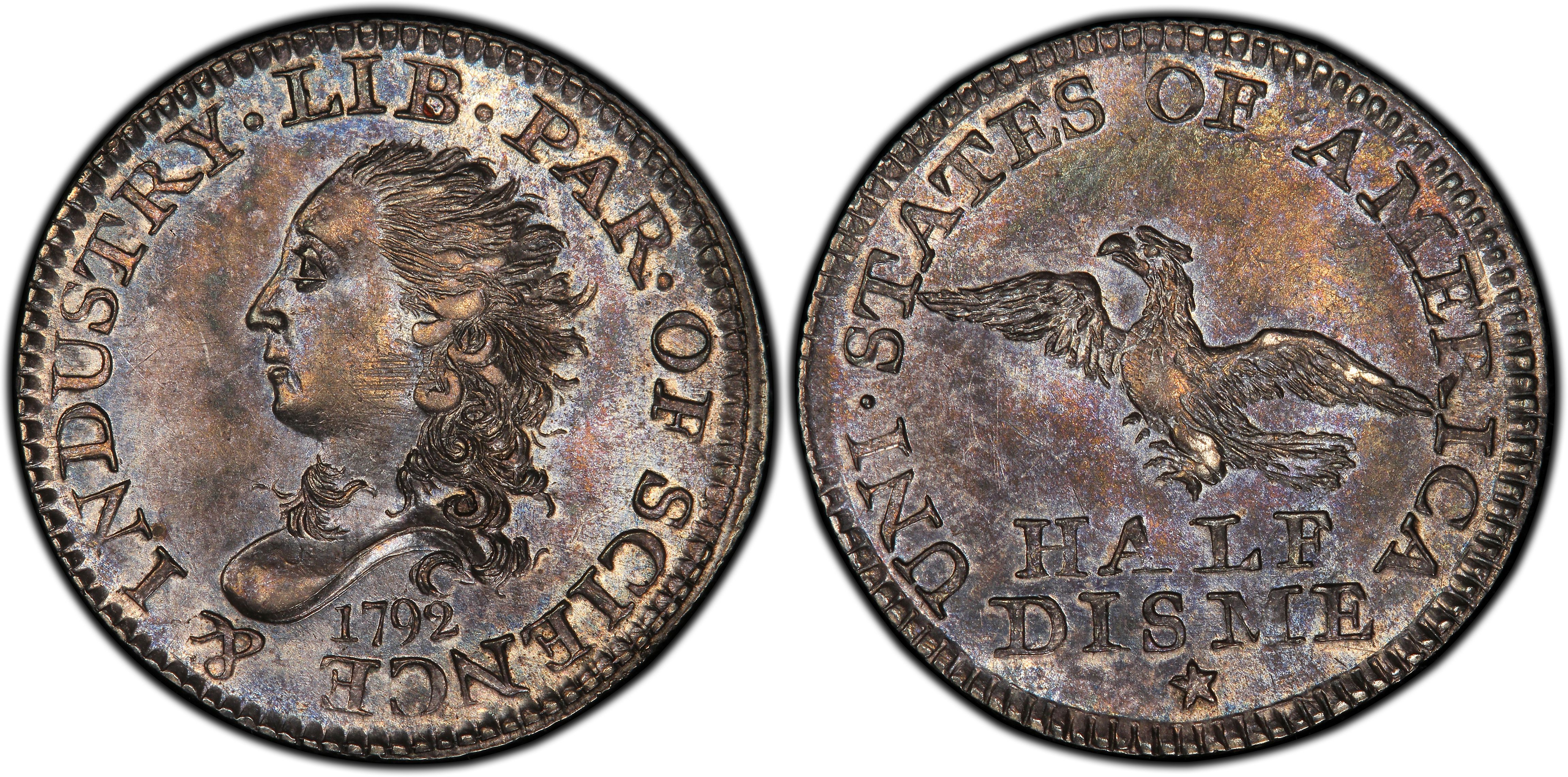 #5 PCGS MS64
As NGC MS63 #660803-001. "The Great Western Collection of Territorial Gold," Heritage Auctions, July 28, 2005, Lot 10144 - $333,500. As PCGS MS63 #04413972. "The Madison Collection," Heritage Auctions, January 2008, Lot 2741; Larry Hanks to D. Brent Pogue, by sale, August 11, 2010. As PCGS MS64 #30922680. "The D. Brent Pogue Collection," Stack's Bowers & Sotheby's, May 2015, Lot 1001 - $440,625. The first coin sold from the historic Pogue sales. Adjustment marks on face. Frosty with ice blue and gold over grey. |
|
#5 PCGS MS64
"The Richard B. Winsor Collection," S & H. Chapman, December 1895, Lot 733; J.M. Clapp; "The J.M. Clapp Collection," sold en bloc to Louis E. Eliasberg, Sr.; "The Louis E. Eliasberg, Sr. Collection," Bowers and Merena, May 1996, Lot 883 - $38,500. As PCGS MS64 #07996112. "The Music City Collection," Heritage Auctions, April 23, 2015, Lot 4961 - $329,000. Lilac toning over grey surfaces. Diagonal adjustment marks on Liberty's face and the eagle's chest. ISME and the star are covered in darker toning than the center of the coin. Winsor was Dr. William H. Sheldon's mother's cousin. |
 #5 PCGS MS64
Pacific Coast Auctions, June 1, 1988, Lot 25 - $110,000. As PCGS MS63. Heritage Auctions, August 16, 1995, Lot 5941 - $50,600. As NGC MS63 #308623-001. Heritage Auctions, November 3, 2005, Lot 2055 - $316,250. As PCGS MS64 #13426009. "The Liberty Collection," Heritage Auctions, January 10, 2013, Lot 5569 - $528,750. |
|
#5 PCGS MS64
As "Gem BU." Stack's, January 14, 1992, Lot 477. As "AU58." Bowers and Merena, January 8, 2002, Lot 345 - $103,500. As PCGS MS64. Bowers and Merena, August 29, 2003, Lot 565 - $200,000. Based on an old photograph, this example exhibits diagonal striations. |
| #5 PCGS MS64 |
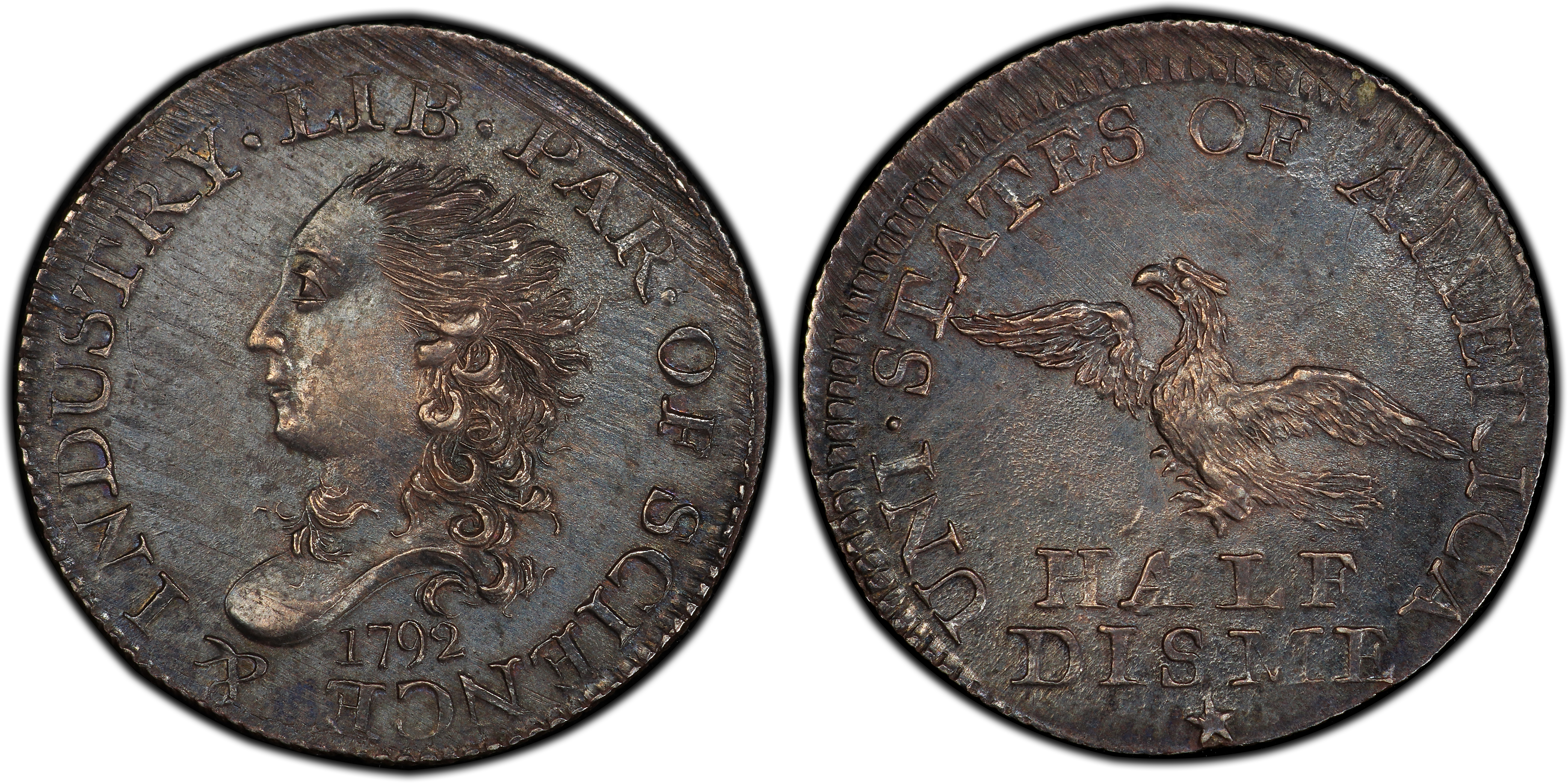 #5 PCGS MS64
|
At a July 4, 1829, ceremony, the 1792 Half Disme (#11020) was among the mementos laid in the cornerstone of the second Philadelphia Mint, alongside an 1829 Capped Bust Half Dime (likely the Proof #4548, #84548), a copy of the Declaration of Independence, a copy of the Constitution, and Washington’s Farewell Address.
The Half Disme was a significant touchstone to the Mint's earliest days. Though struck under the authority of the United States Constitution, it was initially coined in the cellar of saw-maker John Harper. As President George Washington noted in his Fourth Annual Address to Congress in November 1792, the production was merely "a small beginning."
Secretary of State Thomas Jefferson received the 1,500 coins—presumably the entire mintage—on July 13 and recorded the disbursement of the coins along his route home to Charlottesville, Virginia.
Establishing an American National Coinage
The Coinage Act of 1792 established the United States Mint and regulated the coins of the United States, which were to be based on a decimal system preferred by Thomas Jefferson and Alexander Hamilton. Though often on opposing sides of key issues, the two founding fathers were aligned in their belief that the fledgling country needed to produce its own national coinage.
Attempts to establish a national coinage had been ongoing since before the Americans secured victory against the British in the Revolutionary War. The Continental Congress under the Articles of Confederation authorized the establishment of a mint but did not fund it. Financier Robert Morris had pattern coins made as early as 1783, but these did not result in circulating coinage.
Realizing the structure of the confederated government was ill-equipped, a Constitutional Convention was held in 1787. The new Federal Government again took up the coin issue and contracted for the production of three hundred tons of Fugio Cents. This venture was plagued by issues, and it took four years for Congress to finally authorize the construction of a national mint, appropriate the funds, and hire the necessary workers.
What Is a Half Disme and Why Is It Significant?
On April 14, 1792, President George Washington appointed David Rittenhouse, a polymath and recent Treasurer of Pennsylvania, to the role of United States Mint Director. Rittenhouse immediately located an acceptable property at 7th and Arch Streets in Philadelphia and began construction of the Mint building on a lot previously occupied by an abandoned whiskey distillery. Construction began on July 31.
Even before the facility was ready, Rittenhouse was eager to begin operations. In a July 9 letter, Rittenhouse sought approval from Washington to coin half cents, cents, half dismes (pronounced “deems”), and dismes. At the time, the director had access to a press and the cellar of Philadelphia saw-maker John Harper’s Sixth and Cherry Street workshop.
The Mint’s first depositor was Secretary of State Thomas Jefferson, who paid a visit to Rittenhouse on July 11 and ordered that his deposit of $75 dollars in silver be coined. Having dies for a five-cent denomination called a “half disme” available, Henry Voight likely struck Jefferson’s 1,500 coins. The initial striking of the half dismes was challenging: many examples were struck off-center, causing the dies to fail early. Die cracks appeared after striking just a few hundred coins.
More Struck After Jefferson?
Numismatic researchers Pete Smith, Joel Orosz, and Leonard Augsburger propose in their book, 1792: Birth of a Nation's Coinage (2017), that a second order for the Half Disme was likely placed after Secretary of State Thomas Jefferson's initial coins were struck. This theory is supported by earlier accounts, including James Ross Snowden's A Description of Ancient and Modern Coins, in the Cabinet at the Mint of the United States (1860) and Dye's Coin Encyclopedia: A Complete Illustrated History of the Coins of the World (1883), which specifically gives the date October 9 for the subsequent order.
Smith, Orosz, and Augsburger note that the "second striking" coins are distinguishable from the Jefferson strikes due to “rough raised patches found on the reverse; either die rusting or spalling had occurred during three months of humid Philadelphia summer (102).”
First Commercial Transaction Involving a 1792 Half Disme
Notably in Birth of a Nation's Coinage is the first published accounting of a significant historical event: Jefferson picked up the coins on July 13, and later that day paid “servants” at a Chester, Pennsylvania inn 30 cents in the new coin.
This is considered the first commercial transaction of a U.S. coin struck under the authority of the United States Constitution.
With only these coins struck in 1792 and no follow-up mintage in 1793, America’s first half disme briefly faded from public attention.
Dispelling the Myth
The true origins of the half disme were unknown when Mint Director James Ross Snowden later wrote of the following “history” of the coin:
"The bust of Liberty is popularly supposed to represent the features of Martha Washington who is said to have sat for the artist while he was designing it… This piece is said to have been struck from the private plate of Washington, which is not unlikely..."
This myth was immortalized in painter John Ward Dunsmore’s Washington Inspecting the First Money Coined by the United States (1914), a counterfactual painting that is on display at the Philadelphia Mint.
From Half Disme to Half Dime
In 1794, half disme production commenced again at the Mint. The 1794 coin (#4250) had a Flowing Hair design on the obverse and a wreath and eagle on the reverse. Nowhere was the word "disme" inscribed on the 1794 coin or on the Draped Bust Disme (#4461) that entered production in 1796.
The Coinage Act of 1837 officially changed the name of the denominations to half dime and dime. For clarity, contemporary numismatic publications only refer to the 1792 half dismes and the pattern 1792 dismes as "dismes." The half dime served the United States as its five-cent coin until 1873. It was phased out by the five-cent nickel, which was first introduced in 1866.
* * *
The PCGS graded MS67 is from the great John Pittman collection, one of the highest quality U.S. coin collections ever assembled. This specimen has amazing mark-free surfaces and a fully rounded cheek. The luster and originality are outstanding in every way. This coin, along with the PCGS graded SP67, is the finest known example of the first coin officially struck by the U.S. Mint.
LOT 1001 1792 Half Disme