Silver Dollars & Trade Dollars of the United States - A Complete Encyclopedia
Q. David Bowers
Varieties
Class I 1804 Dollar. BB-304 .
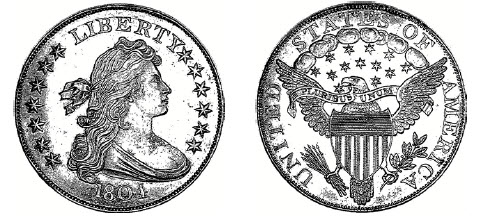
OBVERSE: A later (circa 1830s) Mint copy of the general type with Draped Bust originally used 1795-1803, with bust of Miss Liberty at the center, 7 stars left and 6 right, LIBERTY above, and the date 1804 below. Later (as used in the 1830s) style of denticulated border.
On the left, stars 1 and 2 are spaced closer together than are any of the others. Stars 2-3 and 4-5 are more widely spaced than any others. On the right, stars 12-13 are the closest together, and stars 10-11 have the widest separation. In LIBERTY, the I is tilted slightly to the right, with the left bottom serif being slightly too high, and the right bottom serif slightly too low.
The left tip of the highest curl is missing; a flaw caused by a broken portrait punch. This flaw also is represented on the 1801 novodel, but not the 1802 and 1803.
Obverse die used to strike Class I, II, and III 1804 dollars.
• REVERSE: As preceding. See description under 1801 Proof novodel dollar. This differs from Reverse Y used to strike Class II and III 1804 dollars, to which refer.
"Reverse X" die used to strike 1801, 1802, 1803, and Class I 1804 novodel silver dollars.
• DIE STATES:
Die State I: Perfect obverse die without cracks. Perfect reverse die without cracks. Does not exist.
Die State. II: Mint Collection. specimen: Obverse: With hairline crack beginning to the left of the top of I in LIBERTY, nearly touching the upper right of the serif of L, and in line with the top of the extending through LIBER, to top of the left upper serif of T. Reverse: With hairline crack from right side of I, through TE, and through the center of D. (Data from photograph, Newman-Bressett, pp. 36, 54; the details are not as fine as might be seen from actual inspection of the coin.)
Die State III: King of Siam specimen: Obverse: With hairline crack beginning to the left 'of the top Of L in LIBERTY, about 60% of the way toward the nearest upper point of star 7, and in line with the top of the L, extending through LIBER, to top of the left upper serif of T, then at a slight angle toward the border, ending above the junction of the upright of T and its left arm. Reverse: With hairline crack from top right serif of N, sloping slightly downward through ITED, and ending just past the left edge of the second denticle past the D. Crack resumes, and is hardly visible, at the leftmost feather (presumably, the crack extends from D to the feather, or at least die weakness exists, but is not visible). Struck prior to the 1802 and 1803 Proof dollars. (Data from inspection of coin.)
• COLLECTING NOTES: The historical record shows that 1804 Class I dollars were created for legitimate reasons, and were openly produced at the Mint. As such, among the three classes of dollars bearing this date, the 1804 Class I would seem to be the most desirable from a numismatic viewpointal-though it cannot be denied that the "naughty" background of the Class II and III dollars adds to the appeal of those issues and for any U.S. silver coin.
Of the eight known specimens of the 1804 Class I dollar, just two-the King of Siam coin (part of a set) and the Weyl-Dexter coin-have come on the market in recent years. The Weyl-Dexter piece sold for $990,000, a record for the issue.
• REGISTRY OF KNOWN SPECIMENS: The registry of 1804 Class I, II, and III silver dollars is adopted, expanded, and updated from The Fantastic 1804 Dollar, by Eric P. Newman and Kenneth E. Bressett, 1962; Kenneth E. Bressett's updated listing furnished to the author in 1987 in connection with the King of Siam Proof set offering; (especially, for new information) "11). Fantastic 1804 Dollar: 25th Anniversary Follow-Up," by Eric P. Newman and Kenneth E. Bressett, in Coinage of the Americas Conference, American Numismatic Society, 1987; and Walter Breen's Complete Encyclopedia of u.s. and Colonial Coins, 1988. In addition, Eric P. Newman and Kenneth E. Bressett were, among, those who reviewed and made comments concerning this section of the manuscript of the present book. In addition, certain basic information is from "The Dollar of 1804,"in The Numismatist, July 1937, which includes a reprint of John A. Nexsen's listing of 1804 dollars and their owners, Originally published in the American Joumal of Numismatics, April 1891.