Silver Dollars & Trade Dollars of the United States - A Complete Encyclopedia
Q. David Bowers
1803 Proof Novodel Dollar
Mintage
Fewer than 10 Proofs (estimated)
Varieties
1803. Proof Novodel, BB-303.
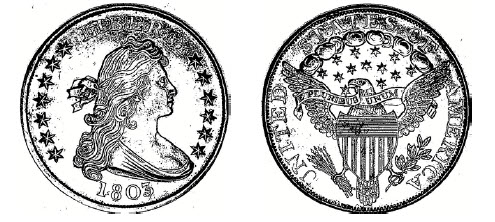
(B-7.)
• OBVERSE: Thick 3. Stars on left are much better aligned than on the obverse of the 1802 novodel. On the 1802, the spacing is fairly good, but stars 3 and 4 are wider apart than are any others. Star 1 is closer to the second curl than star 7 is to L . On the right, the stars are well spaced and aligned.
Highest curl on top of head about centered under upright of E, and next top curl centered under R. A small raised line is present just above the obverse center dot; heavy rust marks around star 4 and light rust marks at the 18 in the date. The die was made by using original number punches from the early nineteenth century. Raised border with denticles made up of truncated beads.
The top left curl tip is intact on the 1803 (and 1802) novodels , whereas on the 1801 and 1804 issues it is missing (due to hub damage). Thus, the 1802 and 1803 dies were made before the others.
Obverse die used to strike 1803 novodel dollars only.
• REVERSE: As preceding. See description under 1801 Proof novodel dollar.
"Reverse X" die used to strike 1801, 1802" 1803, and Class I 1804 novo del silver dollars.
• DIE STATES:
Die State I: Obverse without cracks. Reverse with hairline crack from top right serif of N, sloping slightly downward through ITED, and ending at the bottom of the leftmost wing tip feather. Apparently, struck about the same time as the 1802 Proof novodel. All specimens seen have raised spots, from die rust, on and near star 4 and similar marks between the 1 and 8 in 1803, indication that the novodels were struck measurably later than the time they were prepared.
Note: All known 1801 and 1803 Proof dollars (but not 1802 or 1804) have a small linear depression in the space between UM in UNUM and the shield from a piece of metal or other foreign material on the die face during striking.
• COLLECTING NOTES: The 1803 Proof novodel is more available than the 1801, but is considerably rarer than the 1804.
• REGISTRY OF KNOWN SPECIMENS:
1. Cleneay Specimen, Proof-63
• Capt. John W. Haseltine.
• Thomas Cleneay .
• Chapman brothers' sale of the Cleneay Collection, December 1890, Lot 954. $12.25.
• John P. Lyman.
• S.H. Chapman's sale of the Lyman Collection. November 1913, Lot 15, $30.00.
• H.O. Granberg
• B. Max Mehl's sale of the Granberg Collection, July 1919, Lot 31.
• Frederick C.C. Boyd
• Numismatic Gallery (Abe Kosoff and Abner Kreisberg) sale of the "World's Greatest Collection" (Boyd Collection), January 1945, Lot 125, $210.00. "Brilliant Proof restrike."
• Beverly Hills Stamp & Coin Shop (Max L. Justus), fixed
price list, August 1, 1957, listed as having been sold.
• Dr. J. Hewitt Judd. Omaha, Nebraska physician.
• Abe Kosoff.
• Armand Champa, Louisville, Kentucky.
• American Auction Association (Q. David Bowers and James F. Ruddy) sale of the Champa Collection, May 1972, Lot 916, $14,000.00. "Splendid brilliant Proof with light toning."
• Stack's Autumn Sale, September 1978, Lot 305, $40,000.00. "Splendid russet, sea green and iridescent toning." Some rust spots on and around the 4th [obverse] star."
• Ellis H. Robison, Troy, New York.
• Stack's sale of the Robison Collection, February 1982, Lot 1885, $39,000.00. "Brilliant Proof. Splendid russet, sea green and iridescent toning."
• Larry Whitlow, Illinois dealer. Sold to the following.
• Larry Hanks, El Paso, Texas. Consigned to the following.
• Superior Galleries' section of Auction '84, July 1984 Lot 172, Reserved by the consignor at $68,000.00. "Brilliant Proof-63. Well struck with beautiful natural bluish and light golden toning on both sides. Some minor imperfections in the fields, most of which were as made." Consignor reserve not met. Listed price: $74,800.00. Subsequently sold by Larry Hanks to the following.
• Pennsylvania collector. Consigned to the following.
• Harry Einstein Collection Sale, Bowers and Merena, June 1986, Lot 1735, $41,800.00. "Beautiful magenta, gun metal blue, iridescent toning."
Illustrated in the Breen Proof coin (1977) and regular (1988) Encyclopedias.