Silver Dollars & Trade Dollars of the United States - A Complete Encyclopedia
Q. David Bowers
Class II 1804 Dollar. BB-305.
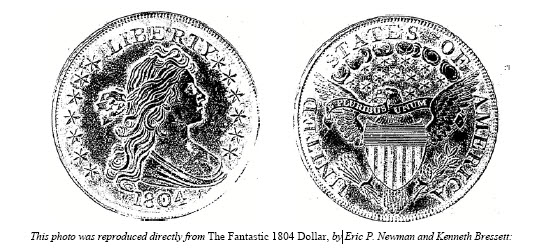
• OBVERSE: As preceding.
Obverse die used to strike Class I, II, and III 1804 dollars.
• REVERSE: The reverse, known as Reverse Y (per Newman and Bressett nomenclature) is another Mint copy of the Heraldic Eagle reverse type used to coin silver dollars of the dates 1798-1803, but is not precisely identical to any die of that era. Undoubtedly, it was punched out at the Mint at the same time that Reverse X was made, in the early 1830s. However, it is believed that Reverse Y was not used for coinage until circa 1858.
Reverse Y was made by using a Heraldic Eagle punch, and adding details including the letters. of UNITED STATES OF AMERICA, one arrow (to the 12 already in the die) and the berries. Twelve of the arrows were part of the eagle punch (the 13th arrow, with its tiny shaft and head to the right of the two leftmost large shafts, was added by hand and differs slightly on this as compared to the 1801 novodel dollar reverse), as was the olive branch (except the berries) and, I believe, E PLURIBUS UNUM (with a linear flaw on the hub connecting the tops of E and P). As was the case with the reverse used on the 1801-2-3 novodels and the 1804 Class I, old letter punches, the Small Letters font of 1798 or a similar set, were used; the lopsided T, with the left serif shorter than the right, is distinctive. This identical die was used to coin the so-called Class III 1804 dollars.
The A in STATES is centered over clouds, bin OF over junction between clouds 7 and 8. Arc star pattern as standard after 1798. UNITED STATES OF AMERICA in the same general font as used 1798-1803. 12 arrows perfectly formed and delineated (and a 13th added by hand), far better than any definition seen on any original business strike dollar c. 1798-1803. Top right berry slightly higher on branch than top left berry. The border denticles are more beadlike (later style) than toothlike (original style).
"Reverse Y" die used to strike Class II and III 1804 novode1 silver dollars.
• EDGE: The edge on the Class II dollar is plain, unlike all other 1801-2-3-4 novodel dollars.
• DIE STATES:
Die State I: Mint Collection specimen, the only one known: Obverse: Crack through top of LIBER to upper left of T. Reverse: Die without cracks. (Data from photograph, Newman-Bressett, p. 36; the details are not as fine as might be seen from actual inspection of the coin.)
• COLLECTING NOTES: Just one Class II dollar is known today, from a mintage estimated to have been five pieces. It is overstruck on a Bern (Switzerland) shooting taler dated 1857 and has a: plain edge.
The piece is believed to have been made at the Mint by George and Theodore Eckfeldt, circa 1858-9.
Electrotype copies of this piece were later made at the Mint for sale to collectors. Three or four pieces are known, one having been formerly listed as a copper pattern by Edgar H. Adams and William H. Woodin in their 1913 text on pattern coins. Another was in the Spier Collection in San Francisco in the 1900s. In 1992, Craig Whitford sold a specimen owned by the National Bank of Detroit Money Museum.
• REGISTRY OF KNOWN SPECIMENS:
1. Mint Cabinet Specimen
•Mint Cabinet Collection. (c. 1858-9 to date)
•National Coin Collection (Mint Cabinet Collection), Smithsonian Institution.
381.5 grains. Plain edge; high wire rim. Reverse slightly misaligned; 0 in date aligned with the second T in STATES.