Silver Dollars & Trade Dollars of the United States - A Complete Encyclopedia
Q. David Bowers
1802 Proof Novodel Dollar
Mintage
Fewer than 10 Proofs (estimated)
Varieties
1802. Proof Novodel. BB-302.
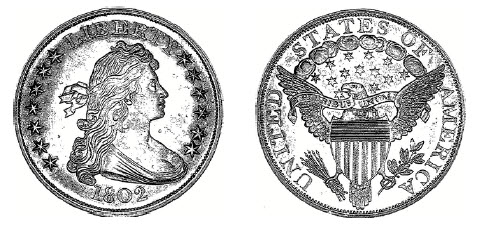
(B-8.)
• OBVERSE: The 2 in date is curled at top, differing from any original obverse, and of the same "fancy" or curlicue style seen on certain 1820 half dollars (but half dollar dies were made from a smaller punch). Star 1 is about the same distance from the second curl as star 7 is from L. The star positioning is cruder than any original dollar of this date. On stars 1 to 7, all points closest to adjacent stars are misaligned! Obviously, whoever made this die was not accustomed to this work. On the right, the stars are aligned better, but this is ruined by something else that never occurred on an original of this date: stars 12 and 13 are so close that they actually touch at their inner points!
Highest curl centered below the E in LIBERTY. Raised border with denticles made up of truncated beadlike denticles quite unlike the toothlike denticles of original dollars of the Draped Bust type. Original 1, 8, and 0 punches from the early 1800s were used to make the die. 2 copied from one of the "Fancy 2" digits used on half dollars of the 1820s.
Perfect die without cracks.
The top left curl tip is intact on the 1802 (and 1803) novodels, whereas on the 1801 and 1804 issues it is missing (due to hub damage). Thus, the 1802 and 1803 dies were made before the others.
Obverse die used to strike 1802 Proof novodels only.
• REVERSE: As preceding, "Reverse X." See description under 1801 Proof novodel dollar.
"Reverse X" die used to strike 1801, 1802, 1803, and Class I 1804 novodel silver dollars.
• DIE STATES:
Die State I: Obverse without cracks. Reverse with hairline crack from top right serif of N, sloping slightly downward through ITED, and ending at the bottom of the leftmost wing tip feather. (Cf. Cleneay and Wilharm specimens)
• COLLECTING NOTES: The 1802 Proof dollar is more available than the 1801 but is considerably rarer than the 1804.
• REGISTRY OF KNOWN SPECIMENS:
Boyd Specimen, Proof-65
• Capt. John W. Haseltine
•Frederick C.C. Boyd
•"World's Greatest Collection" sale (Boyd Collection) by
Numismatic Gallery (Abe Kosoff and Abner Kreisberg). January 1945, Lot 119, $210.00. "Brilliant Proof restrike .... Similar to the Dunham-Higgy specimen."
•Milferd H. Bolender (and into his reference collection)
•M.H. Bolender's 183rd Sale, February 1952, Lot 175,$275. "Brilliant and sharp perfect Proof .... Just as rare as the 1804 dollar, but not as valuable because of the date. In very few of the great collections of the past, there was none in the great Stickney sale, although there was the 1804."
•New York Collection
•Stack's sale of the "Groves" Collection, November 1974, Lot 443, $37,000.00. "A gem."
•Auctions by Bowers and Merena, Inc., Four Landmark Collections Sale, March 1989, Lot 1981, $90,750.00. "423.6 grains. A gem specimen. The obverse and reverse surfaces are delicately toned in pale silver gray, while around the rims there are faint hints of iridescent pale golden brown .... This example appears to be tied for finest known with Stack's French: 13 (the Carter coin)." - Superior Galleries, January 1993 Auction. Lot 615. "Proof-65." Like No.2 in this list, this coin has no rust pit midway between the next to lowest wing feather and the top leaf of the olive branch. The edge was lettered before striking and is similar to that of No. 2, described below.
2. Cleneay Specimen, Proof-64 (PCGS) -Capt. John W. Haseltine
• Thomas Cleneay
• Cleneay Collection sold by S. Hudson and Henry Chapman, December 9, 1890, Lot 949, $12.50.
• Peter Mougey
• Mougey Collection sold by Thomas L. Elder, September 1, 1910, Lot 962, $15.00. -John P. Lyman
• Lyman Collection sold by S. Hudson Chapman, November7, 1913, Lot 14, $40.00.
• H.O. Granberg
• Granberg Collection sold by B. Max Mehl; July 16, 1919, Lot 30, $42.00.
• Unknown intermediaries
• B. Max Mehl private treaty sale to the following, January 11,1937.
• Ambassador and Mrs. R. Henry Norweb.
• Norweb Collection sold by Auctions by Bowers and Merena, Inc., November 1988, Lot 3770, $71,500.00. "420.0 grains [weight of a trade dollar planchet Proof-65, A gem specimen of this highly prized rarity. The fields are toned a beautiful mixture of iridescent electric blue and gold."
• Don Hosier. Shown at the 1992 ANA Convention. Gem Proof. Certified Proof-65 (PCGS). On the obverse, stars 12 and 13 are connected by a die flaw. On the reverse there is a delicate die break from the right top of N through ITED to the eagle's sinister wing tip. This coin has no rust pit midway between the next to lowest wing feather and the top leaf of the olive branch.
(The matter of the reverse rust pit needs more study; all specimens should be surveyed for this feature or lack of it.) The edge lettering appears to be crushed, indicating that the planchet was lettered before striking, not after. Additionally, after the striking of the piece, and possibly to remove some signs of the compression on the edge, the extreme outer portions of the edge seem to have been beveled, as if by a medal lathe, with grinding marks very clearly overlying some letters in the edge lettering. Further, the finish of the edge is not prooflike.