Walter Breen's Encyclopedia of Early United States Cents
Walter Breen
1799
(Mint report 904,585)
This is the most famous date of the series except for 1793 and is certainly the rarest. Part of its fame is traceable to Joseph J. Mickley (1799-1878), sometimes called the "Father of American Coin Collecting," whose illustrious numismatic career began with his vain attempts as a teenager to locate a cent of his birth year. (The editor has been unable to locate the origin of this comment, often repeated among modern daynumismatists.)
Mint conditions in 1799 have been described in the historical text under 1798. Most of the cents actually coined in 1799 were dated 1798. We know this because the two overdate varieties, numbers 1 and 2, were struck between 1798 numbers 38 and 39.
Because of a shortage of die steel of proper diameter for cent dies, obverses dated 1798 were used as long as possible, explaining why many show extended breakage and rust. Several were partially dated 179, remaining without the final digit, and were overdated for 1800 use. This suggests that the overdate cents were made late in 1799.
The Normal Date variety, number 3, may have been struck in 1800. It regularly comes on dark planchets like those found on many cents dated 1800. These were probably from the Boulton shipment (931,875 blanks by weight) received at the Mint on July 3, 1799.
R. W. Julian (R. w. Julian, "From Shortage to Surfeit, The Cent Coinage of 1799," Numismatic Scrapbook Magazine, August 1975, p. 92) mentions that about one-fifth of these Boulton blanks (approximately 185,000) were black enough to require cleaning before sending to press. Others were probably coined as is. However, depending on the method used, extra cleaning before striking most likely activated the copper surfaces enough to induce immediate re-darkening.
The Mint closed August 26 for another yellow fever epidemic, reopening October 23. Two days after the Mint closed a second planchet shipment arrived from Boulton, calculated at 1,594,666 blanks. These were held for use in 1800.
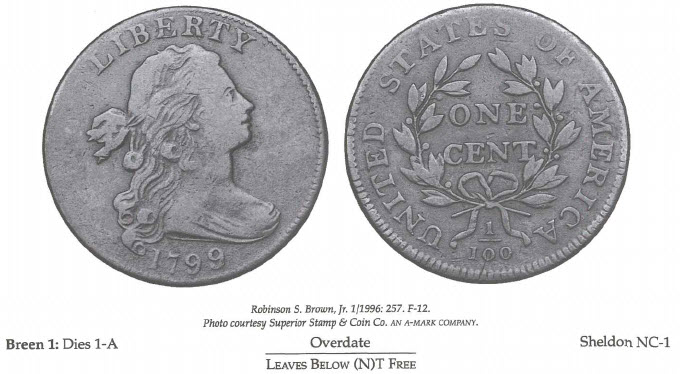
Obverse 1. 1799/8. Wide date with small 7 as on the last two obverses of 1798, but a different die than either of these. Bases of IB are close and base of E is below R. The tip of the curl points between B and E. The rim has a double dentil at 8:30 as on many later obverses.
Reverse A. Same as reverse BB of 1798 number 38 (Sheldon-173). Any of the following points will suffice to distinguish this from reverse B below: I) both pairs of leaves below (N)T are free of the wreath stem; 2) berry below c(e) has a short stem; 3) all leaves have stems; 4) double center dot, the second and smaller one above and to the right of the main dot; 5) bottom serif of c(e) comes to a flat point. Berries are larger than on reverse B, however, this may not be clear on worn examples.
Edge: Plain edge (PE). Die states: Perfect dies.
Equivalents: Sheldon NC-1. EAC 1. Encyclopedia 1733.
Rarity 7. Eight known.
Remarks: Discovered by Dr. Sheldon in the B. Max Mehl mail bid sale of the Frederic W. Geiss Collection, (February 18, 1947, Lot 48.) "a few months before the book [Early American Cents] was scheduled to go to press." First published in Early American Cents. This variety was struck before the later states of 1798 number 38 and does not have the crack at NITE. The alleged example in the 1969 ANA sale proved to be 1798 number 35 (Sheldon-174). (Paramount International Coin Corporation, 1969 ANA Convention Sale, Lot 2457 was described as: "1799 Filler, date not clear. Sheldon Reverse 'W' of 1798; alignment of tops of numerals distinguish this piece as the 1799 - therefore, indicating the rare type 1799, NC-1.")
Condition Census:
F-12 From an old New England collection • Frederic W. Geiss • B. Max Mehl #109, 2/1947: 48 as "D-137" $400 • Judge Thomas L. Gaskill, 9/1947 • Dr. William H. Sheldon, 4/19/1972 • R. E. Naftzger, Jr., 2/23/1992 • Eric Streiner, 3/20/1992 • Robinson S. Brown, Jr. • Superior Stamp & Coin Co. 1/1996: 257 $30,800 • Wes Rasmussen. Reverse illustrated in Early American Cents and in Penny Whimsy, being listed in both texts as VF-20. Obverse and re-verse illustrated in Noyes. The discovery coin for the variety. George H. Clapp offered Sheldon $2,000 ("twice the value of the Strawbeny Leaf variety") for this coin in 1947 and was refused.
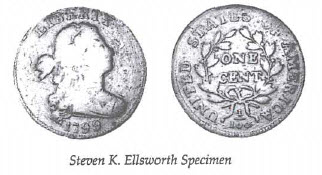
VG-7 Purchased as "5-188" on 5/2/1958 at the Metropolitan New York Numismatic Convention by C. Douglas Smith. Dorothy Paschal, 1972 • Robinson S. Brown, Jr. • Superior Galleries 9/1986: 264 $5,500 • Steven K. Ellsworth.
G-5 Sharpness of VG-7 but evenly granular. Purchased unattributed from Heritage Numismatic Auctions 3/1995: 6915 (large lot) $687.50 by Don Weathers • Thomas D. Reynolds, 3/1996 • Grant O. Reed • Superior Stamp & Coin 9/1998: 1197 $6,612.50.
G-5 Sharpness of F-15 but uniformly corroded. Seen at the 1999 Early American Coppers Convention.
G-5 Purchased unattributed on 4/21/1997 by Evan Kopald who porperly attributed the coin and sold it to Chris Victor-McCawley (CVM).
AG-3 Sharpness of G-S but heavily nicked and dented. Purchased unattributed on 2/15/1977 by Richard V. Punchard, 10/25/1991 • Daniel W. Holmes, Jr.
AG-3 Purchased unattributed at a Garland, Texas coin club show in 3/1992 by Gerry Charron.
FR-2 Sharpness of G-5 but heavily dented. Lawrence A. Nilson, 1/7/1972 • Robinson S. Brown, Jr. • Denis W. Loring, 5/1974 • Dr. Robert J. Shalowitz • John W. Adams • Kagin's Numismatic Auctions #305, 1/1975: 479 $1,900 • John W. Adams, 6/11/1976 • Philip Van Cleave • Kagin's Numismatic Auctions #340, 1/1986: 5205 $1,870 • an unidentified eastern collector.