Walter Breen's Encyclopedia of Early United States Cents
Walter Breen
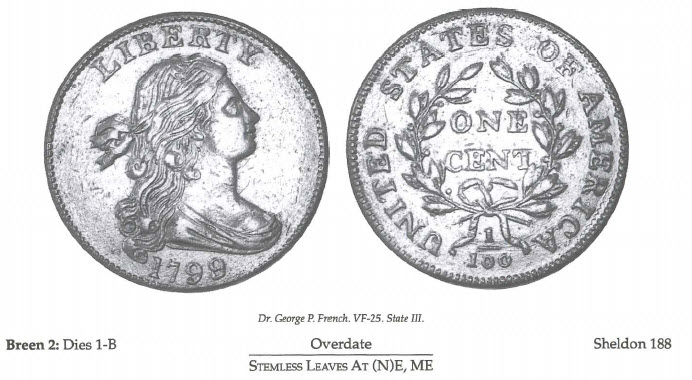
Obverse 1.
Reverse B. Same as reverse CC of 1798 number 39 (Sheldon-186). Any of the following points will suffice to distinguish this from reverse A above: 1) outer pair of leaves below (N)T overlap the wreath stern; 2) berry be-low C(E) has a long stem, nearly double the diameter of the berry; 3) pairs of leaves above (N)E and below ME are stemless; 4) single center dot: 5) bottom serif of C(E) comes to a sharp point. Small spine from inner edge of a leaf in the pair below M is close to the wreath stem, pointing to the nearest outer berry stem.
Edge: Plain edge (PE).
Die states: 1. Perfect dies without clash marks.
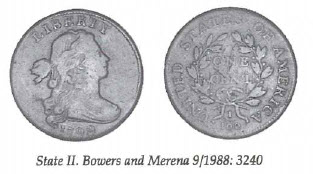
II. Double clash marks near ribbon and before throat. Reverse has clash marks below TES and right of (N)E.
III. At least five sets of clash marks in the same places, including dentils above ERICA.
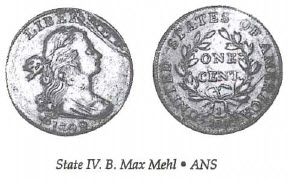
IV. Heavy triple break through RTY to rim. The die starts to fail at RT. Severe clash marks, from RICA, at TY and right, with the A visible between TY. Reverse cracked from the rim through final 0 in the denominator, right ribbon, three lowest outer leaves, and ME to rim. Only six reported: see Remarks.
Equivalents: Doughty 137. Proskey 1. McGirk 1A. Clapp 1. Sheldon 188. EAC 2. Encyclopedia 1733.
Low Rarity 4.
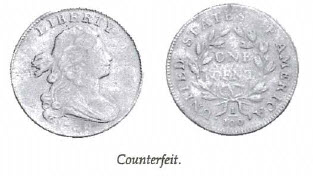
Warning: Extremely dangerous counterfeits exist. These were made prior to 1963 from the Dr. French VF-25 coin. These counterfeits weigh approximately 10% below standard and have slightly mushy detail. Otherwise they pass all the basic counterfeit detection methods, including specific gravity and the ring test! All seen have a prominent gouge from the reverse rim at 12:00, extending down to the crossbar of E in STATES. Electron microprobe analysis of the composition yields approximately 96% copper, 3% zinc, and 1 % other trace elements.(Lange, David, report to the editor, 11/12/1997. The interior of the counterfeit tested consists of 95.88% copper, 3.74% zinc, and 0.38% trace elements. The surface consists of 64.86% copper, 33.08% sulfur, 1.43% zinc, and 0.63% trace elements. Testing was performed by David Lange at Harvard University Department of Earth and Planetary Scieces.) The genuine French coin provides the primary illustration for this variety. One of the counterfeits is illustrated above this paragraph.
Remarks: The die breakage looks as though it was a consequence of axial misalignment while the obverse die was loose. This variety was struck before 1798 number 39. George W. Rice announced his broken die 1799 as anew discovery in "The Cents of 1799." (Numismatist, March 1900, pp. 71-72; Lapp & Silberman, pp. 378-79. Rice, Secretary of the ANA, is sometimes also remembered for his marvelous hoard of 756 Flying Eagle cents dated 1856.) Rice used his broken die coin as evidence against earlier claims (e.g. that of J. H. Gray in "The 1799 Copper Cent,") (Numismatist, August 1897, pp. 127-29. Reprinted by Lapp & Silberman, pp. 377-78, under the title "The Rarest Date of United States Cents.") that all 1799 cents shared a single reverse: the normal dates have the chip between (N)E and (N)T but no reverse crack, whereas the broken die 1799/8 has a reverse crack but no chip.
The six broken die examples:
Fine-12. Purchased in his store by B. Max Mehl, 4/ 1925 • George H. Clapp • ANS. Obverse and reverse illustrated in Clapp and in Penny Whimsy. Obverse illustrated in Early American Cents and in Noyes.