Walter Breen's Encyclopedia of Early United States Cents
Walter Breen
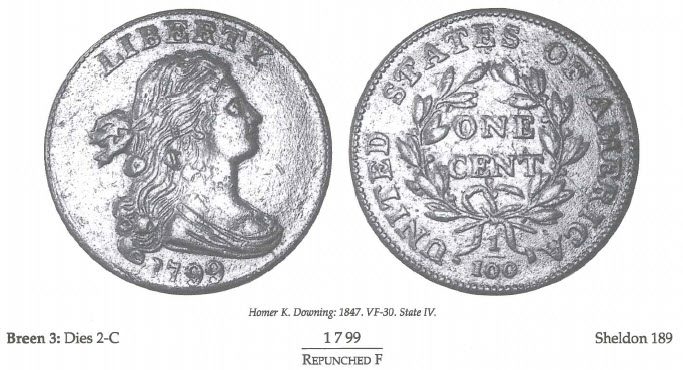
Obverse 2. Date is spaced 1 7 99 with the 179 evenly spaced and the loop of the second 9 much closer to the curve of first 9. E leans right, R is high, and ER are closer than other letters. If in doubt, check the die state photographs.
Reverse C. Type of 1799. E(D) and E(S) are normally formed with traces of recutting on their bases. (C)E has a heavy crossbar touching its upper serif. T(A) has a heavy right pendant. F is repunched which is plainest on its crossbar. The digit 1 in the denominator is formed C differently than on most other dies and has a broad, squared upper serif. This digit appears to be from a different punch than the numerator.
Edge: Plain edge (PE).
Die states: I. No die chip and no rim break. Date is weak with LIBERTY strong, the result of axial misalignment.
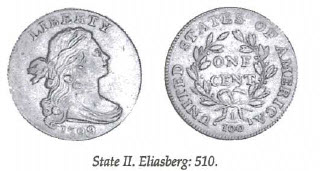
II. Minute die chip in the field between (N)E and (N)T (for generations called the "mintmark"), gradually growing stronger and larger, eventually triangular. Date is weak as in state I.
III. Narrow rim break above the space between F A which enlarges. This may not be discernible on specimens with weak dentils in this area.
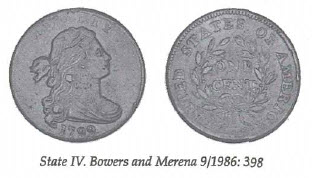
IV. Second narrow rim break above AM. Both breaks gradually enlarge although neither break may show on specimens with weak dentils in this area.
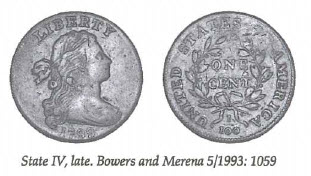
At least one specimen suggests light rim crumbling at CA; others are weaker in this area and do not show any traces of such crumbling. Usually with date weak and LIBERTY strong, as before. This is the least rare die state. Later with date stronger and LIBERTY weaker due to slight axial misalignment in the other direction from that of states I-III: this is rarer.
V. Short crack from rim to the end of drapery, beginning nearly vertical and bending to the left. This is caused by the axial misalignment at the end of state IV.
VI. Plain rust marks below chin. From the crack of state V a plain straight crack extends through the drapery and curls into the field past the third curl from bottom, faintly reaching the left rim as a bulge. Extremely rare with only one identified: Howard R. Newcomb, privately • Dr. William H. Sheldon, 1969 • Dorothy Paschal, 1977 • R. E. Naftzger, Jr. • Herman Halpern • Stack's 3/1988: 173 $5,500 • Henry Hettger • Bowers and Merena, Rare Coin Review #79-83, $11,795. lllustrated in Penny Whimsy. (Del Bland has notified the editor that he believes this is a scratch, not a die crack.)
Equivalents: Doughty 138. Proskey 2. McGirk 2A. Clapp 2. Sheldon-189. EAC 3. Encyclopedia 1734.
High Rarity 2. The number of survivors is in the range of 600 to 700, mostly much worn. Remarks: Usually in low grades, Poor to Very Good.
On some of these only the tops of the date show and identification depends on the die chip of state IT or the rim breaks of states III or IV. Examples are often found on dark planchets like those of 1800: Boulton blanks, discolored by salt and bilge water enroute from England.
Probably over 90% of this variety have strong LIBERTY and weak date, from axial misalignment; on these the fraction looks heavier than on most 1798s of the type. Fewer than 10% have a strong date and weak LIBERTY (the converse misalignment), including the state VI coin. For decades, a selling point for specimens of this variety was "bottoms of both 9's visible." Slightly over 1% show both LIBERTY and date strong. These are mostly in low grades and are fromstate IV although the rim breaks are not always discernible.