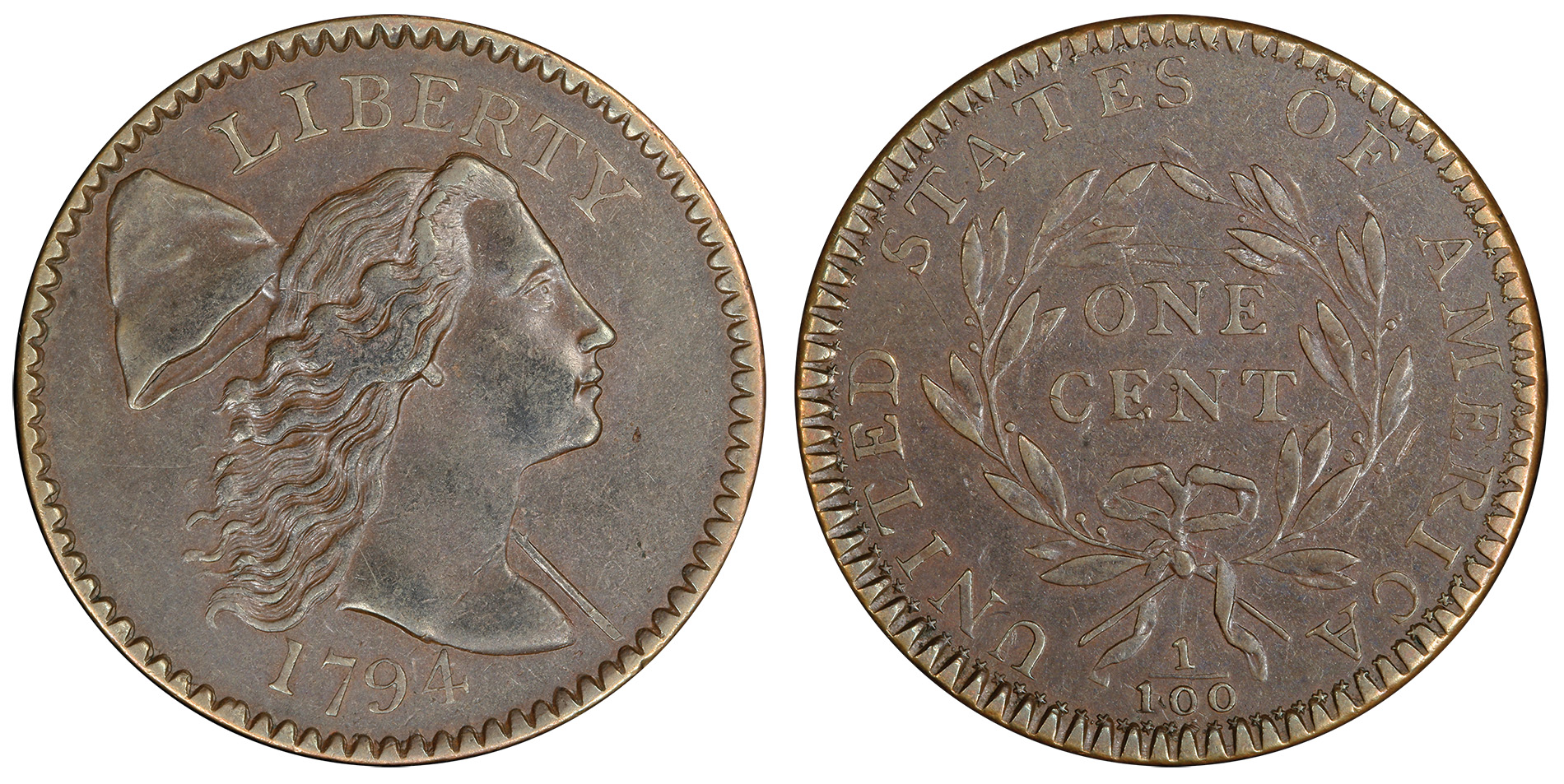
1794 Starred Reverse Flowing Hair Large Cent
The United States Treasury Department has set in motion a plan to discontinue production of the one cent coin next year. In continuous circulation since first being struck in 1793, the cent is one of the first denominations produced by the U.S. Mint. Having been struck in numerous sizes, styles, and compositions, these iterations have not only popularized coin collecting by way of numerous transitions but also through a wealth of varieties to boot.
Struck for circulation starting in 1793, the “large cent” measured from between 26 to 29 millimeters in diameter and was made of 100% copper. Perhaps the most famous and desired variety of the series is the 1794 Starred Reverse. Also known as Sheldon-48, the Starred Reverse features 94 roughly equidistant stars around the perimeter (7 of which are hidden by dentils). Why this 1794 Large Cent reverse was made with stars remains a mystery. However, it has been speculated that planchets originally struck for the 1792 quarter pattern reverse went unused and were later overstruck with the 1794 design. About 50 to 60 specimens have been identified since their discovery in 1877.

1857 Flying Eagle Cent with Liberty Double Eagle Die Clash, Snow-7
Due to the rising cost of production (sound familiar?), the size of the cent was reduced to 19 millimeters during 1857, and no longer made of 100% copper. This new “small cent” design, however, was immediately popular and gave numismatics a surge in popularity by creating nostalgia for the disappearing large cent. Three of the most curious 1857 Flying Eagle varieties feature clash marks with other denominations. One of them, recognized as Snow-7, has clashed through “AMERICA” the profile of Liberty from the Double Eagle. The other two multi-denomination clashed dies, cataloged as Snow-8 and Snow-9, show clash marks corresponding to the Liberty Seated Quarter and Liberty Seated Half, respectively. Easy to spot even in lower circulated grades, it is unknown to this day why these fascinating varieties came to exist.

1873 Closed 3 Indian Cent
The Flying Eagle design, while popular with the public and numismatists alike, was replaced only two years later in 1859 with the second of the small cent designs, the Indian motif. Struck until 1909, this series features varieties as dramatic and aesthetically curious as those of any U.S. series. One of them is the eye-catching 1873 Doubled Liberty. Known as Snow-1/1b, this “Closed 3” 1873 variety features prominent doubling of “LIBERTY” as well as the headdress feathers and Liberty’s portrait (with the eye and lips still prominent on worn examples). Only about 400 to 500 of this popular “Red Book” variety (one listed in A Guide Book of United States Coins) are known to exist, few of which were preserved in Mint State.

Close AM & Wide AM Lincoln Cents
The third and final small cent design is the one currently featuring Abraham Lincoln’s profile. First struck in 1909, the Lincoln Cent series includes two of the rarest and most desired varieties in all of numismatics, the 1958 and 1969-S Doubled Die Obverses. This series also includes collectible subsets of varieties known as the “Wide AM” and “Close AM” reverses. The reverse design for proof Lincoln cents, featuring the spaced apart or “wide” AM of “AMERICA,” along with a flared vertical bar in the G of the designer’s initials, were accidentally used for some 1988, 1988-D, 1998, 1999, and 2000 business-strike issues, with the rarest being 1999. The reverse design for 1993 Lincoln Cents, featuring the closely spaced or “close” AM of “AMERICA” and accompanied by a straight vertical bar in the G of the designer’s initials, was inadvertently used for some 1992 and 1992-D business strikes, as well as on some 1998 and 1999 proofs. The 1992 is the rarest known so far.



 Copper & Nickel
 Silver Coins
 Gold Coins
 Commemoratives
 Others
 Bullion
 World
World
 Coin Market
 Auctions
 Coin Collecting
 PCGS News