

We get a lot of comments here at PCGS from people who are confused by the differences between the words and meanings of “proof” and “prooflike.” The terms, despite their similarities in name and the fact that both frequently (though not always) refer to coins that are shiny or reflective, do not mean the same thing. In fact, it’s a misnomer that all proof coins are mirrorlike in finish (just consider the matte-finish United States proof coins of the early 20th century). Just as well, proof coins are usually struck in a different fashion than prooflike coins.
What are the official PCGS definitions of proof coins versus prooflike coins? Here is a breakdown of these two terms and their definitions:
- Proof – A coin usually struck from a specially prepared coin die on a specially prepared planchet. Proofs are usually given more than one blow from the dies and are usually struck with presses operating at slower speeds and higher striking pressure. Because of this extra care, proofs usually exhibit much sharper detail than regular, or business, strikes. PCGS recognizes proofs (PR) as those struck in 1817 and later. Those coins struck prior to 1817 are recognized as specimen strikes (SP).
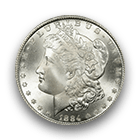
- Prooflike – Term to designate a coin that has mirror-like surfaces, the term especially applicable to Morgan Dollars. Those Morgan Dollars that meet PCGS prooflike standards are designated PL. Additionally, according to PCGS standards, a coin’s surface is prooflike when there is a clear reflection in the fields on both sides as viewed from two to four inches away. A cloudy effect or striations may impede the reflectivity.


 Copper & Nickel
 Silver Coins
 Gold Coins
 Commemoratives
 Others
 Bullion
 World
World
 Coin Market
 Auctions
 Coin Collecting
 PCGS News