Silver Dollars & Trade Dollars of the United States - A Complete Encyclopedia
Q. David Bowers
J-1468 (A-W 1491). Dollar Design as preceding. Copper, reeded edge.
J-1469 Dollar. Design as preceding Copper, plain edge.
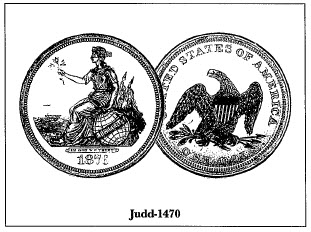
J-1470 (A-W 1494). Dollar. Obverse as preceding. Reverse: The No Motto type used to coin regular-issue silver dollars 1840-1865. Silver, reeded edge.
J-1471 (A-W 1495). Dollar, Design as preceding. Copper, reeded edge.
J-1320 (A-W 1338). Trade dollar. Obverse: A seated figure of Liberty facing left with 13 stars around, but without the date below. Similar tothe adopted type, but the base is shaped differently. Reverse is similar to the adopted type, but the eagle is larger, and the leaves and berries on the olive branch are differently arranged. Evidence found in recent years suggests that these pieces were made in 1876 rather than 1873 as Adams-Woodin and Judd suggested. See R.W. Julian's chapter on dollar history for more details. Silver, reeded edge.
J-1321 (A-W 1339). Trade dollar. Design as preceding. Copper, reeded edge.
J-1472 (A-W 1496). Commercial dollar. Obverse as preceding. Reverse with the denomination COMMERCIAL DOLLAR, the weight, 420 GRS, and the quality of the alloy, 900 FINE, are expressed within a laurel wreath. The motto GOD OUR TRUST is on a scroll at the base of the wreath, and the legend UNITED STATES OF AMERICA is at the border above. Silver, reeded edge.
J-1473 (A-W 1497). Commercial dollar. Design as preceding. Copper, reeded edge.
J-1474 (A-W 1492). Trade dollar. Obverse as preceding. Reverse: the type used to coin regular-issue trade dollars from 1875 through 1883, without the berry on the olive spring beneath the eagle's left talon. Silver, reeded edge.
J-1475 (A-W 1493). Trade dollar. Design as preceding. Copper, reeded edge.
J-1476 (A-W 1480). Trade dollar. Obverse and reverse: The regular-issue 1876 trade dollar dies. Copper, reeded edge. The existence of aluminum strikings from these dies has not been confirmed.
1877 Patterns
J-1542 (A-W 1503). Obverse features a bust of Liberty facing left with the motto IN GOD WE TRUST above and the date 1877 below. Miss Liberty is wearing a coronet inscribed LIBERTY in raised letters, and her hair is tied in the back with a ribbon. There are 13 stars at the border, seven right and six left. Reverse: The denomination 1 DOLLAR centered in a wreath of corn, wheat, and cotton with the legend UNITED STATES OF AMERICA above, and the motto E PLURIBUS UNUM below. Copper, reeded edge.
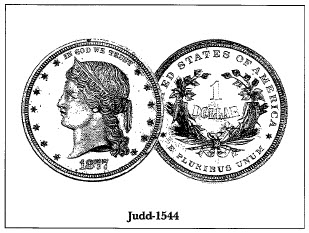
J-1543 (A-W 1504). Obverse has a bust of Liberty facing left with the motto IN GOD WE TRUST above and the date 1877 below. Miss Liberty is wearing a coronet inscribed LIBERTY in raised letters, and her hair trails along the back of her neck. There are 13 stars at the border, seven left and six right.
The coronet is beaded along the top margin. Reverse as preceding. Copper, reeded edge.
J-1544 (A-W 1505). Obverse similar to the preceding, but without ornamentation along the top border of Miss Liberty's coronet. Reverse as preceding. Copper, reeded edge.
1878 Patterns
Background: In May 1877, Dr. Wheeler W. Hubbell of Pennsylvania formulated alloys of gold, silver, and copper termed "goloid alloy" and "goloid metric alloy" The ratios of silver to gold in these compositions were 24 to 1 and 16.1 to 1 respectively. It was intended by Hubbell that his alloys should be used in coinage. His supporters in Congress thought that the compositions would be useful in eliminating the old rivalry between silver and gold, as under this proposal a dollar struck in goloid metal would contain approximately 50¢ in silver and 50¢ in gold. Later in 1877, a bill was introduced in Congress calling for the creation of a goloid dollar weighing 258 grains. On December 29, 1877, Alexander H. Stephens, chairman of the Coinage Committee in the House of Representatives, requested Mint Director Henry R. Linderman to supply some pattern pieces struck in goloid metal for the use of the committee. These goloid patterns are dated 1878.
The goloid and goloid metric alloys were not feasible for use, for in the absence of having a skilled operator of laboratory equipment on hand, a bank or other commercial entity could not tell if a coin was a counterfeit made of silver, or an authentic piece containing silver and gold. The coins were silver-colored.
The passage of the Bland-Allison Act of February 28, 1878 authorized the resumption of the standard silver dollar coinage in the United States. Both George Morgan and William Barber hurriedly pre-pared designs for the new coin, and patterns were produced illustrating their proposals. Certain of these motifs had been used earlier by Morgan on 1877 pattern half dollars.
J-1550 and 1550a (A-W 1559). Standard dollar. Morgan design. Obverse features a head of Liberty facing left with the motto E PLURIBUS UNUM above, and the date 1878 below. There are 13 stars at the border arranged seven left and six right. The motif is very similar to the obverse adopted for use of 1878 regular-issue Morgan dollars. Reverse: An eagle with upraised wings holding a sprig of three leaves in its right talon and three arrows in its left. The eagle is centered in a laurel wreath, and the motto "In, God we trust" is expressed over the eagle's head in Gothic letters. the legend UNITED STATES OF AMERICA is at the border above, and the denomination ONE DOLLAR is below. Silver, reeded edge. Three distinctly different die varieties are known.
J-1551 (A-W 1560). Standard dollar. Design as preceding. Copper, reeded edge. Three distinctly different die varieties are known.
J-1552 (A-W 1561). Standard dollar. Obverse similar to preceding, but reportedly with smaller obverse denticles and 'other minor differences.' Reverse similar to the regular-issue type with nine leaves on the olive sprig, but with five berries on the sprig instead of just one. Silver, reeded edge.
J-1553. Standard dollar, Design as preceding. Copper,reeded edge.