Silver Dollars & Trade Dollars of the United States - A Complete Encyclopedia
Q. David Bowers
1836-1839 Patterns
Background: Patterns of this series, known as Gobrecht dollars, are discussed in detail in a separate chapter. Issues of 1836 depict Liberty Seated, without stars, and the date below. The reverse of the original issue has 26 stars, as do some restrikes. "Fancy pieces" were made later without reverse stars. Edges can be plain or reeded. 1838 and 1839 dollars have stars on the obverse, have reverses with or without stars, and have plain or reeded edges. Most varieties are restrikes pr fantasy pieces. However, certain issues of 1836 and 1839 were made for circulation, to the extent of 1,600 and 300 pieces respectively.
1851 Patterns
J-132 (A-W 144). Copper impression of the 1851 "restrike" dollar dies. A "fancy piece" made from another "fancy piece," so to speak, as no originals were struck from these dies. About five are known, one of which is silvered. Produced at the Philadelphia Mint in 1858 or later.
J-133. As preceding, but struck in nickel. Possibly unique. Another fancy piece made for sate to collectors. Produced at the Philadelphia Mint in 1858 or later.
1852 Pattern
J-134 (A-W 169). Copper impression from the dies used to coin 1852 restrike dollars. It is believed that just two or three are known today. Produced at the Philadelphia Mint in 1858 or later.
1853 Pattern
J-154. Impression in copper of the dies used to make 1853 "restrike" Proof dollars (actually, no original Proof dollars are generally believed to have been made, so 1853 impressions in silver are probably novodels). Produced circa 1862-1863.
1863 Patterns
J-345 (A-W 367). Obverse from Proof Liberty Seated silver dollar die dated 1863. Reverse with IN GOD WE TRUST as used 1866 and later. Struck in silver. Minted in the late 1860s. Sold in sets with similar pieces dated 1864 and 1865.
J-346 (A-W 368). As preceding, but struck in copper. Produced at the Mint in the late 1860s.
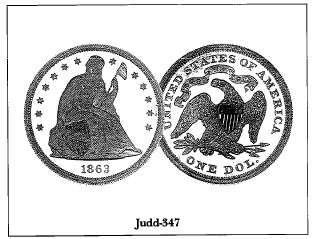
J-347 (A-W 369). As preceding but struck in aluminum. Struck in the late 1860s.
In the late 1860s, it was decided to create "fancy pieces" for collectors by resurrecting earlier-dated dies and combining them in mulings never originally produced. For the years 1863, 1864, and 1865 impressions were struck in copper, silver, and aluminum, with reeded edge. The production quantities were quite low.
J-348 (A-W 370). Impression in copper from regular-issue dies.
1864 Patterns
J-396 (A-W 433). Silver. Reeded edge. Made at alater date, this issue employs the obverse of the 1864Proof dollar with the reverse of a dollar die inscribed IN GOD WE TRUST, as used 1866 and later.Produced at the Mint in the late 1860s. Sold in setstogether with those dates 1863 and 1865. These were fancy pieces made in various metals for collectors and had no pattern purposes.
J-397 (A-W 434). As preceding, but struck in copper.
J-398 (A-W 435). As preceding, but struck in aluminum.
J-399. As preceding, but struck in nickel. One from Lenox R. Lohr Collection; later, Dr. William Michal Collection.
1865 Patterns
J-434 (A-W 490). Silver. Reeded edge. Obverse from a regular Liberty Seated dollar die dated 1865. Reverse from a dollar die inscribed IN GOD WE TRUST, as used 1866 and later. Produced at the Mint in the late 1860s. Sold in sets together with those date 1863 and 1864. These were fancy pieces made in various metals for collectors and had no pattern purposes.
J-435 (A-W 491). As preceding, but in copper.
J-436 (A-W 492). As preceding, but in aluminum.
J-437 (A-W 493). Regular 1865 Liberty Seated dollar dies, obverse from a Proof die, reverse without motto, struck in copper. Reeded edge.
1866 Patterns
J-540 (A-W 535). So-called transitional piece employing an 1866 Liberty Seated obverse die with a reverse die of the pre-1866 era without motto. Two are known. See separate listing under Liberty Seated dollars. Not a pattern, as such an issue was not contemplated at the time. In fact, the motto was being discontinued. Probably made as a fancy piece for numismatic sale.
J-541 (A-W 534). Regular die trial piece with the 1866 Liberty Seated obverse. Reverse with motto. Copper impression of the regular Proof dies, reeded edge.
1867 Patterns
J-592 (A-W 610). Regular Proof dies struck in copper. In the absence of Mint documentation that it was standard practice to use copper planchets to test Proof dies before making silver impressions, one can surmise that this and related pieces were made as fancy coins for privileged Mint officials. The production of copper (later, aluminum as well) impressions continued intermittently for a number of years. Such pieces were usually produced clandestinely and in small numbers.
J-593 (A-W 609). Regular Proof dies struck in brass; Five pieces are believed to have been made. Another fancy piece; certainly no brass alloy was being contemplated for regular silver dollar coinage, and brass, being a very hard metal, could, not have been used to test the dies.
1868 Pattern
J-652 (A-W 660). A number of trial strikings were made of Proof dies in aluminum, again an issue made for collectors. No serious contemplation was given to striking one-dollar pieces in aluminum at the time. However, insiders at the Mint considered it a profitable enterprise to coin 1868 Proof sets from the cent through the $20 piece in aluminummetal for numismatic sale.