Silver Dollars & Trade Dollars of the United States - A Complete Encyclopedia
Q. David Bowers
1873 Patterns
Background: While two different varieties of 1873-dated pattern silver dollars were made, in the trade dollar denomination several dozen different varieties were created. Some of these were legitimate patterns in the course of creating an acceptable final trade dollar design, but others-particularly strikings in metals other than silver and those using the regular Liberty Seated dollar die reverse were simply delicacies made to enrich Mint personnel.
J-1274. Regular Liberty Seated silver dollar
Proof dies struck in copper. Reeded edge.
J-1275. Design as preceding. Aluminum, reeded edge.
J-1276 (A-W 1298). Trade dollar. Obverse with head of Miss Liberty wearing a coronet inscribed LIBERTY, her hair tied behind in a knot and encircled by a band of pearls. The reverse is the tradedollar dieearlier used to coin J-1220. Silver, reeded edge.
J-1277 (A-W 1297). Trade dollar. Design as preceding. Silver, plain edge.
J-1278 (A-W 1299). Trade dollar; Design as preceding. Copper, reeded edge.
J-1279 (A-W 1300). Trade dollar. Design as preceding. Aluminum.reeded edge.
J-1280 (A-W1301). Trade dollar. Design as preceding. White metal, plain edge.
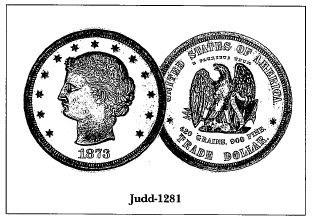
J-1281 (A-W 1303). Trade dollar. Obverse with Bailly's stern portrait of Miss Liberty crowned with leaves, her hair tightly braided and coiled behind. The reverse is the trade dollar die with. perched eagle similar to that used on J-1223, but with the inscription E PLURIBUS UNUM in the field above, not on a ribbon. Silver, reeded edge.
J-1282 (A-W 1302). Trade dollar. Design as preceding. Silver, plain edge.
J-1283 (A-W 1304). Trade dollar. Design as preceding. Copper, reeded edge.
J-1284 (A-W 1305). Trade dollar. Design as preceding. Aluminum, reeded edge.
J-1285 (A-W 1306). Trade dollar. Obverse with Bailly portrait as preceding. Reverse with Barber's perched eagle, E PLURIBUS UNUM on ribbon, as used on J-1223 of 1872. Copper, reeded edge.
J-1286. Trade dollar. Design as preceding. Aluminum, reeded edge.
J-1287 (A-W 1329). Trade dollar. Obverse with portrait of Miss Liberty facing right, appearing to face backward, as it is contravention to the normal motif of the time used on gold coins. The word LIBERTY is on her coronet. The reverse is the trade dollar die and is used on J-1220 of 1872. White metal, plain edge.
J-1288 (A-W 1340). Trade dollar. Obverse:
James B. Longacre's portrait of Miss Liberty similar to that used on the $20 piece of 1849, in this instance surrounded by stars and with the date 1873 below. Reverse shows a small eagle perched on a shield, with wings raised. E PLURIBUS UNUM appears in the field above the eagle, and below on a curved ribbon is IN GOD WE TRUST, below which is found in two lines 420 GRAINS, / 900 FINE. At the border above is UNITED STATES OF AMERICA, while TRADE DOLLAR is at the bottom border. Copper, reeded edge.
J-1289 (A-W 1341). Trade dollar. Obverse with "double eagle head" as preceding. Reverse with perched eagle, with William Barber's perched eagle, with E PLURIBUS UNUM in field above (not on a ribbon), as used on J-1281. Copper, reeded edge.
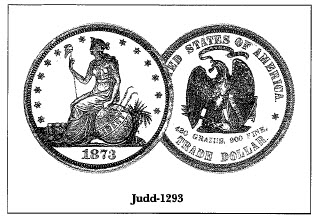
J-1290. Trade dollar. Obverse with Liberty Seated, her right hand holding a pole on which is a liberty cap, and her left hand resting on a globe inscribed LIBERTY. Behind the globe are two plow handles and a small sheaf of wheat. In front of Miss Liberty are two cotton bales. The sea is in the distance. Reverse with William Barber's perched eagle, above which is E PLURIBUS UNUM (not on a ribbon), as used on J-1289 and certain other issues. Silver, reeded edge.
J-1291. Trade dollar. Design as preceding. Silver, plain edge.
J-1292 (A-W 1322). Trade dollar. Design as preceding. White metal, plain edge.
J-1293 (A-W 1318). Trade dollar. Obverse as J-1290. Reverse with William Barber's perched eagle, and with E PLURIBUS UNUM on a scroll as used for J-1223 of 1872 and J-1285 of 1873. Silver, reeded edge.
J-1294 (A-W 1317). Trade dollar. Design as preceding. Silver, plain edge.
J-1295 (A-W 1320). Trade dollar. Design as preceding. Copper, reeded edge.
J-1296 (A-W 1319). Trade dollar. Design as preceding. Copper, plain edge.
J-1297. Trade dollar. Design as preceding. Aluminum, reeded edge.
J-1298 (A-W 1321). Trade dollar. Design as preceding. White metal, plain edge.
J-1299 (A-W 1335). Trade dollar. Obverse is a variation of the preceding, but with longer plow handles, and larger glove and wheat sheaf, but with the cotton bale smaller. The reverse is William Barber's perched eagle as used on J-1290, with E PLURIBUS UNUM in the field (not on a ribbon). White metal, plain edge.
J-1300 (A-W 1330). Trade dollar. Obverse as used on J-1299. Reverse with William Barber's perched eagle, but with E PLURIBUS UNUM on a ribbon, as used on other issues including]-1285. Silver, reeded edge.
J-1301 (A-W 1331). Trade dollar. Design as preceding. Copper, reeded edge.
J-1302 (A-W 1332). Trade dollar. Design as preceding. Copper, plain edge.
J-1303 (A-W 1333). Trade dollar. Design as preceding. Aluminum, reeded edge.
J-1304 (A-W 1336). Trade dollar. Obverse as preceding. Reverse with small perched eagle holding three arrows in its dexter claws and an olive branch in its, sinister claws. Above on a ribbon is, E PLURIBUS UNUM while below appears 420 GRAINS /900 FINE/ and on a scroll E PLURIBUS UNUM. UNITED STATES OF AMERICA is at the top border, and TRADE DOLLAR at the bottom. White metal, plain edge.
J-1304a. Trade dollar. Obverse as preceding.
Reverse is the trade dollar die used on J-1276. Silver, reeded edge.
J-1305. Trade dollar. Design as preceding. Copper, reeded edge. Four said to be struck.
J-1306 (A-W 1334). Trade dollar. Design as preceding. White metal, plain edge.