The History of United States Coinage As Illustrated by the Garrett Collection
Q.David Bowers
Nathaniel March was born in Portsmouth on June 14, 1807. He became a junior partner in the firm of Childs & March, the successor to Childs & Sparhawk. Childs left the firm soon thereafter, and business was subsequently conducted as Nathaniel March & Co. until about 1839. After that time the business was conducted simply in his personal name, Nathaniel March. He died on July 19, 1846, after which the trade was continued by Samuel A. Badger.
William Simes was born in Portsmouth on April 9, 1806. He entered business in 1828. At different times Thomas E. Call and Henry F. Gerrish were partners. His business was sold in 1860 to Moulton & Blaisdell, who continued the trade for many decades thereafter. In 1861 and 1862 William Simes was elected mayor of Portsmouth. A third nomination was subsequently declined. The token issued by March and Simes is believed to have been struck by H. M. & E. I. Richards of Attleboro, Massachusetts.
The legend PHALONS NEW & SPLENDID STYLE OF HAIRCUTTING is found on Low 127, a token issued in 1837 by Edward Phalon who at that time was located at No. 35, Bowery, New York City. He began business as a hairdresser several years earlier. In 1834 he was located at Hi 1 Chatham Street, one of at least 11 addresses, including that given on the token, listed for him from 1834 to 1860. In 1842 he was situated at 214 Broadway, opposite St. Paul's, where he sold the" Amazon toupee" and' 'wigs and scalps," for which the American Institute awarded him a silver medal in 1841 and a premium in 1842. The American Institute itself is commemorated on several other tokens of the series, Low 75 issued by Robinson's, Jones & Co., in 1833, being an example. The American Institute conferred many awards and citations on different merchants and products, many of whom used the institute's seal in their advertising, a forerunner of the numerous exposition and fair awards which were to become popular during the last part of the 19th century.
In 1848 Phalen was located at 61 Broadway and advertised his "Chemical Hair Invigorator." Lyman H. Low relates that:
The height of his popularity was reached when, after several other removals, he occupied a gorgeous shop in the St. Nicholas Hotel, where the prices charged for service and for the various cosmetics which he offered for sale were in accordance with the brilliancy of the numerous mirrors, the gilded frames, the marble basins, and their silver-plated fixtures, which adorned the place. Here he remained until the hotel was closed.
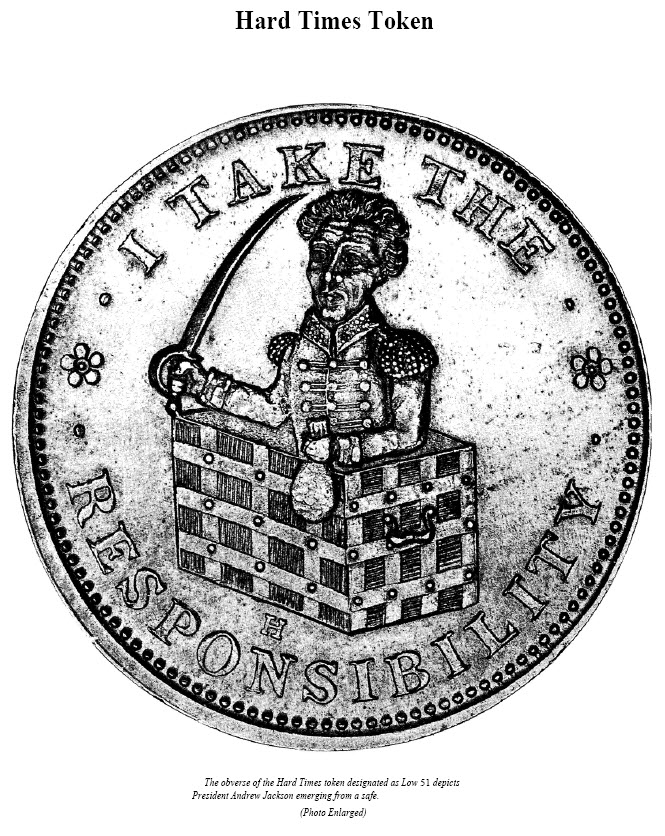
Low had a personal interview with him in 1886, but by this time Edward Phalon could not recall specific information concerning the issuance of the 1837 tokens distributed nearly a half century earlier.
The Roxbury Coaches furnished the subject for an 1837 token designated as Low 129. The coaches were large omnibuses with a capacity of 16 to 20 people. Drawn by four horses, they made the route through what later became Washington Street, Boston, to the top of the hill in Roxbury, where a stop was made at the Norfolk House. Low relates that the coaches were handsomely painted in yellow and bore scenic designs as well as such names as Regulator, Conqueror, and Aurora, the latter with the scene of a goddess in a cloud-borne chariot painted on its yellow sides. By 1856 horse drawn street cars had made the Roxbury Coaches obsolete.
Low 133 bears on the obverse the face of a clock and the inscription TIME IS MONEY. The reverse notes that it was issued by Smith's Clock Establishment located at No. 71/2 Bowery, New York, in 1837. Andrew B. Smith's third-floor shop offered a wide variety of clocks for sale, mostly of the shelf type. In November 1838 the firm name was changed to A. B. Smith & Co. In 1841 it was conducted as Smith & Brothers. By that year a branch was established at No. 5 North Fifth Street in Philadelphia. Several different varieties of the Smith token are known today, indicating that original production must have been quite extensive.