The History of United States Coinage As Illustrated by the Garrett Collection
Q.David Bowers
One of the most widely circulated tokens of the era depicts Jackson emerging from a chest of money .holding a purse in one hand and a sword in the other. This was a reference to the fear, subsequently reported in the Albany Argus on October 1, 1842, that the liberties of the Union were threatened "by Union of the purse and sword in the same hands," a reference in this instance to the following administration of Martin Van Buren. Presidential power over the nation's money and military has been the subject for concern at intermittent intervals since that time. In 1832 Jackson campaigned against Henry Clay. The president's stand against the Bank of the United States struck a popular chord and resulted in an overwhelming victory for him. In order to lessen the effectiveness of the Bank of the United States, which was chartered to continue until 1836, Jackson removed federal deposits from it and placed them in state banks. This and his July 1836 specie circular were among the causes of the nationwide financial panic of 1837 and the consequent depression.
In May 1835 Martin Van Buren, Jackson's vice president, was nominated for the presidency. His platform included opposition to rechartering the Bank of the United States. During his administration the main problem concerned the nation's depressed economy. Van Buren urged that an independent Treasury be established apart from the United States government and that the Treasury surplus was not to be distributed to the states. His stand on this and other issues alienated many conservative Democrats and at the same time caused him to be denounced by the Whigs. Seeking re-election, he was defeated overwhelmingly by William Henry Harrison in the 1840 election campaign.
In his inaugural address Van Buren declared, "I follow in the steps of my illustrious predecessor," a reference to Jackson. Caricaturists of the era represented the newly-elected president carefully stepping in the footprints of a jackass, a sentiment which extended itself to certain tokens of the time.
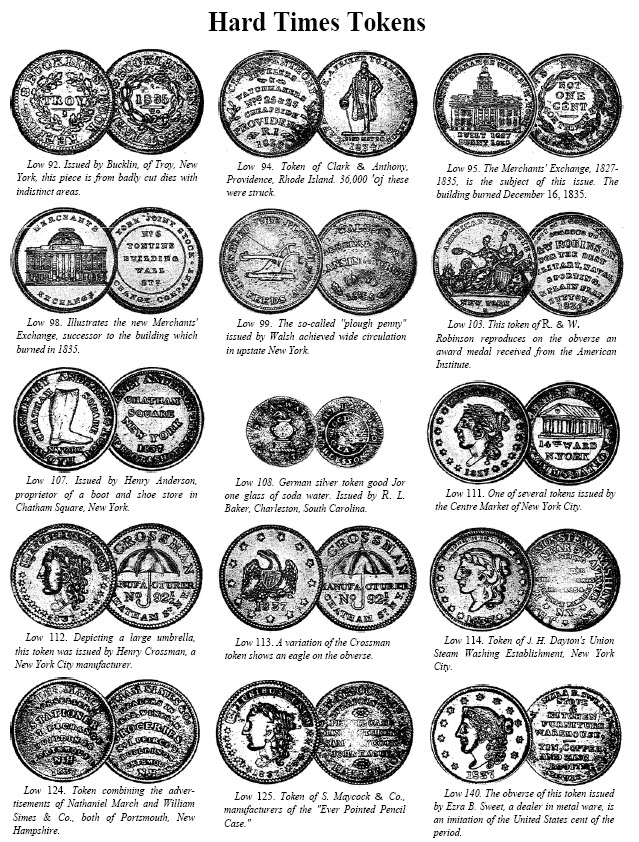
The Panic of 1837 resulted in many business failures and a hoarding of coins in circulation. This period was generally referred to as the era of "Hard Times," the title of which was later adopted to include tokens of the wider 1833-1844 period.
To fill the need for small change in circulation, a wide variety of copper tokens appeared in 1837. One issue bore the legend SUBSTITUTE FOR SHINPLASTERS, a reference to the flood of often-worthless paper money issues distributed by banks, merchants, and others, which were called "shin-plasters" and which had backing no stronger than the financial credit of the issuer, which was sometimes nil.
Important among the issuers of Hard Times tokens was the firm of J. M. L. & W. H. Scovill, of Waterbury, Connecticut. This firm and its successors have a rich numismatic history. In 1862 Scovill produced encased postage stamps. Later the firm supplied planchets to the United States Mint for the production of nickel alloy coins.
Scovill's beginnings can be traced to 1802 when. Abel Porter & Co. produced buttons. The company was composed of Silas Grilley (who earlier had made pewter buttons in Waterbury), Abel Porter, Levi Porter, and Daniel Clark. Brass was formed into ingots: on the premises, transported to nearby Bradleyville, where it was rolled into strips, and then returned to Waterbury for cutting and stamping. In 1806 Levi Porter withdrew from the firm in order to enter the dock business with Eli Terry, a pioneer Connecticut manufacturer. David Hayden, a manufacturer of brass buttons in Attleboro, Massachusetts, came to Waterbury and became a partner. A water-powered mill was constructed on the site later occupied by Scovill. In 1809 Grilley left the business, and in 1811 the firm was dissolved. A new company was founded by Frederick Leavenworth, David Hayden, and James M. L. Scovill under the name of Leavenworth, Hayden & Scovill. The former business of Porter was acquired. In 1827 Hayden and Leavenworth left the firm, and W. H. Scovill, J. M. L.' s younger brother, acquired a half in-terest in the business. The title was changed to J. M. L. & W. H. Scovill.