The History of United States Coinage As Illustrated by the Garrett Collection
Q.David Bowers
John Work Garrett and Robert Garrett
Following her husband's death, Mrs. T. Harrison Garrett took her three sons, John Work, Horatio, and Robert, abroad for a grand tour. From 1889 to 1891 they traveled throughout Europe and the Near East. Robert Garrett later wrote:
We boys learned some things by observation and others through the earnest efforts of our tutor. We visited Egypt one winter and also Palestine and Syria. One of the greatest experiences was a three-week journey on horseback between Damascus and Jerusalem. I still have vivid memories of the region of the conversion of St. Paul, with snow-capped Mt. Hermon toward the west; of the waters of Merom where we first crossed the Jordan; of camping on the shore of the Sea of Galilee at the site of Capernaum; and of visiting Nazareth and many other places of importance.
Upon their return to the United States John Work Garrett and Horatio Garrett entered Princeton. To be near them, their mother bought a house close to the college where she lived until her sons graduated. In 1895 John and Horatio completed their studies at Princeton. In the same year Horatio married Charlotte Doremus Pierson. An impressive mansion, named Evergreen, Jr., was built near the family home, Evergreen House, on Charles Street. Horatio Garrett contracted a rare bone disease and died a short time afterward. Years later Evergreen, Jr. became the faculty house of Loyola College.
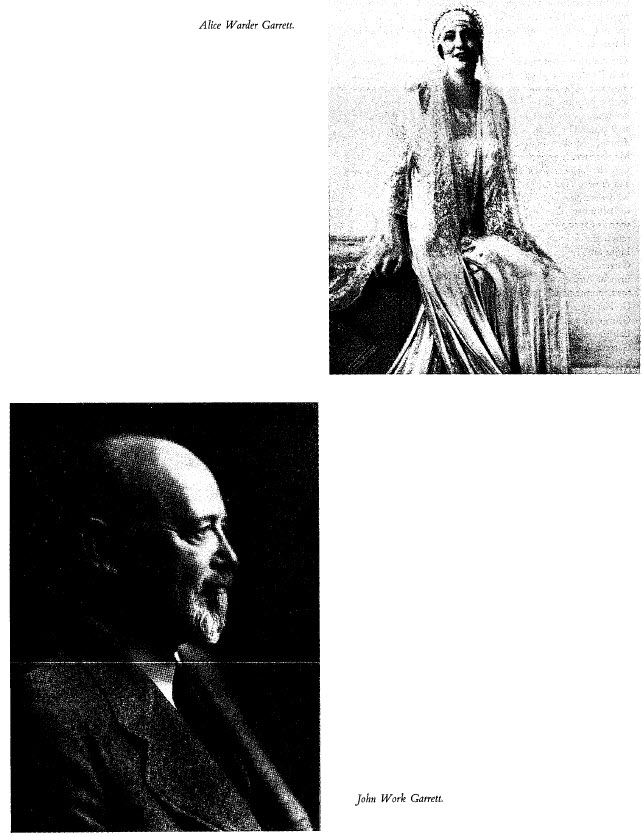
Following graduation, John Work Garrett went to the Yellowstone Valley with the Princeton Geological Expedition. A scare arose when no word was heard from the party for two weeks after an Indian uprising in the area. Rumors spread that members of the expedition had been killed. Fortunately, all were safe. Following this introduction to the West, John spent much of his time in the western areas, particularly Arizona and New Mexico. At one time he became a partner in an insurance agency in Phoenix. In 1896 John Work Garrett became a partner in Robert Garrett & Sons. Although he maintained his partnership until 1934, he was not active in the business, preferring instead to spend his time in the diplomatic service, which he first entered in 1901. First he served in The Hague, followed by positions in Berlin and Rome. In 1908 he married Alice Warder.
His first ministerial post was in Venezuela from 1910 to 1911. Following that he served three years as minister in Argentina. Following the onset of World War I he was appointed as a special agent of the Department of State to assist Myron T. Herrick, the United States ambassador to France. In 1917 he was named minister to the Netherlands and Luxembourg. In the summer of 1918 he became chairman of a special diplomatic mission to Berne, Switzerland, where the treaty with Germany regarding prisoners of war was signed on November 11, 1918. After the conflict he returned to Baltimore. He served as secretary general of the Conference on the Limitation of Armament in Washington during the 1921-1922 years. President Herbert Hoover appointed John Work Garrett as American ambassador to Rome in 1929, the position which he retained until 1933. During the period he had the opportunity to observe the dictatorship of Mussolini. Upon his departure he was given the Grand Cross of St. Maurice and St. Lazarus, the highest order conferred on anyone except royalty by the king of Italy.